

Brazil’s nude beaches are being defended beach by beach
At Praia do Pinho and Galheta, two naturist groups are fighting different battles against the same pressure

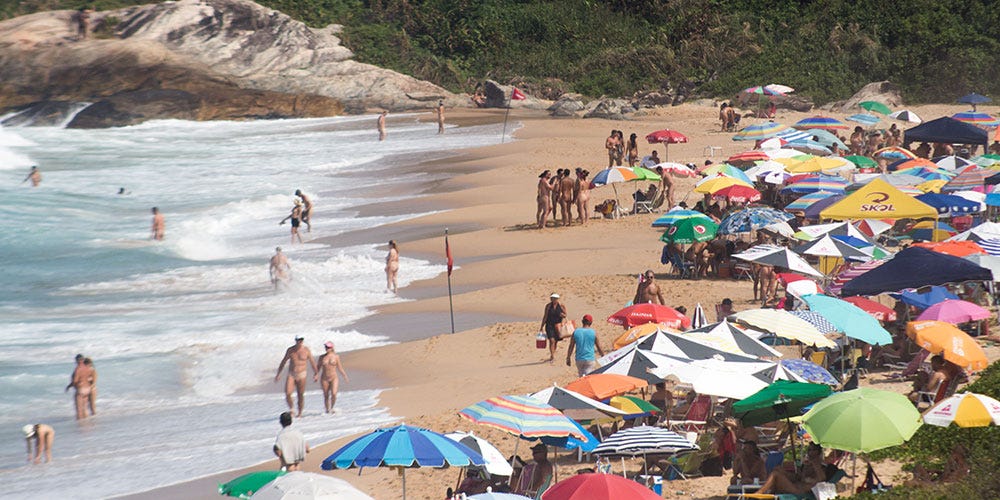
For years, naturists at Praia do Pinho asked the city of Balneário Camboriú for help. The trails leading to Brazil’s first officially recognized naturist beach had become a problem—sexual activity, harassment, behavior that had nothing to do with naturism. The requests went unanswered. There wasn’t enough personnel, they were told. Then, in December 2025, the city banned naturism entirely. Enforcement appeared almost overnight. Paula Duarte Silveira, president of the Federação Brasileira de Naturismo (FBrN), noticed. “Before, there was no effective policing to curb sexual acts on the trails,” she said. “Now there is a strong police presence both on the trails and on the stretch of sand. It’s surprising how quickly enforcement resources increased after the law banning naturism was approved.”
That sequence—neglect, chaos, criminalization—is the story of naturism in Brazil right now. And it is playing out, simultaneously and in opposite directions, on two beaches in the state of Santa Catarina.
Brazil is a country that has never been shy about the body. Carnival puts that on display for the world every year—the costumed and commercially broadcast body, celebrated as national identity. What Brazil has always been less comfortable with is the body that just exists. No performance, no product, no point. That body—the naturist body, the one standing on a beach meaning absolutely nothing by it—keeps running into trouble.
In Santa Catarina, that trouble has a shape and an address. Balneário Camboriú sits about 90 minutes north of Florianópolis along the coast. The two cities share a state and a shoreline. They do not share a policy. While Balneário Camboriú was banning naturism at Pinho in December, Florianópolis was moving, however slowly, toward re-legalizing it at Praia da Galheta. Same coastline. Opposite directions.
At Pinho, FBrN moved fast. Days after police detained a nude man at a campground adjacent to the beach following the ban, the federation filed a collective habeas corpus arguing that nonsexual nudity at a historically naturist beach does not constitute an obscene act under Brazil’s Penal Code. A court agreed. A second ruling in January expanded those protections, issuing a collective safe-conduct order that blocked arrests on the sand and in the sea while the broader case proceeded.
Those rulings did not overturn the city’s ban. The ban still stands. What the courts did was draw a line between municipal regulation and criminal law—a city can restrict land use, but it cannot automatically treat a nude naturist as a criminal. That distinction matters.
It matters even more now. In the past few weeks, a Santa Catarina court denied FBrN’s request to suspend the municipal ban outright, and as a result the safe-conduct protections have lapsed, meaning effectively that police can once again enforce the prohibition at Pinho.
FBrN has vowed to appeal. The federation’s lawyer has argued that the underlying law was passed improperly and will ultimately be struck down. For now, the beach that started it all—the one where organized Brazilian naturism took root—is legally closed to nudity.
Balneário Camboriú, for its part, has the most expensive real estate per square meter in Brazil. Seven of the country’s ten tallest residential buildings have risen there. The city has been called, without irony, the Dubai of Brazil. Praia do Pinho sits inside a protected coastal zone. The city denies any development plans for the area, but given the circumstances, skeptics draw different conclusions.
Ninety minutes south, the fight looks different. Galheta is not fighting a ban. It is fighting for formal recognition of something that has existed informally for decades. Naturism has been practiced there since the late 1970s. It was legally recognized in 1997. A 2016 reclassification of the area as a protected natural monument quietly removed that authorization without explicitly prohibiting anything—leaving the beach in a gray zone that has persisted ever since. That ambiguity deepened when Complementary Law 130/25 invalidated earlier injunctions that had offered some informal protection, leaving naturists there without any legal footing until the courts intervened.
The organization holding that ground is AGAL, the Associação Amigos da Galheta. Where FBrN is a national federation with legal standing and institutional weight, AGAL is a local nonprofit whose mission is narrower and more rooted: protect the beach, preserve the environment, defend the right to be there. The two jobs have always been the same job at Galheta, where naturists have long functioned as the beach’s most consistent stewards, cleaning up, monitoring the space, reporting problems to a city that rarely responded.
In March 2026, a Santa Catarina court issued a preventive collective habeas corpus protecting Galheta naturists from arrest based solely on nonsexual nudity on the sand and in the sea. The ruling—which AGAL brought—does not authorize naturism, but prevents criminalization of it while the city continues to debate formal regulation.
In the Florianópolis city council, a bill introduced by vereadora Carla Ayres that would re-legalize naturism at Galheta has cleared its first committee and is still moving. The bill’s structure reflects something naturist groups have said consistently: they are not asking for the absence of rules. They are asking for honest ones.
It’s notable that these two fights over naturist use of public space are unfolding so close to one another. What links them is the argument at the center of each challenge. Both beaches have experienced a kind of yo-yo effect, with ordinances and enforcement shifting back and forth in response to pressure on the status quo, the result of diligent work from local advocates. Their argument is consistent: nonsexual nudity, particularly in historically naturist settings, is not a crime. The problems cited by authorities may be real, but they are not caused by naturism itself, and the choice is not as binary as total freedom or total prohibition. Naturist spaces have always operated with rules. The question is whether public authorities are willing to engage with those norms, or whether they will continue to use disorder at the margins as justification for something else entirely.
It seems, perhaps, that the courts in Santa Catarina are beginning to listen, but these fights are not over. That didn’t happen because attitudes changed. It happened because FBrN and AGAL built records, filed petitions, showed up, and gave judges a framework for understanding these beaches as more than convenient problems to manage. That’s what it looks like to fight for naturism. 🪐


Thanks for bringing international visibility to what's happening here in southern Brazil, Evan!
Disguising under false morality, their greed to "develop" those two areas (Galheta and Pinho) is palpable. It's crazy that they do not see how profitable naturism could be if ethically implemented, keeping what makes those beaches incredible: the nature around them.