

Legal victory halts arrests at Brazil’s first naturist beach
After action by Brazil’s naturist federation, a court rules nonsexual nudity at Praia do Pinho is not a crime

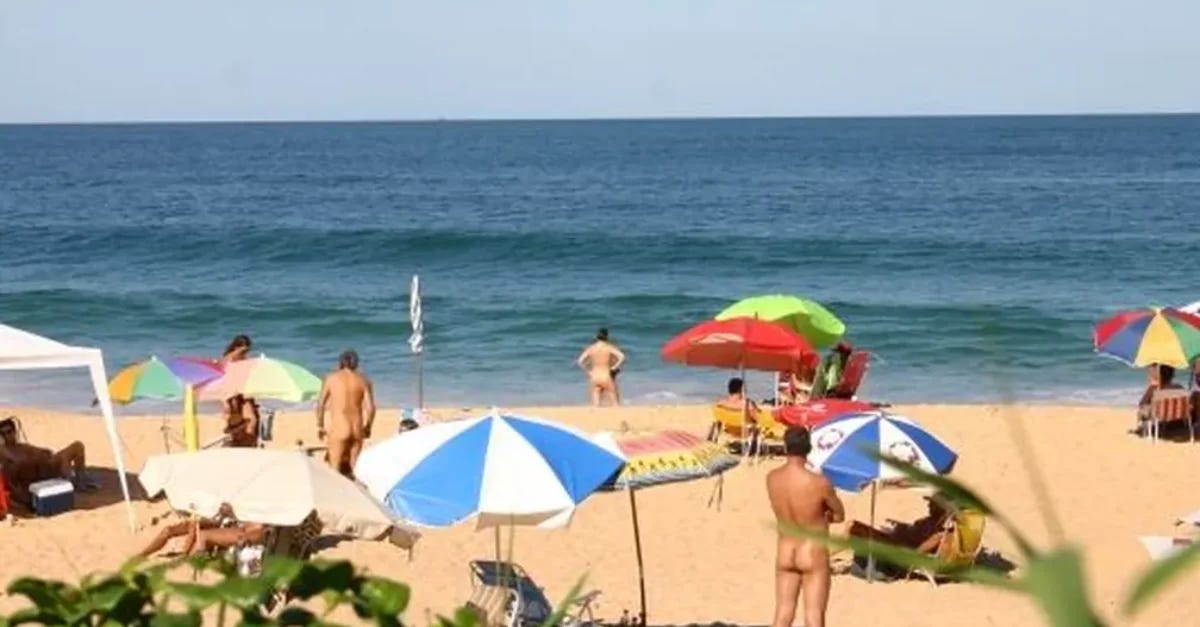
A Santa Catarina court has issued a preliminary injunction recognizing the legality of naturism at Praia do Pinho, preventing municipal and state authorities from criminalizing beachgoers for nonsexual nudity at the site. The injunction is temporary and partial, but it immediately halts arrests and criminal charges based solely on nudity while the broader case continues. The decision represents a major legal reversal just days after Balneário Camboriú moved to ban naturism across its coastline—and it came only after swift intervention by Brazil’s national naturist organization.
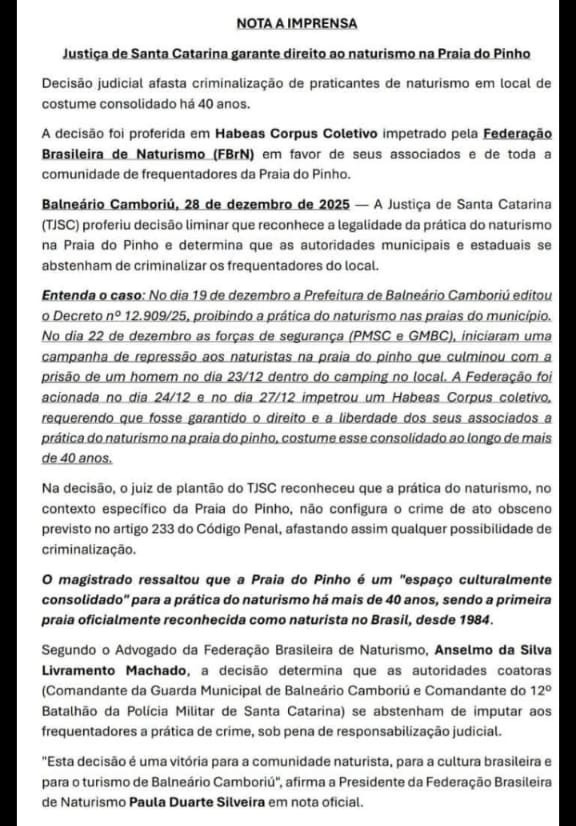
The ruling was issued in response to a collective habeas corpus petition filed by the Federação Brasileira de Naturismo (FBrN) on December 27. According to FBrN president Paula Duarte Silveira, the federation acted within days of the first enforcement action following the city’s adoption of Municipal Decree No. 12.909/2025 and a rapid escalation in enforcement, including the detention of a man for public nudity in a campground adjacent to Praia do Pinho.1
In the injunction, a duty judge of the Santa Catarina Court of Justice held that the practice of naturism at Praia do Pinho does not constitute the crime of an obscene act under Article 233 of Brazil’s Penal Code.2 The judge emphasized that obscenity must be assessed within its cultural and social context, noting that Praia do Pinho has functioned as a recognized naturist space for more than four decades. The beach was officially designated for naturism in the 1980s and has long operated under established codes of conduct prohibiting sexual activity, harassment, and unauthorized photography. The court ordered municipal and state authorities to refrain from imputing criminal conduct to naturist beachgoers based solely on nudity, warning that failure to comply could result in judicial liability.
Importantly, the ruling does not overturn the city’s revised master plan or repeal the municipal decree banning naturism. Instead, it draws a sharp legal distinction between municipal regulation and criminal law. While the city may continue to enforce its policy through administrative channels, the court made clear that simple, nonsexual nudity at Praia do Pinho cannot be treated as a criminal offense while the case proceeds. Paula Silveira, president of FBrN, told Planet Nude that the injunction was “partial,” and that the federation has already filed an appeal seeking a more definitive ruling.
Naturist advocates hailed the decision as a significant victory. In a statement, FBrN described the ruling as “a victory for the naturist community, for Brazilian culture, and for tourism in Balneário Camboriú.”3 In a message to Planet Nude, Paula added that the court recognized not only the beach’s historical significance, but also what she described as a long-standing failure by public authorities to provide the kind of security naturists had repeatedly requested.
Paula also pointed to a striking shift in enforcement priorities. “Before, there was no effective policing to curb sexual acts on the trails,” she told Planet Nude. “Now there is a strong police presence both on the trails and on the stretch of sand. It’s surprising how quickly enforcement resources increased after the law banning naturism was approved.”
The decision adds a new layer of complexity to an already volatile moment along Santa Catarina’s coast. As Planet Nude has reported, nearby Florianópolis has recently moved to reaffirm naturist use at Praia da Galheta after its own period of restriction. The contrast highlights how uneven and contested nude recreation remains along Santa Catarina’s coast, shaped as much by local politics and economic interests as by law. Rather than a single policy trajectory, the region is revealing a patchwork of decisions that reflect deeper disagreements about public space, morality, and cultural tradition.
That unease is part of a wider national pattern, says journalist Nina Lemos. Writing for DW Brasil, Lemos situates the Praia do Pinho ban within Brazil’s long-standing discomfort with nonsexual public nudity, particularly outside tightly scripted contexts like Carnival. After years living in Germany, where nude swimming and sunbathing are treated as culturally ordinary, Lemos argues that Brazil’s approach exposes a paradox: a country often described as permissive continues to criminalize everyday, nonsexual nudity while tolerating or even celebrating sexualized displays in limited settings. The result, she suggests, is a growing taboo intensified by contemporary conservatism, where nudism becomes an easy stand-in for broader anxieties about order, decency, and control.4
Seen through that lens, the legal battle over Praia do Pinho is not only about one beach, but about whether Brazil is willing to recognize nonsexual nudity as a legitimate cultural practice rather than a recurring moral problem.
For now, the court’s intervention ensures that Praia do Pinho’s decades-long tradition of naturism cannot be erased overnight by handcuffs and patrols. It also emphasizes the importance of supporting local naturist federations like FBrN for their legal advocacy for naturist spaces. But, as Paula cautions, the fight is far from over. “This was only the first step,” she says. “It is not yet definitive.” 🪐
More reading:


All quotations from Paula Silveira throughout this article were translated from Portuguese using automated translation tools.
BC Notícias. (2025, December 29). Decisão judicial impede prisão por nudez na faixa de areia da Praia do Pinho em Balneário Camboriú. https://www.bcnoticias.com.br/decisao-judicial-impede-prisao-por-nudez-na-faixa-de-areia-da-praia-do-pinho-em-balneario-camboriu/
Federação Brasileira de Naturismo. (2025, December 28). Nota oficial sobre decisão judicial na Praia do Pinho. Press release.
Lemos, N. (2025, December 23). Que problema é esse com o corpo nu, Brasil? DW Brasil. https://www.dw.com/pt-br/coluna-que-problema-é-esse-com-o-corpo-nu-brasil/a-75289751
Thanks, Evan, for keeping us updated on this situation. Although I'll probably never visit Praia do Pinho it's important for us to support our fellow naturists and their struggles all across the globe.
I'm willing to speculate there is a plan to build a hotel or resort on the vacant property just west of the beach. We just have to "follow the money."
Breaking news journalism like this is why I subscribe to Planet Nude. It's worth paying for, folks.