

Pinho loses its legal protection—again
A court has cleared the way for arrests to resume at Brazil’s first nude beach

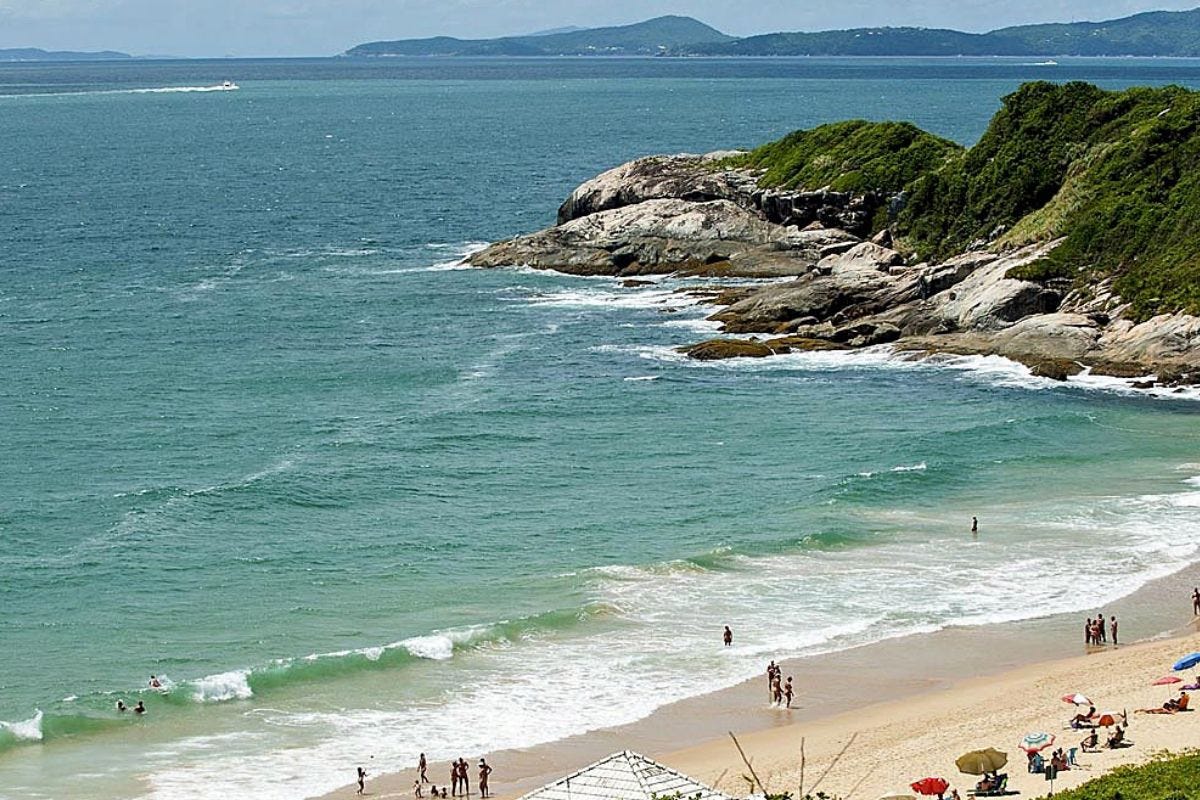
When Planet Nude first reported on Praia do Pinho last December, the situation was stark: Balneário Camboriú had just banned naturism across its entire coastline, ending four decades of recognition at Brazil’s first officially designated naturist beach. The Federação Brasileira de Naturismo (FBrN) responded within days of the first arrest, filing legal challenges that produced two successive court victories—first blocking criminal charges for nudity in late December, then securing a broader safe-conduct order in January that prevented police from arresting naturists on the sand and in the sea while the case proceeded.
That protection is now gone.
What ended it was not one ruling but two developments in the same week. On March 18, Balneário Camboriú's new city master plan—Complementary Law 130/25—came into effect, removing naturism from the list of permitted activities on any of the city's beaches. According to FBrN, this new plan eliminated the legal basis on which the earlier injunctions had rested: those protections had been granted partly on the argument that the original ban exceeded the authority of the previous master plan. With a new master plan now in force, that argument no longer applies. Then, on March 24, Brazilian news outlets Página 3 and ND Mais reported that a Santa Catarina court denied FBrN's separate bid to suspend the municipal ban through a civil action the federation had filed in February. In a clarification statement shared with Planet Nude, FBrN confirmed that the earlier injunctions shielding naturists from arrest have lost their validity as a result of both developments. Police can enforce the ban again.
The city called it a vindication. “We are acting with responsibility, transparency, and respect for the public interest,” city attorney Diego Montibeler said in a statement reported by Diarinho. FBrN is not treating it as a final defeat—FBrN lawyer Anselmo Machado told Página 3 the outcome was not a surprise, and the federation’s core argument that the ban was passed in violation of Brazil’s City Statute remains before the court. An appeal is coming.
Still, the practical reality has shifted. Brazil’s first officially recognized naturist beach—where naturism officially took root in 1984 and was formally written into the city’s master plan in 2006—is now legally closed to nudity with no court order standing in the way.
The pattern is hard to miss. FBrN president Paula Duarte Silveira told Planet Nude in December that naturists had spent years asking Balneário Camboriú for more security at the trails leading to Pinho, where problems unrelated to naturism had taken hold. They were told there wasn’t enough personnel. After the ban, enforcement appeared fast. “It’s surprising how quickly enforcement resources increased after the law banning naturism was approved,” she said.
Brazil’s back-and-forth
The ruling lands twelve days after a court 90 minutes down the coast went the other direction. On March 12, as Planet Nude reported, the Santa Catarina Court of Justice issued preventive habeas corpus protection for naturists at Praia da Galheta in Florianópolis—blocking arrests for nonsexual nudity on the sand and in the sea while the city continues to debate formal regulation. Galheta has spent nearly a decade in legal limbo since a 2016 reclassification stripped its naturist designation without explicitly banning the practice.
Just as Galheta gets good news, Pinho gets the opposite.
One detail that connects the fight at Pinho to the one 90 minutes south: according to FBrN’s clarification statement, it was the lawyer for AGAL (the Florianópolis-based association that has been defending Praia da Galheta) who answered the federation’s call and filed the original habeas corpus at Pinho, when no local legal representation was available. The two organizations are fighting different battles on the same coastline, and as FBrN’s statement makes clear, they have been doing it together and with shared resources.
Two courts, same state, twelve days apart, opposite conclusions. Neither beach is settled. Neither fight is over. What the rulings together make clear is that naturism in Santa Catarina is not moving in any single direction—it is being contested, ruling by ruling, by people who have decided that showing up is the only way to keep these places alive. 🪐


