

Toronto's famous nude beach is losing its sand
As Hanlan's Point partially closes for Pride Month, advocates are demanding the city move faster on erosion.

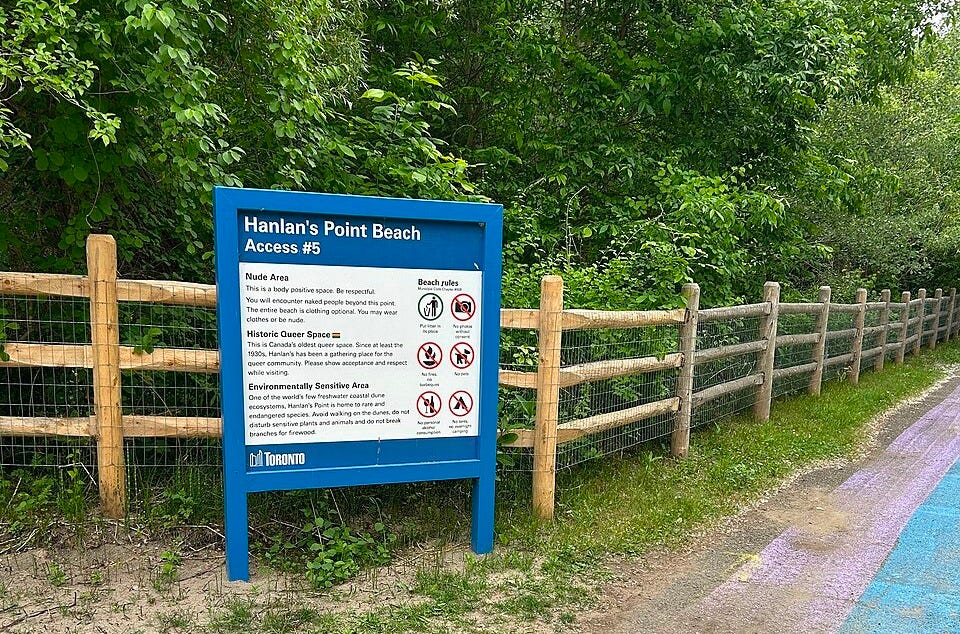
TORONTO — As Pride Month gets underway, part of Hanlan’s Point Beach—the historic clothing-optional shore where Canada’s queer liberation movement held its first gathering in 1971—remains closed to visitors due to severe shoreline erosion and high lake levels.
The City of Toronto blocked off a large southern section in recent weeks as rough conditions made the area unsafe. Advocates say the closure is the latest sign of a decade of neglect.
“Hanlan’s Point as a beach has been decimated,” Travis Myers, co-founder of Friends of Hanlan’s, told CityNews. “There used to be about 15 to 20 meters of shoreline. That’s completely gone.”
The site of the 1971 Gay Day Picnic—now recognized as Canada’s first Pride event—has itself been lost to the lake. “That historic place in our civil rights movement, the site of the first Pride, is underwater and has been,” Myers said.
The closure comes three years after Toronto City Council unanimously passed a motion recognizing Hanlan’s as a historically queer space, expanding its clothing-optional zone to the full two-kilometer beach, and directing the city to invest in ecological restoration. Critics say the symbolic wins haven’t translated into the basic upkeep the beach needs to survive.
The timing compounds concerns for organizers of Lez Beach, an annual June event for lesbian, queer, trans, and non-binary visitors. Co-organizer Cris Nippard said routing everyone to the one open section puts the most marginalized visitors at risk. “Having everyone kind of mixed into this one very small part of the beach is harming the people who are the most marginalized,” she said.
Councillor Ausma Malik, who co-sponsored the 2023 motion, called the erosion “an urgent issue” and said she moved a motion at Council last week directing the city to restore access by June 1. As of press time, the status of that reopening had not been confirmed.
A feasibility study on long-term shoreline protection is due by year’s end, with new funding to be requested in future budgets. The city notes it placed 50,000 tons of sand on the southern end of the beach between 2021 and 2023 — advocates say that work hasn’t kept pace with the rate of erosion.
“It’s a pretty easy request to put sand on a beach,” Nippard said. “Pretty much every other coastal city in the world does that easily.” 🪐


