

The mother of social nakedness
Lois Waisbrooker's fight for women's rights and bodily freedom through anarchist politics

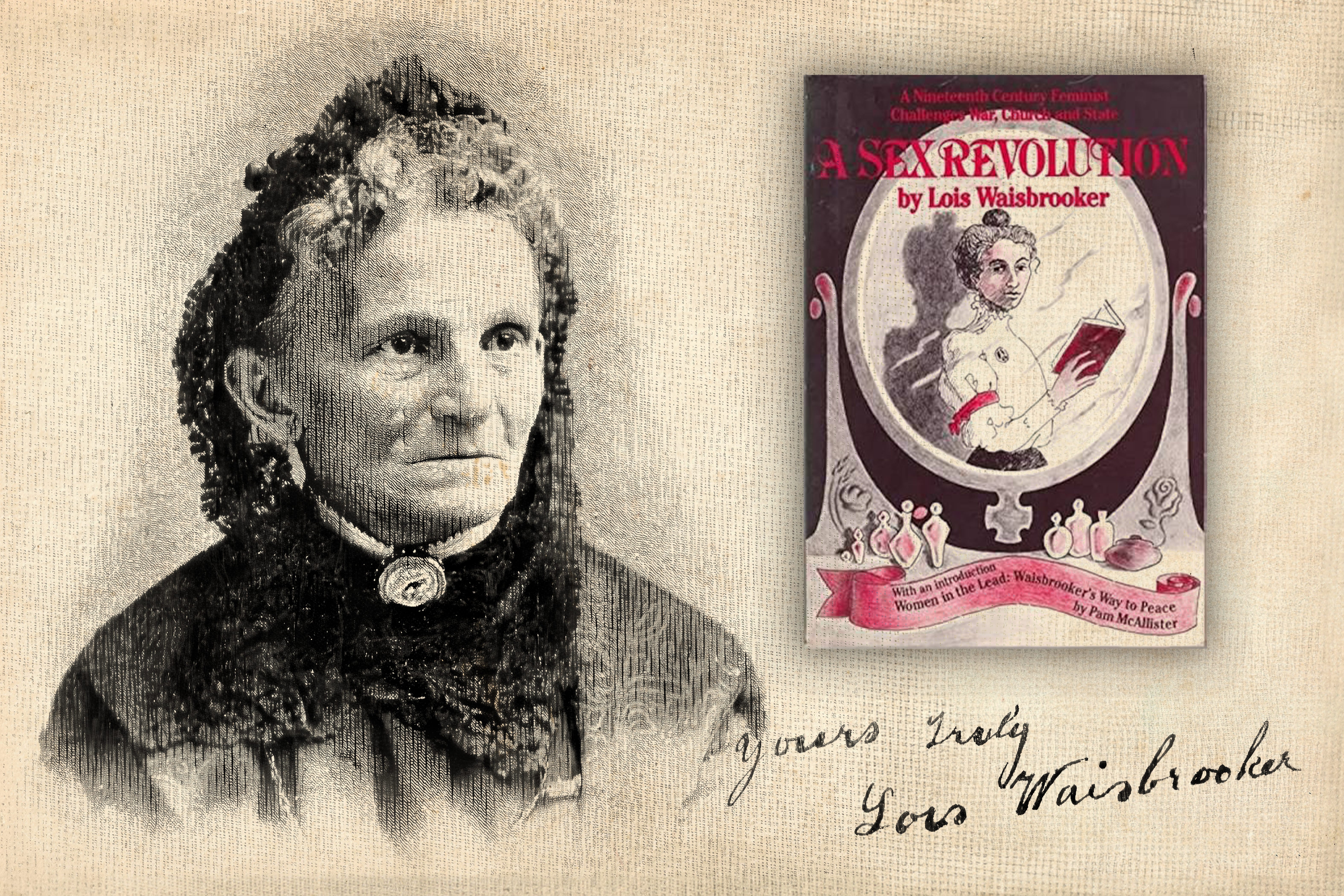
There have long been debates over who should be named the Father of Nudism. Was he from Europe or America? There is controversy over who that individual may have been and what involvement he had with later atrocities or what was considered then deviant behaviors. Would we be proud of our Founding Father in all aspects of his life? Some look back thousands of years to the gymnosophists as a group in 300 BCE in Pakistan or the Greeks for their promotion of athletics and the human form. However, there has been far less attention paid to the Mother of Social Nakedness.
There appears to be some competition in 1900, albeit with her earlier writings on women’s rights and her own behaviors, there appears to be a forerunner, at least from this author’s understanding.
There was the experimental artist community in Switzerland of avant garde, hedonists led by Ida Hoffman, a professional pianist, who set up a vegetarian farm in 1900 where clothing was optional. There was a strong encouragement to be close to nature. This enclave, Monte Verità, or the Mount of Truth, was to become a collection of intellectual artisans. She was a catalyst for moving the 20th century into an age to question social restraints and foster dynamic innovation in the arts. However, this was not the foundation for the average person to engage in the classless act of being socially naked. These were individuals actively pushing the parameters of social engagement and reuniting with nature. Monte Verità was not at all dissimilar to the Carmel Bunch at about the same time in Monterey Bay, California. Artists attempting to reconnect with nature for inspiration to change the world.
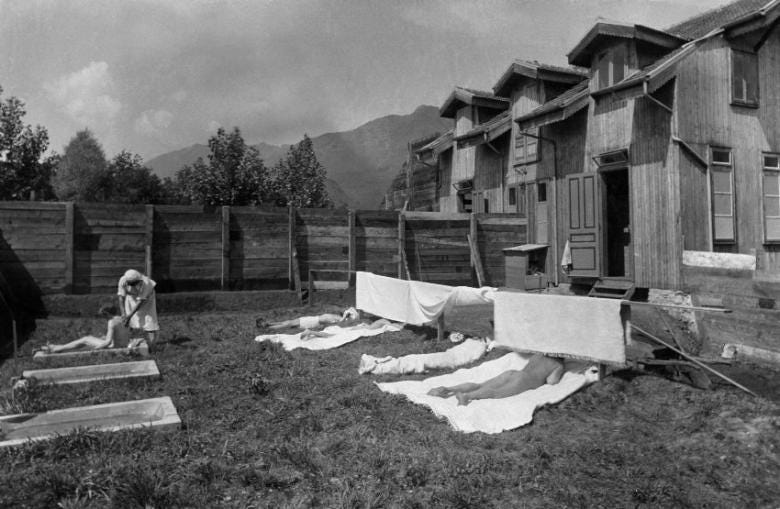
While Monte Verità would become synonymous with European life reform, an earlier and more radical experiment in communal freedom had already taken root in America. In 1896, four years before Hofmann established her Swiss enclave, an anarchist community was founded on Joes Bay in Washington and named Home. Lois Waisbrooker moved there in 1900 when there were about 100 residents and twenty-five houses. She was seventy-five years old at the time and moved from San Francisco, California to Home, Washington by herself with some assistance from her son.
Anarchy
Anarchy is a philosophy of living without government and laws specifying individual behaviors. Immanuel Kant, a German idealist put it this way:
Anarchy is law and freedom without force.
Despotism is law and force without freedom.
Barbarism is force without freedom and law.
Republicanism is force with freedom and law.
Thomas Jefferson felt that “a stateless society might lead to greater happiness.” He is quoted as “that government is best which governs least.” In the early days of the 20th century Emma Goldman followed the anarchist philosophy when she was asked to define it and stated “Anarchism is all about thinking for yourself.” She also offered that anarchy is: “The philosophy of a new social order based on liberty unrestricted by man-made law.” She visited Home in the early 1900s and claimed Abby and John Russell Coryell, two early nudist pioneers, as her best friends in America, and with whom she went skinny-dipping.
Anarchy took on a more negative tone after Karl Marx and the Communist Revolutions in Asia and during the turbulent 1960s. However, in the early 21st century, anarchy has been identified as what takes place during a natural disaster or emergency. People voluntarily assist others offering food, clothing, physical labor as the need exists. Most religious texts offer guidance for anarchy with simply stating; do good, treat others as you would like them to treat you.
Lois Waisbrooker
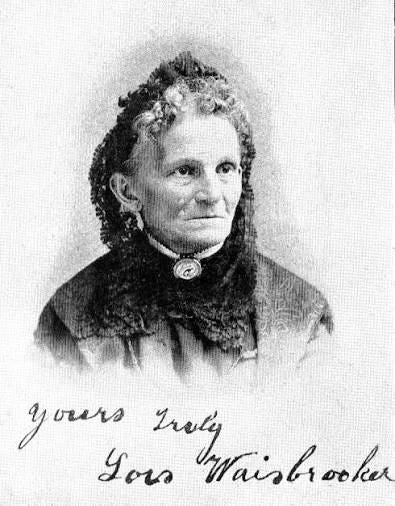
Ms. Waisbrooker was born Adeline Eliza Nichols on 21 February 1826 in Catherine, NY. Just as she turned seventeen, and pregnant, she was forced to marry George Fuller on 12 April 1843 in Ohio. She bore a son named Abner Fuller. It was an unpleasant marriage and ended in divorce. She later married Isaac Snell on 9 August 1856 in Ohio. It also ended in divorce.
In 1863, during a spiritualist session, she adopted the name Lois Waisbrooker from a spiritual guide she encountered. She used the name for the balance of her life as a single woman. She was a writer and publisher advancing “assertive womanhood and female sexuality as a positive power.”
She gained notoriety with her 14 December 1873 speech “The Sex Question and the Money Power.” Her point was that the construct of marriage is just legal prostitution. Men with money request a woman and then under the laws of the land and the guidance of the church, the female becomes his property to be done with as he desires. A woman was to wait under her father’s control, until he gave permission to another man to take her hand and body.
Waisbrooker later reported in February 1901 in Vol. 2, No. 1, p 3, of the newspaper she wrote, typeset, produced, and distributed from Home the following:
Do you know?
That in thirty-seven of these United States the married mother has no legal right to her children?
That in sixteen states a wife has no right to her earnings outside the home?
That in eight states a woman has no right to her own property after marriage?
That in seven states there is no law compelling a man to provide for his own family?
Waisbrooker championed for women’s rights decades before the Suffragette movement calling for their right to vote. She was attempting to document the hardships placed on women, especially those single women with children, for whom a man selected and paid for them in some manner, and yet was able to have no responsibility to her or his children.
In 1894, she was arrested in Kansas for publishing a letter about a public person’s affair in the paper “Foundation Principles.” It was felt that printing the salacious story of an extra-marital affair was an affront to the community, no matter how truthful the account even when couched in generalities.
In the 1890s, Waisbrooker moved to San Francisco and changed the name of her publication to “Clothed with the Sun” (CwtS). She reported that the sun is the symbol of direct power or light. Woman has not been allowed to shine by her own light but only by what the moon reflects on to her. This is likely a metaphor for her monthly menstrual cycle, which made men perceive them as weak or lacking in their own power. The image of a woman under the sun and standing on the horns of the moon is taken from the Bible, Revelation 12:1. The first issue of CwtS was produced in San Francisco in February 1900. It had the stated purpose for “The Freedom of Woman.”
Suppression and censorship
CwtS, Vol 1, No 2, p 3, mentioned the “American Inquisition.” In Medieval times the Church punished individuals for “heresy”. In the 1900s the catch phrase was “obscene literature.” Marriage sex manuals, birth control information, basic sex education, Sexually Transmitted Infections (STI) education were all considered topics that just were not discussed in public and even rarely privately. The American Civil Liberties Union was formed in the 1910s to address such concerns.
The lead crusader to suppress vice and unwholesome materials, was Anthony Comstock who was going after anything distributed by the US Postal Service. Bernarr Macfadden published John Russell Coryell’s story “Wild Oats” in his Physical Culture magazine and it was deemed “obscene literature”. It was a fictional story about the tragedy of bringing an STI back to a family and the subsequent health consequences to everyone. The case was argued as the story being health education for the public and went all the way to the Supreme Court, where Macfadden lost, paid a significant fine, and requested and received a Presidential Pardon from William Howard Taft.

Likewise, Albert Arthur Allen, a photographer from Oakland, CA, was repeatedly charged with sending “obscene” images in the 1910s across state lines even by private carriers and won four of the five cases in Federal court by distinguishing that mere nudity was not obscene. In the early 2000s, the literal “catch phrase” is now that a “nude image” will get those who post them on electronic social media censored and censured. Waisbrooker’s “American Inquisition” continues its grudge against openly discussing and portraying the human body.
An incident
In September 1901, CwtS, Vol 2, No 8, p 3, there is an article titled “An Incident”. From the review of most of the available copies of CwtS this article is the only one that has been found that targets clothes free individuals. Other sources have reported that sun-bathing and skinny-dipping occurred regularly in the Home community as people bathed in Joes Bay. Later, court cases appear to be centered on the capacity for Home’s neighbors to “see” naked individuals or groups. However, in Waisbrooker’s writings and publications this is the only account that has been found. In keeping with the underlying anarchist beliefs of the residents of Home, the tone and content appear right on target.
A stranger to Home arrives and goes to the CwtS office in Home. He had walked several miles to learn more about the people and their behaviors in Home. Along the way, he witnessed a man and a woman, not far from the community, sunbathing entirely nude. What should he think about it? He assumed they were residents of Home. When questioned by Waisbrooker about why he thought they might be from Home and not just some people camping in the area. He mentioned the proximity and that he thought the people of Home were into free-love. She then editorializes if being without clothes “as though there was any love in that!”
She then writes about how this man and others like him want to pay to bring women to Home. The sense is that with the freedom to do as one pleases, that sex may be more accessible. This sounds like the accusations made of many nudist clubs throughout the century about what is “actually going on” behind those tall fences: it must be bad, if they are naked they must surely be having orgies. Waisbrooker goes on to write; “Men and women have the right to roll around in the mud if they choose, but is it the better way?” The idea of anarchism was not to delve into debauchery but to seek a better life without dogma and restrictions by doing good for oneself and others. Couples sunning naked or skinny-dipping in Joes Bay had nothing to do with free-love or consensual sexual activities, and whose business is it anyway if the activities are among consenting adults.
In December 1901 CwtS, Waisbrooker wrote that sex between people who were in mutual love was not a sin or a crime. It did not matter if they were married or legally bound by some sanctioning entity. What mattered was that the couple had mutual feelings for each other and consented to the activities. Again, she was charged with sending obscene material via the mail.
Waisbrooker fought to clarify the hypocrisy of the church and government’s positions on how people behave toward each other. She comments that “the teachings of anarchy and love in freedom, is what nine-tenths of Protestant ministers will say ‘That’s what Jesus taught’.” But it was considered against the government’s promotion of the capitalism of marriage and the church’s structural dogma.
Waisbrooker also was concerned about what was happening to women as they age and can no longer bear children to build a husband’s legacy. She even ventured to see a bright future for women. CwtS, Vol 1, No 12, in Jan 1901; “The woman of the future will not be relegated to the ‘chimney’ corner because of her years. She will have less of one man ownership-protection and more LIFE than have most women of today.”
She was also ahead of her times in that her anarchist newspaper article “Discontent: Mother of Progress” she uses the term “comrade” for her peers in 1901. This is decades before the Russian revolution when comrade came into common usage.
Her views on how poverty impacts health and that urban living can be deleterious to one’s well-being were also ahead of their time. Nudist promoters of the 1920s put emphasis on the need to get out to the fresh air and sunshine on the one day a week some people had off from work. In CwtS, Vol. 2, No 1, she writes of the economic value of health and that living in cities can be devoid of sunshine with low-cost rents only available on the shady side of buildings and long hours of indoor work. Likewise, she called for access to proper air.
Waisbrooker also coined a term that was fitting for the role of the church in addressing the practicalities of married life. She wrote in “Sex on the Brain” as a topic that needs to be discussed but “churchianity” is against all sex education and that results in many problems with marriage. Upon reading this Susan Douglass on 19 June 2026 coined her own word—“churchiarchy” as a problem of enforcing dogma and beliefs that have no factual basis.
These comments fit with the publication in CwtS, Vol 1, No 2, p 4, of a letter from a male “I cannot begin to tell you I have suffered in this latter (want of soul companionship) and how I hate the conventional, custom bound tenets of society and the fearful prudery that is maintained!” Waisbrooker was using CwtS to expose these conventional, custom bound tenets. She wanted to break up the strangle hold of religious dogma. She wanted to challenge the government’s laws that inject themselves into personal matters.
A living legacy
It is no surprise that when in 1980 Lee Baxandall, founder of The Naturist Society, and well-known author on socialism and leftist history, set up the magazine to promote social nakedness in public areas that he honored Lois Waisbrooker by naming his magazine Clothed With The Sun. Subsequently he changed the name in 1989 to the now popular N for Nude & Natural.
If there is ever a Nudist Hall of Fame nomination for a founder or a citation for the mother of social nakedness, Lois Waisbrooker should be seriously considered. 🪐
More to explore:


 | A guest post by
|