


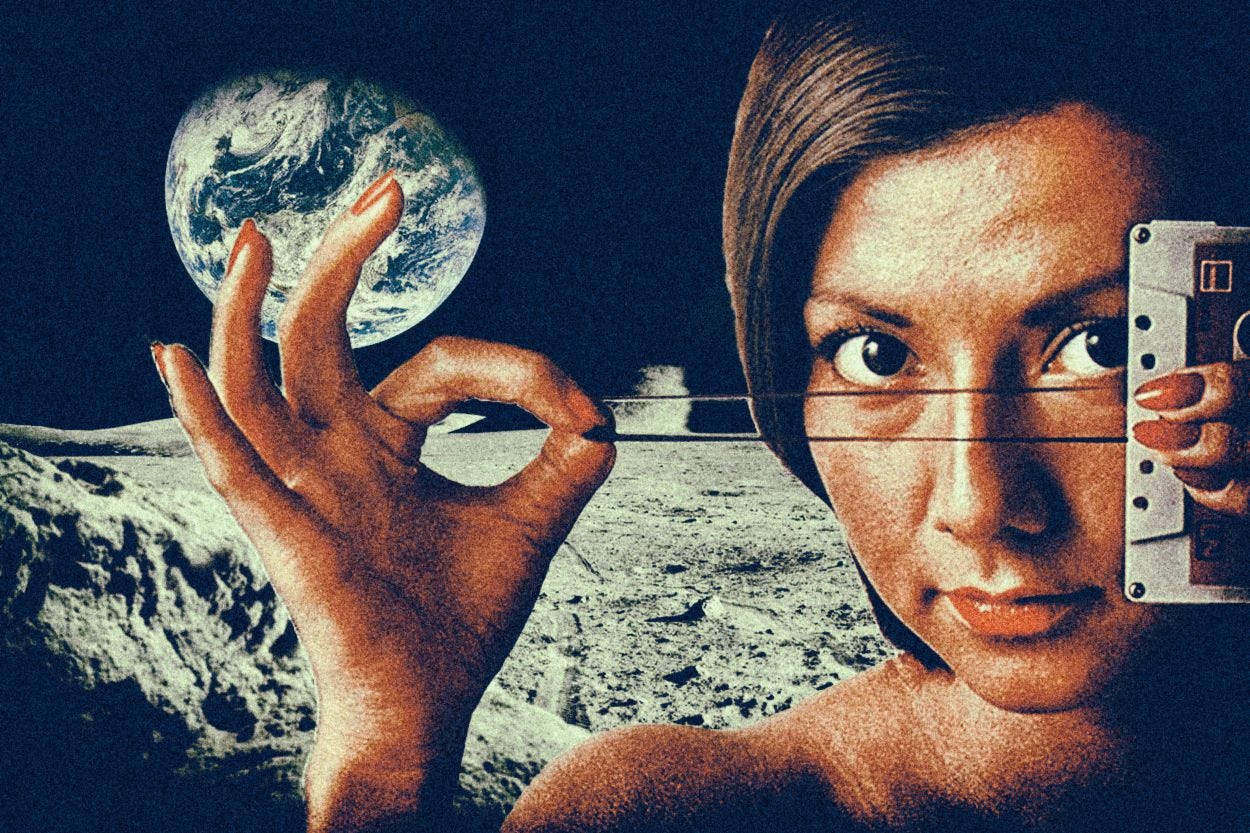
The science fiction writer John Varley passed away late last year. While Varley, a multiple-time winner of both the Hugo and Nebula awards, was well known and respected among his peers and science fiction enthusiasts, his reputation never really spread to the broader public. The most well-known piece of media associated with his name is the made-for-public-television adaptation of his novella Overdrawn at the Memory Bank, and that mostly from its second life on Mystery Science Theater 3000. Which is a shame, because Varley really does deserve to be known better, and particularly known better by nudists. He uses nudity in his works frequently, in ways which are both deeply thoughtful and highly unexpected.
Apologies here, but I do have to indulge in a little sci-fi wonkery to lay out what makes Varley’s vision so interesting. Many of Varley’s novels and short stories take place in a fictional framework loosely known as the “Eight Worlds” series. Never an obsessive about continuity, Varley’s Eight Worlds works share more of a premise than a completely mapped out and rigid canon. But it is a fascinating premise.
A few hundred years from now, after humanity has already begun spreading out in the solar system, Earth is invaded. The Invaders are a species that evolved on a gas giant, and has a completely different relationship to space and time than humanity. They can also manipulate space and time in ways that mankind is biologically incapable of understanding. These Invaders group sentient life into three categories. There are beings like themselves that evolved in similar conditions, such as those living on Jupiter, with whom they get along fine. Then there are cetaceans, intelligent sea life such as whales and dolphins, who they think require their protection. Everything else, including humanity, are categorized as vermin. And these guys take “save the whales” very seriously. To rid the planet of its vermin and protect the cetaceans, in a single day they cause everything on Earth ever made by human hands to vanish into thin air. Within a year, almost every human on Earth has died of starvation. The remainder of humanity, spread out tenuously across the solar system, are forbidden to return to Earth or approach the planet Jupiter. Humanity has to adapt to survive.
One of the largest outposts of this remainder of humanity is on the Moon, where people live in sealed cities below the lunar surface. In a climate-controlled environment with limited resources, the lunar society evolves into a clothing-optional one. Some people will wear clothes as a sign of luxury, state officials like police will wear sashes for identification, but everyone else just largely goes about naked. But while this nakedness is presented in a very matter-of-fact way in the books, there’s much more to it than that.
Varley’s writing could be described as hard social science fiction. Varley’s worlds explore how the extreme conditions posited by most science fiction could possibly change people and society.
In Varley’s world, not only is society’s relationship to clothing remarkably different, but so is the relationship to the body itself. Cloning, genetic tweaking, and uploaded, backup copies of minds have made people’s bodies into something like commodity goods. If your body is broken or you’re unhappy with it, just get a new one. People in Varley’s universe can choose their age, choose their sex, and have any number of bodily adjustments made, cosmetic or otherwise. Those who work in zero gravity in Varley’s stories will routinely have their feet replaced with a second set of hands. A teacher may have himself genetically tweaked to be the same biological age as his students to better relate to them. If someone matures beyond a fashionable age, they can just dispose of the old body and download themselves into a new clone that puts them back in their prime.
As a result of all these possibilities, the Lunar society depicted in Varley’s works evolves into one where not only individuality, but individualism, are highly prized. This is explored in his deeply unsettling novella The Barbie Murders, where a reactionary cult forms that completely rejects individuality. Members are altered to be physically identical and genderless, and must renounce all sense of self. And, in the mostly undressed society of the moon, they stand out even more by all dressing identically.
There’s also a bit of culture clash in Varley’s novel The Ophiuchi Hotline, when some lunar residents have to travel to the hyper-capitalist planet of Pluto.1 There, the nudity of the visitors from the moon is seen as not shameful, but laughable. Pluto is envisioned as something like St. Louis in the late 19th century, made fabulously wealthy from being the gateway to the riches of the outer asteroid belts. On Pluto, ornamenting yourself as ostentatiously as possible is the way to show off your social position. To walk around naked is to announce that you’re some rube from the backwoods come to gawk at the big city. Nudity has social meaning, just a different social meaning than what we’re used to.
Nudity, in Varley’s writing, is used metaphorically to explore a world where the relationship of the self to society, and the self to the self, has radically shifted. In many ways, nudity is the baseline metaphor of his work. What Varley understood was that the meaning of nudity is a social meaning. And that metaphorical nudity gives him opportunity to brilliantly consider just how far that meaning can be stretched.
If you’re not a science fiction fan, or if all of this sounds a little too geeky for you, rest assured that one of Varley’s greatest strengths was that he was a damned good writer. Even non sci-fi buffs can enjoy his work. He puts sentences together one after the other in ways that keep you from looking up from the page for hours on end.
Varley’s career spanned over thirty years, so there’s a lot out there to enjoy. If you want a good starting off point, his novel The Ophiuchi Hotline is highly recommended. If you want just a taste, his short stories Options, The Pusher, and Overdrawn at the Memory Bank should all definitely be on your list. His short stories have been anthologized in multiple collections over the years, and have now been mostly gathered into The John Varley Reader. Pick up a copy for your next nude beach read. 🪐
More reading:


The novel was written in 1977. Poor Pluto.
The only John Varley I've read is The Ophiuchi Hotline but it was so long ago that I had forgotten the different attitudes to nudity on the Moon and Pluto I must give it another read although the copy that I have is almost falling to pieces. Science fiction set in alternative societies give a lot of scope for ideas about clothing and nudity which I've explored in my own writing featured here https://www.planetnude.co/p/the-warm-season
ZP - I already loved you for your fantastic cartoons and artwork, but I love you even more now! Thank you for bringing John Varley to more people's attention. 😊❤️