

Nude beach signs caught in national park review
A leaked database shows routine visitor warnings at Playalinda Beach among hundreds of materials submitted for federal review

A federal review of interpretive materials across the U.S. National Park Service has unexpectedly swept up signs warning visitors about nude sunbathing at one of Florida’s best-known unofficial clothing-optional beaches.
According to reporting by SFGATE, two “nude beach” signs at Canaveral National Seashore’s Playalinda Beach were included in a database of park materials flagged for internal review.1 The database, leaked by anonymous federal employees and first examined by The Washington Post, lists hundreds of signs, exhibits, brochures, and educational materials submitted by park staff as part of a broader content review ordered by the U.S. Department of the Interior to identify materials that might “inappropriately disparage Americans.”2
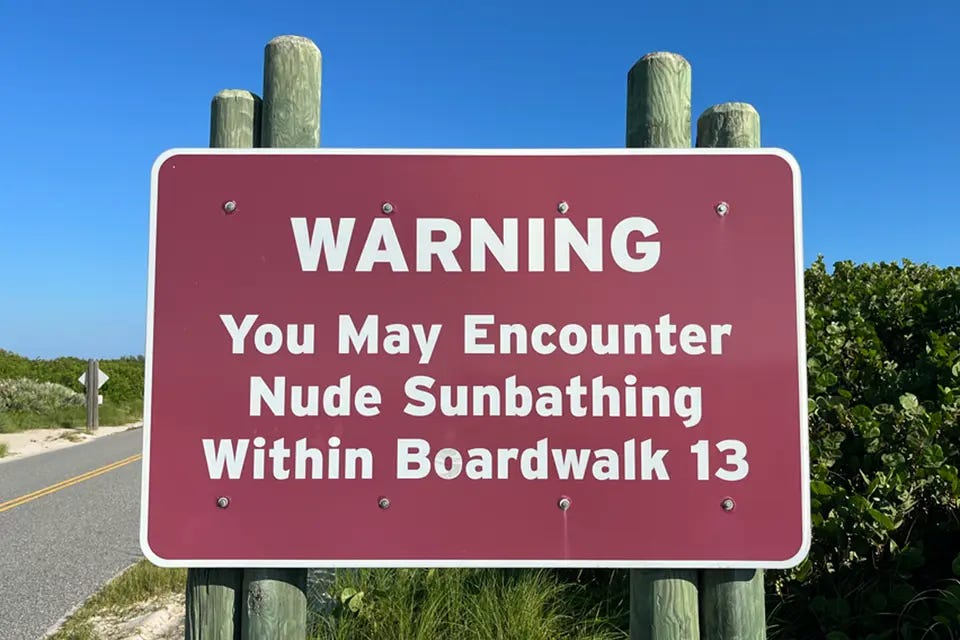
Much of the attention around the review has focused on historical interpretation related to the Civil War, Indigenous history, and climate change, signaling familiar culture-war–driven cuts and scrutiny within the current federal government. But the list also includes some unexpected entries, among them signs near the northern access points of Playalinda Beach alerting visitors that they may encounter nude sunbathing beyond certain boardwalks.
The signs do not promote nudity, of course. Rather, they serve a practical purpose warning visitors that the far northern stretches of the beach have long been used by naturists.
Playalinda’s clothing-optional culture has developed through an unusual patchwork of jurisdiction. While the seashore itself is federally managed, Brevard County’s anti-nudity ordinance technically applies near the southern access points. For decades, visitors seeking a clothing-optional experience have walked north toward the Volusia County side of the park, where enforcement has historically been more tolerant. Informational signs have helped prevent confusion for newcomers encountering the beach’s informal naturist zone.
The beach is one of only a handful of public sites in Florida where social nudity remains either officially authorized or widely tolerated, alongside places such as Haulover Beach in Miami-Dade County and Blind Creek Beach in St. Lucie County.
Recent years have also brought occasional reports of inconsistent enforcement at Canaveral, adding to uncertainty around the beach’s long-standing but unofficial nude section. The seashore also faces pressures from expanded rocket launch activity at nearby Kennedy Space Center, and indeed the beach is currently closed in advance of an April launch.
It remains unclear whether the Playalinda signage will ultimately be removed or altered. The Interior Department has said the leaked database reflects draft internal materials rather than final decisions, and officials have criticized the release of the documents.
For now, the flagged signs illustrate how even routine visitor warnings—meant simply to inform people what they might encounter on the sand—can become entangled in broader debates about how America’s public lands are interpreted and presented. The episode also hints at the persistent challenges naturists face in shaping public perception as they advocate for wider acceptance of nude recreation on public lands. 🪐
More reading


Mohr, K. (2026, March 10). List of national park signs under federal review moves into the absurd. SFGATE. https://www.sfgate.com/national-parks/article/absurd-signs-national-parks-22024223.php
Brulliard, K., & Dennis, B. (2026, March 2). Confidential database reveals which items NPS thinks may ‘disparage’ America. The Washington Post. https://www.washingtonpost.com/climate-environment/2026/03/02/national-parks-signs-censorship-slavery/