

Men are from Mars, Gurley is from Venus
Excerpt from Nudetopian Nightmares, seeking a new Garden of Eden. 1933-1955

Editor’s note:
The following text is an excerpt from Nudetopian Nightmares: Seeking a New Garden of Eden, 1933–1955, a new historical work by Olaf Danielson. The book explores a series of little-known nudist, naturist, and back-to-nature experiments that emerged in the United States during the interwar and postwar years, many shaped by overlapping currents of religion, health reform, utopian thinking, and social experimentation.
This excerpt focuses on Floyd M. Gurley, an eccentric figure whose attempts to merge Christian fundamentalism, nudism, vegetarianism, and prophetic belief placed him at the far edges of American nudist history. His story reflects the kind of overlooked archival material Danielson frequently uncovers for Planet Nude readers.
We’re publishing this excerpt both for its standalone interest and as a window into the broader scope of Nudetopian Nightmares, which brings together dozens of similarly strange, revealing episodes from nudist and naturist history.
Nudetopian Nightmares is a 268-page softbound volume and is currently available directly from the author. Copies can be ordered for $20 plus shipping by contacting Olaf Danielson at storolaf@yahoo.com. 🚀
Men are from Mars, Gurley is from Venus
Historically, nudist or nudism is a person or practice of being naked and associating with other people. In Europe, the term naturist evolved differently. In the Twenties it was used to refer to women not using makeup. It later came from the French term first used at Île du Levant, and their term naturiste or naturisme is a way of life involving a collective practice of nudism and based on the idea of returning to the “natural state,” like a woman not using makeup would. An English derivation of “back to nature-ist” was undoubtedly shortened to just “naturist.”
In North America, the term “naturist,” however, had nothing to do with nakedness. It was “invented” in 1930 by American writer Henry Chester Tracy in his seminal ecocriticism work American Naturism. In his book, he uses the term naturists to describe those who feel and enjoy nature and wrote about it from the standpoint of literature and philosophy of life. This was in contrast to “naturalists,” who wrote about it in terms of pure science. So, when did the definition change to involve nudity?
In the early to mid-Thirties, naturopathy became all the rage in America. Naturopathy, or “nature-cure,” was associated with non-traditional but more mainstream health ideas and practices, like vegetarianism, organic gardening, and sunbathing and fresh air. More controversial ideas included fruitarianism or drinking only coconut water. First, people went to sanitariums for the nature cures, like Yungborn in New Jersey, but others devised the idea of going back to nature.
Naturism was typically associated with people trying to live like Adam and Eve in a tropical environment, and eating what they thought a wild ape would eat.
So, simplified, the term naturism evolved from a merger of nudism with naturopathy, but like everything, it kept expanding. Soon it promoted everything from socialism and avoiding drinking water. Many discussed the creation of a super race of people, immortality, or involvement with esoteric religion, from sun worshiping to more, and even sun-aided reproduction without having sex, apparently following the footsteps of Adam, Eve, and Jesus, which also had a metaphysical and religious feel to it.
There were many strange men with odd beliefs, and one of the oddest was the “God of White Thunder.” Truth be told, Floyd M. Gurley never claimed to be from Venus; he just claimed to be the only human to ever have visited the planet. Later on, he even threatened to sue a man who had written in a newspaper that Venusians roamed the Earth. Apparently, everyone knew that Floyd had been the only person from Earth who had actually ever been to Venus.
He found it a somewhat preposterous assertion anyhow, since Venusians could not simply walk the streets of the Earth’s cities. They were fourteen feet tall, had greenish skin, and did not wear clothes. As such, they would have trouble blending in.1
There are two newsworthy people of note that claimed to be from Colony, Kansas. One was Dr. Dean Brooks, a psychiatrist who has one motion picture credit—playing the doctor in One Flew Over the Cuckoo’s Nest. Dr. Brooks also gave permission for the famous movie to be shot at the Oregon State Hospital.2 The second was Floyd Gurley, yet another man who appears to have found that fine line between genius and mental illness. Apparently, the pair also have mental illness in common.
There is not much written about Gurley except in some esoteric biblical archaeology journals, UFO texts, and editorial comments, but what is known might make an even better movie.
Gurley’s early life is confusing to contradictory. In his high school years, he disappeared; family and friends placed ads worried that the frail lad’s heart would give out. They did not need to worry. The police had arrested him in Wichita for the production of alcohol. It was a frequent situation for him.
In 1934, at the age of 28, after his fiancée married another man, allegedly, Gurley burned the new couple’s house down. He fled to San Francisco, quickly becoming an expert on trolleys. Arrested and extradited back to Kansas, Gurley confessed to the crime after Harry O’Reilly, the District Attorney and the State Fire Marshal, nearly drowned the handcuffed man in the bottom of a toilet bowl. He had to be resuscitated by a physician.
He was sentenced from one to four years to the reformatory. Prior to going to jail, young Floyd married Frances Brassfield, the fourteen-year-old younger sister of the woman whose house he had allegedly burned down, after he got her parents’ permission. Talk about future family gatherings being uncomfortable.
Odd things started happening after he was incarcerated. Signs and writing made with rocks on Osage Hill began appearing, pronouncing proclamations like “The White Thunder God is here.”3 Gurley did not serve his full prison term, as he was out and about at least by 1935, when he was reportedly operating a gold mine in Colorado.
It was after his gold prospecting that Gurley became the Right Reverend and began preaching the gospel and his form of devout Christianity, albeit a naked one.
Gurley led a colony of fundamentalist naturist Christians into South Florida in 1936 or 1937 who felt they needed to return to living the way God had commanded them, like Adam and Eve, and raise their families away from the filth of American cities. They settled on twenty-three of the forty “Isles of Eden” located in the middle of the Ten Thousand Islands at the mouth of the Everglades, southeast of Marco Island.
It is unknown how he recruited his faithful. A man named James R. Latham, reportedly en route from the Bahamas to Tampa, stopped by these islands in 1937 on a report from a native eight-year-old boy. The residents observed the Sabbath, and the group was led by Rev. Gurley.
The group raised chickens, did crafts for the Seminole Indians, and ate only raw vegetables and fruit (what were the chickens for?). They did not pray in their church, but besides the author commenting on the naked and comely young women singing in the choir, nothing more was said about the visit.
I do not know if this was a fictionalized account, as Gurley was prone to fiction, or if it was true. There are some corroborating but extremely vague sources about a colony of nudists living down there that were driven out soon after arriving by bugs and the weather. I tried to make contact with the Marco Island Historical Society, but they did not return my messages.
Gurley was a staunchly conservative Christian, as evidenced by what he wrote in his magazine, The New Eden. It is a quite strange late-Thirties magazine that tried to blend deep Christianity and naturism. The two covers available have naked women on them. Copies are extremely hard to come by.


After the war and his writing days, Gurley ended up back in Chase County, Kansas. By all accounts, he was a chicken breeder and a writer under his other names: the White Thunder God and Pat Reid, a nom de plume.
The one book credited to “Pat Reid” was titled White Thunder God. Per the Penn State Library, it is an “odd Christian eutopia set in Mexico with a history going back to the formation of the Earth. Quetzalcoatl was John the Baptist. They were raw vegetarians; even panthers did not eat meat. They were nudists, and the group was in contact with Venus, which is more advanced than Earth spiritually and technically, with some of those advances available to the people of the eutopia.”4
After his unsuccessful nudist colonization project, assuming it was not just another fictional account, he bought and managed the Ozark Telephone Company in Colony and also became the leader of the state’s Anti-Saloon League. He was running for the U.S. Senate under the Prohibition Party in Kansas until his jail time and other shenanigans came out. He won the primary in 1950 but pulled out ahead of the general election.
He was a living contradiction. He penned both chastising letters to Mississippi newspapers extolling the value of nudism in a fight to make it illegal there and wrote letters to Hawaiian officials calling a naked statue featured in a museum filthy and pornographic.
His most famous, or infamous, work was an oft-quoted “scoop” written in a 1940 issue of The New Eden. He claimed that a Russian pilot during the First World War had seen what appeared to be Noah’s Ark on Mount Ararat. This led to needless archaeology expeditions and much false reporting. Unfortunately, it was not until 1986 that Gurley fully admitted the details of the story were the work of imagination, though he also told Ark hunter Eryl Cummings that he had received some information from a Russian immigrant.5
Using his White Thunder God moniker, Gurley wrote thousands of terse letters to the editor, most never published. He even predicted Kennedy’s assassination almost to the hour nine months before it happened, reciting a Native American curse. Receiving notoriety for that, in 1965 he made five subsequent predictions, none of which ever happened.6
After a while, it is difficult to actually believe anything he wrote, and to do so takes a lot—really, a lot—of alcohol or hard-core drugs.
Despite the Kennedy prediction, I have serious doubt about two of Gurley’s other claims. I do not think he visited Venus, and I also doubt he was the White Thunder God, but now I am not so sure.
In 1958, while inspecting a connection at the top of a high pole, the manager of the Ozark Telephone Company was attacked by a giant bald eagle, which grabbed his left arm in its talons and tried to carry him off. The bird did not succeed, but Gurley required many stitches and took three days off to heal.7 Then again, maybe this was proof he was who he claimed to be.
Gurley and his wife Pat (buried Pansy) were nudists for decades and long-time members of the Kan-Tan Club in Burlington. I assume Pat was his second wife, and not a nickname for Frances. They moved to New Mexico and then to Hawaii in the Eighties. She died in 1986, and Floyd in 1991, aged 84.
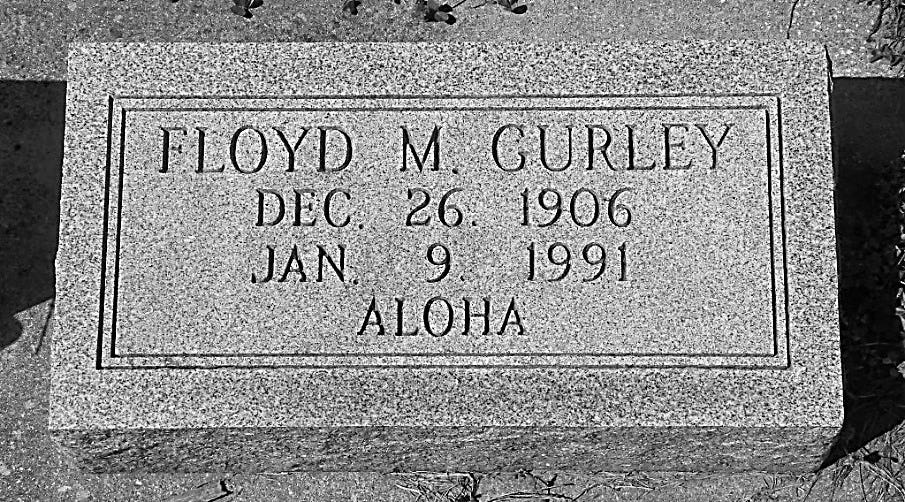
No obituary survives. They are both buried in Colony, Kansas. Both headstones are simply marked “Aloha.” Sadly, no mention that he was the White Thunder God was engraved in the granite. Maybe the “Aloha” was meant to say hello, not good-bye.
It is quite clear that, like many included in this work, an autobiography would have made an interesting read. Possibly Mr. Gurley spent so much time penning complaints to newspapers that he simply forgot to write it. 🪐
Find more forgotten naturist histories in Nudetopian Nightmares.
Email Olaf to order directly.

Nadis, Fred. The Man from Mars: Ray Palmer’s Amazing Pulp Journey. Penguin Publishing Group, 2013.
“Colony, Kansas,” Wikipedia.
Heat-Moon, William Least. PrairyErth (A Deep Map). Houghton Mifflin, 1999.
Reid, Pat. White Thunder God. Los Angeles: Author, 1947.
Heat-Moon, 1999.
Nadis, 2013.
“Faulty forecasts,” Emporia Gazette, Emporia, KS, June 6, 1966.
Telephony. Chambers-McNeal Company, 1986.
 | A guest post by
|
"(what were the chickens for?)" cracked me up so much.
I wonder if the man who claimed that Venusians walked the Earth was Samuel Eaton Thompson, who claimed to be in contact with them in the 1950s and stated that they frolicked in the nude and foretold the return of Jesus Christ? Or if maybe Thompson had read some of Gurley's, erm, work prior to his own contact?