

Mākena permit approved
The hearing we flagged in June is decided. Here's what the commission approved, and what it put off until 2029.

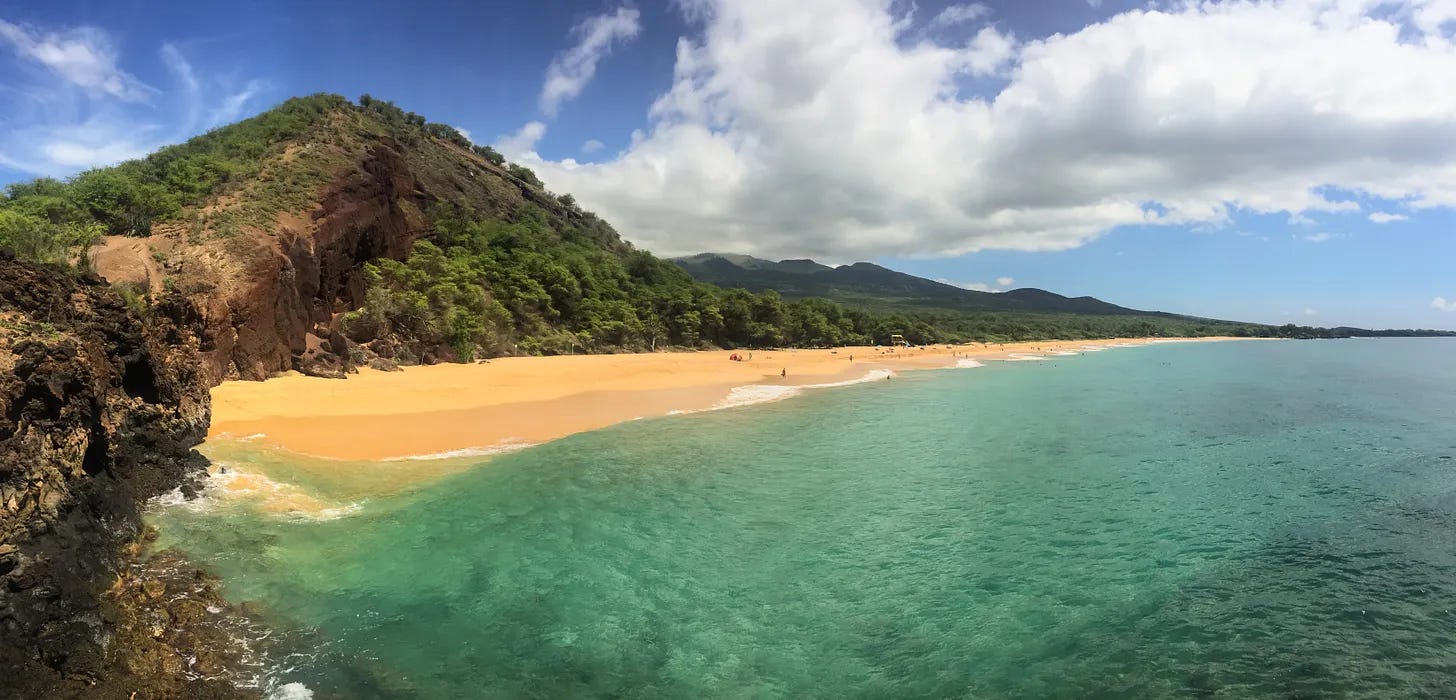
The Maui Planning Commission approved the state’s Special Management Area permit for the Mākena State Park Improvements project on July 14, voting 6-1. The June 23 hearing ran more than seven hours, drew roughly 50 testifiers, and ended without a vote. Commissioners continued it three weeks and sent the state away with eight questions.
The state came back having given ground. Acting State Parks Administrator Alan Carpenter opened the July meeting by dropping the new asphalt. “The biggest compromise we’re going to offer is we see no need to add any asphalt at all to this park,” he said. Only the ADA stalls will be paved. Exterior lighting was cut from six fixtures to one, on a timer that shuts off at 8 p.m., after testimony about hawksbill turtles nesting at Oneloa. What remains is two comfort stations, two outdoor showers, and water service to a park that has never had any.
None of the elements that alarmed Little Beach regulars were in the permit. No perimeter fence, no single point of entry, no reservation system, no hotel shuttles. In June, Carpenter named the beach directly in his opening remarks to the commission. “We have no intention of impeding access through fences in any way,” he said. “The gate and fence that was installed during COVID to deal with overuse of Puʻu Olaʻi, also known as Little Beach, that’s been removed, and it’s not part of any plan to ever put it back.”
That is the clearest statement anyone at State Parks has made on the record about the gate that closed Little Beach in 2021. It carries no legal force, but it is in the hearing record.
Bill Watts of Friends of Little Beach told commissioners the state was describing only part of the project. “The DLNR has told you and the media this project is just about restrooms and parking improvements,” he said. “That is one-eighth of the truth.” He read from what he identified as DLNR’s own Mākena plan, describing a single point of entry, a booth to control access, and hotel shuttles, all contingent on parking or entry fees. He cited 2023 written testimony he attributed to the DLNR chair describing an exterior fence, a park-wide limit of 246 cars, and a reservation system. Planet Nude has not independently reviewed those documents.
The condition the commission attached matters more than the project it approved. Commissioners required a quantitative carrying capacity study covering environmental, ecological, cultural, social, and physical components, due by July 31, 2029. Vice Chair Andrea Kealoha, who has published one of the only quantitative carrying capacity studies done in Hawaiʻi, pushed for it over the state’s objection. “You guys can’t compel us,” Carpenter said, before agreeing the state was open to it.
Carrying capacity studies are how Hawaiʻi’s managed-access parks became managed. When crowding strained Hāʻena and Waiʻānapanapa, the state commissioned this kind of study, and the tourism management plans that followed brought reservations, timed entry, and, as legislators noted approvingly at the time, additional revenue.
Better facilities draw more people. More people produce a crowding finding. A crowding finding justifies managed entry. Each step is defensible on its own terms, and none of them requires anyone to take a position on nudity.
Little Beach has never been formally designated clothing-optional, and nudity remains illegal throughout Hawaiʻi’s state parks. Local coverage describes Puʻu Ōlaʻi as a longtime hotspot for nude sunbathers. What has protected it for five decades is friction: a rocky scramble, informal parking, and enough spontaneity that no one has had to decide anything. Managed entry removes that friction.
Nudity came up once in the proceeding, on June 23. A representative of the American Association for Nude Recreation, whose western region voted in late May to fund opposition to access restrictions at Little Beach, testified that the beach “has been known as a beach for nude recreation for over 30 years” and that DLNR “has accepted its operation for a long time and has done no harm to the community.” That changed in 2020, he said, when the department increased its footprint and began “without any warning enforcing an administrative rule around no nudity.” A larger DLNR presence would mean more citations and people “not feeling very welcome at the beach practicing things they’ve been doing for over 30 years.” AANR “is not opposed to doing great things for the park,” he added.
Two others mentioned it. Tiare Lawrence, supporting the project, said keeping Mākena “wild” should not mean “allowing invasive species to take over, human waste and toilet paper to accumulate in the bushes, or illegal activities like nudity to continue unchecked.” Albert Perez of Maui Tomorrow called nudity “irrelevant to this discussion.”
No commissioner asked a question about any of it. On July 14, across four and a half hours of staff presentations, deliberation, and the vote, the words “Little Beach” and “nudity” do not appear in the record.
Construction is expected to begin in roughly a year. The study lands in 2029. 🪐


