

Makena State Park changes could tighten access to Little Beach
Proposed “improvements” could shift the park toward a more controlled entry model

Editor's note, May 3, 2026: Since this article was published, the public hearing has been rescheduled to June. Check mauicounty.gov/191/Maui-Planning-Commission for the updated date and testimony deadline."
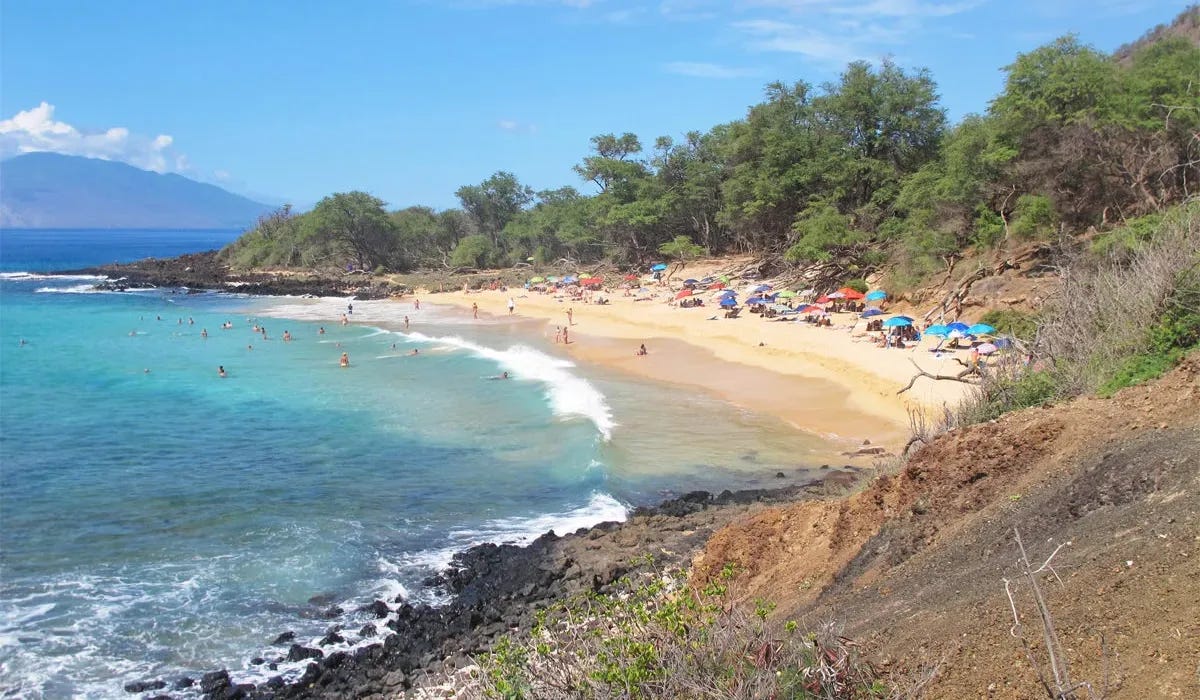
MAUI — An upcoming public hearing could shape the future of one of Maui’s most-used shoreline parks—and Little Beach, its clothing-optional beach tucked behind the headland, which has operated that way for more than five decades.
The Maui Planning Commission will consider a Special Management Area permit tied to the state’s proposed “Mākena State Park Improvements” project, a plan drawing growing alarm from local advocates who say it would fundamentally change how the park is accessed and used. The fight isn’t specifically about Little Beach—it’s about Mākena as a whole. But what happens to the park happens to the beach.
The proposal, advanced by the Hawaiʻi Department of Land and Natural Resources, calls for large comfort-station buildings, outdoor showers, and a reconfiguration of parking areas that would replace the current informal, unstriped lots with paved and managed alternatives. On paper, it’s an upgrade.
Opponents read it differently. The redesign, they argue, would push Mākena away from its open, walk-in character toward a more controlled model—fewer access points, less parking flexibility, and the groundwork for reservation-based entry. A three-page report circulating under the “Save Mākena State Park” banner frames the permit as the first step toward something like Hāʻena State Park on Kauaʻi: advance reservations, timed entry, capacity caps. The DLNR has not publicly confirmed that outcome, but the comparison has become the lens through which opponents are reading the plan.
Some of those elements are specific. The current proposal would eliminate more than 100 natural parking spaces—while canceling a planned expansion of 104 additional spaces from a 2013 planning document—for a net loss, advocates calculate, of over 200 spots.
Organizers are urging supporters to frame testimony around access, parking, and the park’s wilderness character—deliberately avoiding references to Little Beach or nudity. The approach is strategic: a broader argument about public access is more likely to resonate with decision-makers than one tied to a specific use of the park.
Little Beach—tucked behind Big Beach at the park’s north end, accessible only by scrambling over a lava rock headland—has functioned as a clothing-optional space for more than five decades. It has never been formally designated as such. Nudity is, technically, illegal there, as it is throughout Hawaiʻi’s state parks. But decades of relative tolerance and the beach’s natural seclusion created a de facto arrangement that held until COVID enforcement swept it away. In late 2020, DLNR officers conducted sweeps of the beach; by January 2021, signs and fencing had been installed at the trail entrance to formally close it. The closure’s stated rationale was pandemic behavior—crowded drum circles, no masks—but DLNR also signaled interest in more permanent solutions. The gate came down, and Little Beach has since returned to something like its former equilibrium. The underlying question of who controls access, and how, was never actually resolved.
The improvements project doesn’t target nudity. It doesn’t need to. Managed-entry parks concentrate oversight. Fewer entrances and tighter parking controls reduce the foot traffic and spontaneity that informal spaces depend on. Even without new prohibitions, the margin for informal use shrinks.
How to be heard
In-person testimony will be held at the Planning Department Conference Room, Kalana Pakui Building, 250 South High Street, Wailuku.
Written testimony can be submitted to the Maui Planning Commission at mauicounty.gov/191/Maui-Planning-Commission. You don't need to be a Maui resident to weigh in. If you do write, the suggested arguments are centered on access, parking, and the park’s wilderness character—not the nudity. For those watching from afar, Little Beach’s future may depend on how that broader case is made. 🪐

