


I am a big baseball fan and historian. When I play trivia, I rarely miss a baseball question. I still collect cards and watch the “Twinks,” my usually pathetic excuse for a team, the Minnesota Twins. My first baseball memory was watching the 1973 World Series at age seven—the same year the American League instituted the designated hitter, which I have resented ever since. I still believe AL pitchers should bat.
I caught a baseball thrown by Bert Blyleven, a legendary Twin and Pirate with two World Series rings and a Hall of Fame plaque. I heard stories about the greats of the Thirties and Forties from my grandfather, who met many of them while working for the Forest Service and training as a teacher down the road from Hall of Famer Burleigh Grimes’ cabin in the Wisconsin Northwoods—Pie Traynor, Dizzy and Daffy Dean, and Frankie Frisch. I even wrote a chapter in a book about Grimes, the last legal spitballer in major league history. Grimes was a nice man in person and a deeply imperfect one otherwise: married five times, reputed to have a woman waiting in every National League city, suspended a year as a Dodgers manager for spitting on an umpire, and happy to throw at hitters, managers, umpires, and the occasional fan in the stands. Such was his schtick. Pete Rose, whom I loved to watch and once saw hit the first home run in the Metrodome, is barred from Cooperstown for betting on his own team. The greats, it turns out, are rarely simple. This essay, however, is not about baseball.
As of this writing, there are fifty-six members of the AANR-sponsored “Nudist Hall of Fame.” As a historian, I know most of the first half of the inductees and, sadly, have not heard of many of the recent ones. The recognition—I am not sure one should call it an “award”—was first given in 1964. That inaugural class included three people: Kurt Barthel, Ilsley Boone, and Alois Knapp. Both Boone and Knapp had, within twelve years of their enshrinement, snubbed their noses at the A.S.A. (now AANR) and given up their membership. Barthel had by then moved to California and joined Oakdale Guest Ranch, which was not an A.S.A. club; I am not sure he ever joined the American Sunbathing Association at all. As the founder of organized nudism in America, he surely deserved to be enshrined regardless. The other two are an essay for another time.
The fourth inductee, in 1965, was Rudolph Johnson—the great-great-grandfather of the publisher of Planet Nude—and I will defer his biography to him.
Like the baseball greats, many of the “greats” of nudism are imperfect people, and in some cases deeply imperfect people. The founders of American nudism include a Soviet agent, eugenicists, and a few men looking to make a fast buck. Even the inductees, supposedly the best of the best, are deeply flawed. Some are so flawed I cannot get my head around why they were elected. One inductee had between nine and thirteen wives (estimates vary, depending on which friend you ask), killed a woman, and appears to have defrauded some investors. Many had disowned the very organization—the ASA/AANR—that would later honor them.
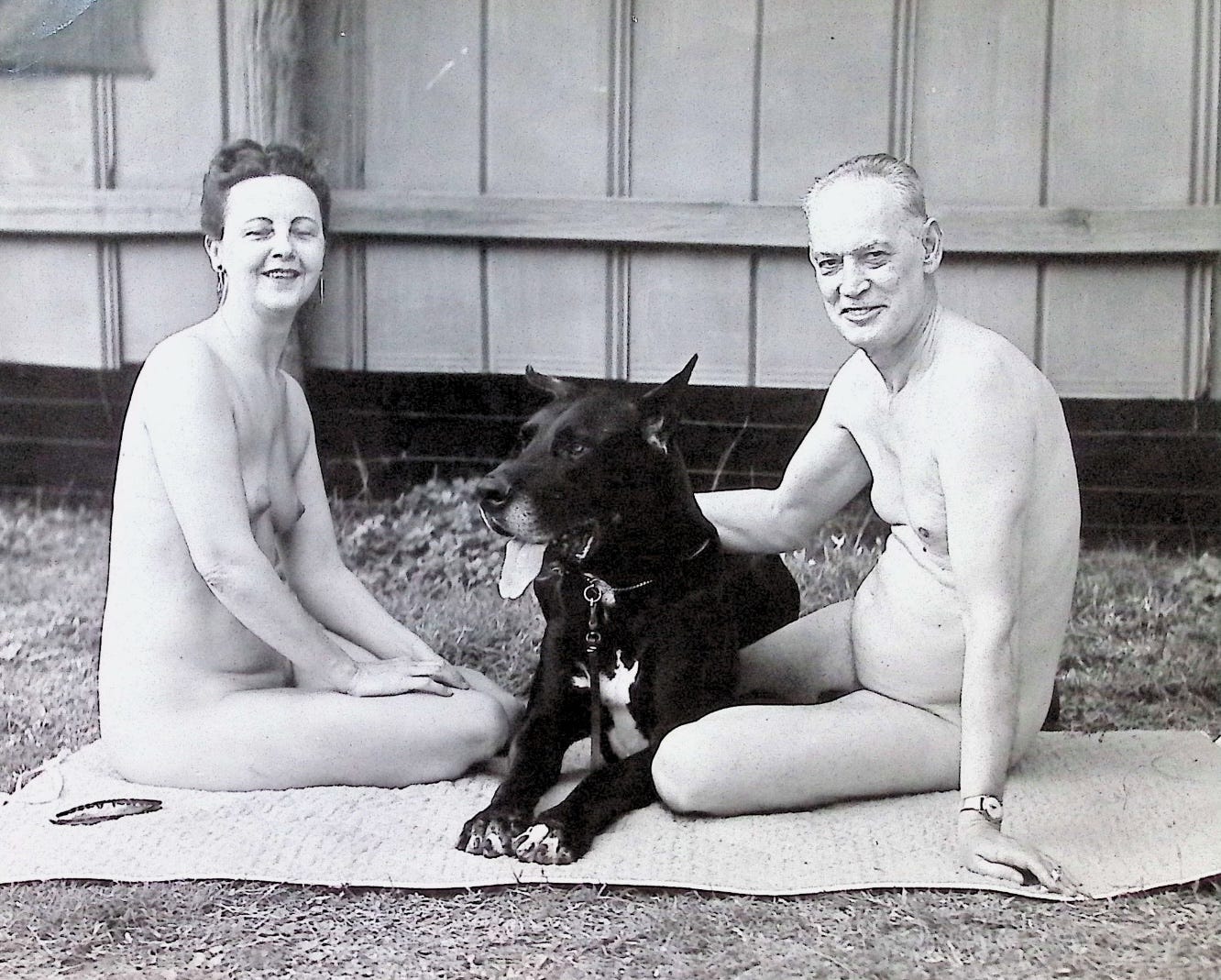
One of these men is Norval “Pack” Packwood. Pack was the executive director of the American Sunbathing Association from 1950 to 1962. He succeeded Ilsley Boone, who did not go away willingly. When Packwood took over, the post itself was renamed: “Executive Secretary” became “Executive Director,” and Boone was made “Executive Secretary Emeritus” for life. So Pack was the first to hold the directorship, stepping into the role Boone had built and guarded for two decades.
Uncle Danny’s iron grip on the organization caused the 1951 convention turmoil, where two presidents and two boards of directors were elected at an infamous gathering in Pennsylvania. The two sides ended up in court—the A.S.A. versus the A.S.A., the organization suing itself. The judge excoriated Boone for the shoddy structure he had drafted, put the organization into receivership, and forced a special master to run a 1952 convention that elected new officers, a new board, and new bylaws. Packwood led the side that won. The Boone group—Alois Knapp, Edith Church, and others—took their ball and went home, splitting away into the National Nudist Council. Mervin Mounce was elected ASA president at that court-supervised meeting, 1,457 votes to 432.
The Packwoods were living at Sunshine Park in New Jersey, which Boone owned, so Pack and Myra were forced to move a few miles down the road, where they bought a piece of land and developed it into a new venue they called Pine Forest. When Packwood began as director, the A.S.A. had about two thousand members; by 1962, it had ten thousand. One reason was Packwood’s push to have the A.S.A. sponsor the film Garden of Eden, shot at Lake Como, as a way of marketing nudism to the outside world. It worked—and, for many at Lake Como, probably worked too well. He also convinced Mounce to set up Outdoor Publishing in Spokane to expand the available nudist titles, after Boone persuaded the U.S. Supreme Court in 1958 to allow nudist magazines into the mail.
When Mounce flew home from the 1961 ASA convention, he decided a new national organization was needed. He and Pack began writing letters and editorials, mostly about the A.S.A.’s lack of a financial cushion to support affiliated clubs in legal fights. In 1961, Lake Como had largely fought alone to keep Pasco County from licensing nudists. Art Cotterill (“Cot”) had even been arrested for practicing nudism without a license—a deliberate test case meant to carry the law to the Florida Supreme Court. The case was overturned at great expense, but it also made Cot something of a hero. That, plus Lake Como’s size, made him the new kingmaker in the ASA, controlling the biggest block of votes.
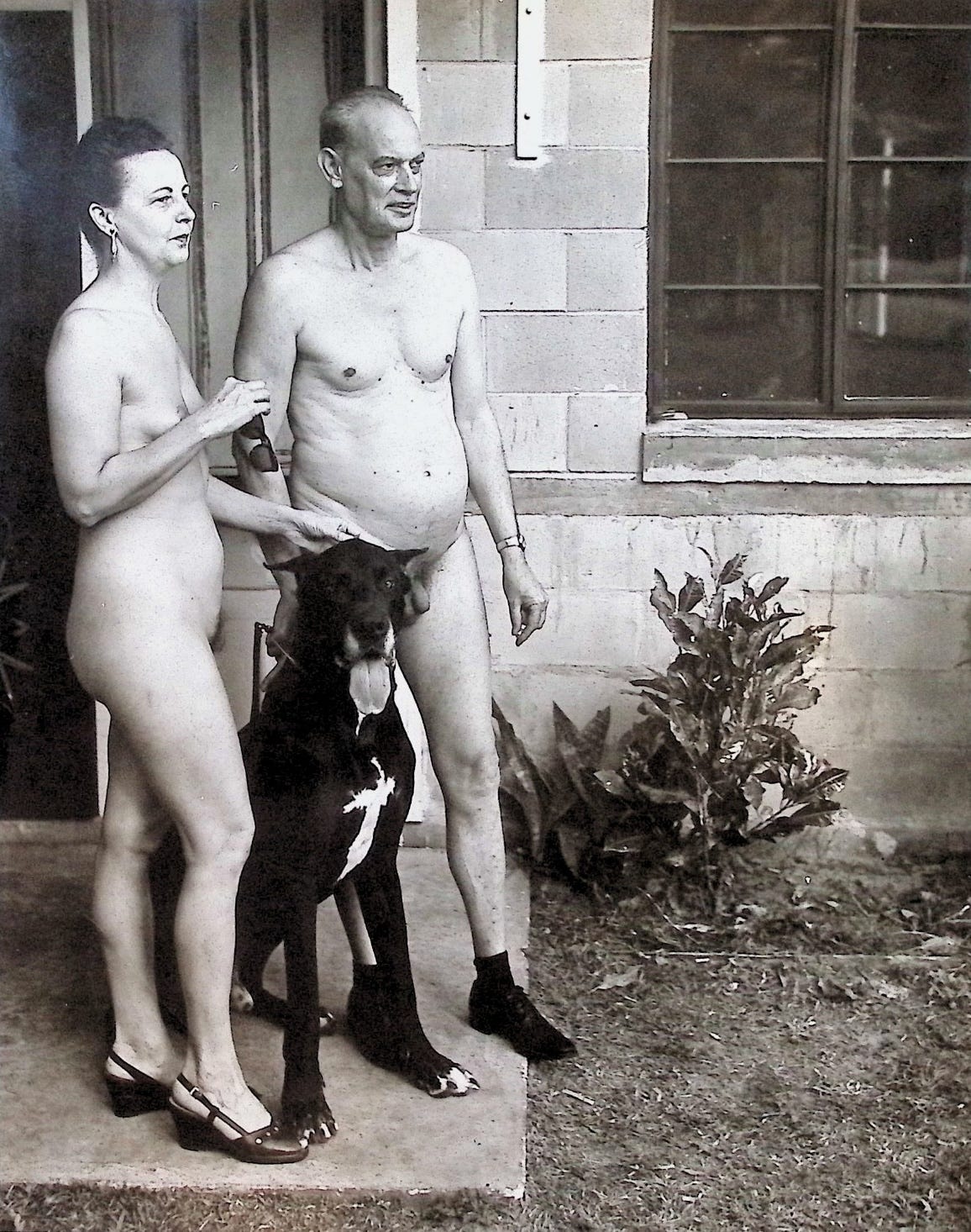
Stating their intention to form a democratic organization (a pointed knock against Cot) with the financial means to support its members’ legal needs, in February 1963 both Packwood and his club Pine Forest, and Mounce’s Sunshine Country Club near Spokane, became the first two charter members of the new American Health Alliance, breaking with the A.S.A.
There were now three national nudist governing organizations. Every A.H.A. member club was a privately owned operation, and—true to their word—$25,000 was set aside as a mutual defense fund. (Mounce, for one, would later denounce co-op clubs in his writing, though he never fully explained his objection.) Temporarily, before the N.N.C. moved to Ohio, all three national groups were based in New Jersey. The A.H.A. admitted only privately owned camps and resorts.
It took the pair just ten years to come full circle. Just as in 1952, when a past A.S.A. president (Knapp) and a recently deposed executive director (Boone) denounced the A.S.A. and pulled their two camps, Zoro and Sunshine Park, out to form the N.N.C., Packwood and Mounce now did the same thing. Like Boone, Mounce had built a significant publishing empire—Nudist Leader, Eden, Paradise, The Naturist, Nude World, and others, largely overlapping one another. Eden was produced in concert with Ed Lange of California. Mounce’s publications were now sponsored by the new A.H.A.
It is hard to put a flattering spin on the A.H.A. Mounce’s plan to market nudism to the masses through his publishing house did happen—and just after the A.H.A. started, Boone’s Sunshine Publishing went bankrupt in 1963 and liquidated in 1964. Sunshine & Health ended after its April 1963 issue, but it was hardly missed, given the proliferation of titles that—tacitly sponsored by the NNC, AHA, or ASA—pushed the norms of nudist decency.
After censorship loosened in 1968, Playboy, Hustler, and Penthouse soon outcompeted these low-budget productions for newsstand space. Since most of the readers were never true nudists, and there was a glut of material, demand for the nudist issues collapsed under far too much supply. When the nudist-magazine craze ended around 1970, the publishers stopped nearly all of them. Packwood wrote that Mounce’s Outdoor Publishing refused to print the sexualized material the buyers craved—though later issues of Eden and the other Lange-assisted titles look plenty sexualized to me. Packwood believed one of the leading on-ramps into nudism had closed, and worried that nude beauty contests and wet T-shirt nights would take its place, since there was no longer an easy way to market a club. The A.S.A. kept publishing The Bulletin to its existing members, but it was a black-and-white newsletter. About the only way converts now found their way to a camp was through newspaper classifieds or big events like the Miss Nude pageants—which, he wrote, tended to draw the wrong sort of crowd.
Disgruntled, Packwood sold Pine Forest in 1971 and retired, complaining to Alois Knapp about the state of nudism. He also published the last Nudist Newsletter for the A.H.A. membership at the end of 1971, effectively abandoning them at year’s end. Over its nine-year run—though many members never seemed to realize their national organization was functionally dead—the A.H.A. never lived up to its billing as a democratic body with deep pockets. Mervin Mounce was its only president and Norval Packwood its only secretary-treasurer. Mel Hacker, of Oakdale, was the only director ever added. Many of the clubs that had joined quietly rejoined the A.S.A. or the N.N.C.
The last mention of the American Health Alliance anywhere is in a La Crosse, Wisconsin newspaper article from 1973, about a mysterious club to the north in Galesville called the Sol Vista Recreation Club. The piece opens: “This is not a sex or wife-swapping club as some people think … you should see the letters we get.” The founders of nudism had spent forty years trying to distance the movement from sexuality, and it took only a few years for that work to be thoroughly muddled. That is an essay for another day—but Packwood and Mounce certainly did not help the devolution, whatever revisionist history they offered later, or whatever an apologist might write on their behalf.
Did Pack do good things for nudism in America? Yes. Did he seek to enrich himself while leading a non-profit? Yes. Did he save the A.S.A. in 1951–52? Yes. Did he try to destroy it after 1962? Also yes. Does he deserve to remain in the AANR Hall of Fame? Well—at least he never killed anyone. It is hard for me to get my head around Norval Packwood, and harder still to understand why, in 1983, the people of the A.S.A. chose to honor him so soon after an organization he had built tried to subvert and possibly eliminate theirs. Curiously, Mounce was never selected for the Hall of Fame, while Ed Lange was, in 1987. One cannot really separate the two men’s accomplishments—or their detractions—except that Mounce lived in Spokane and Lange in California.
Dave Bancroft was a .280-hitting shortstop who played for five major league teams over fifteen years, and he is in the Baseball Hall of Fame. In my opinion—and I am not alone—he did nothing to earn it. He owned a cabin next to Burleigh Grimes’ on Yellow Lake in northwestern Wisconsin (the same lake whose nearby swamp nearly killed a young Bud Grant, the future Vikings coach, during the Armistice Day Blizzard of 1940). Bancroft was also a buddy of Frankie Frisch, the Fordham Flash, who spent his years on Cooperstown’s Veterans Committee making sure his friends got enshrined. Maybe the Nudist Hall of Fame is, or has been, a similar effort.
Later in life, both Pack and Mounce were asked to write a history of the A.H.A. Pack refused; Mounce said he would get around to it, and never apparently did. Maybe the two men recognized their error and felt guilty. Maybe Pack was embarrassed to write the truth years after being enshrined by the A.S.A. Mounce was said to be a quiet man, but he was a voracious writer, which makes his silence on his own history seem odd. I do not know.
I once doubted that my grandfather really used to hang around baseball greats. I assumed it was revisionist memory—until I confirmed that in 1935 he had indeed spent a fall and spring teaching in a two-room school a baseball throw from the cabins of two future Hall of Famers, in a year when the entire Cardinals team came up to visit. Did Dizzy Dean show him a changeup grip, and Grimes a spitter? It is easy, after all, to remember only what you want to.
Men and women like Boone, Church, Mounce, Packwood, and Knapp wanted it both ways. Their resorts, camps, and publishing empires were never intended to be non-profits, yet they complained about the lack of money in the non-profits meant to help them—while resisting any higher fees. Packwood, writing to Knapp in 1971, blamed the A.S.A.’s tolerance of alcohol at its affiliates as a major cause of the decline. I think approving the use of the A.S.A.’s name — and later the A.H.A.’s—on some rather sexploitative magazines was a much bigger issue. And I think setting up a competing voice in nudist governance was bigger still. Don’t get me started about Alois Knapp. 🪐
More by Olaf:


 | A guest post by
|
Fascinating reading. Sadly, we humans usually fail to appreciate our history and learn from our mistakes.
In today's crazy world, we, as nudists, need a singular, unified voice representing our interests and our concerns more than ever.
Let this be a lesson to us all.