

H&E Naturist changes hands, goes digital
After more than a century in print, the world’s oldest naturist magazine turns the page

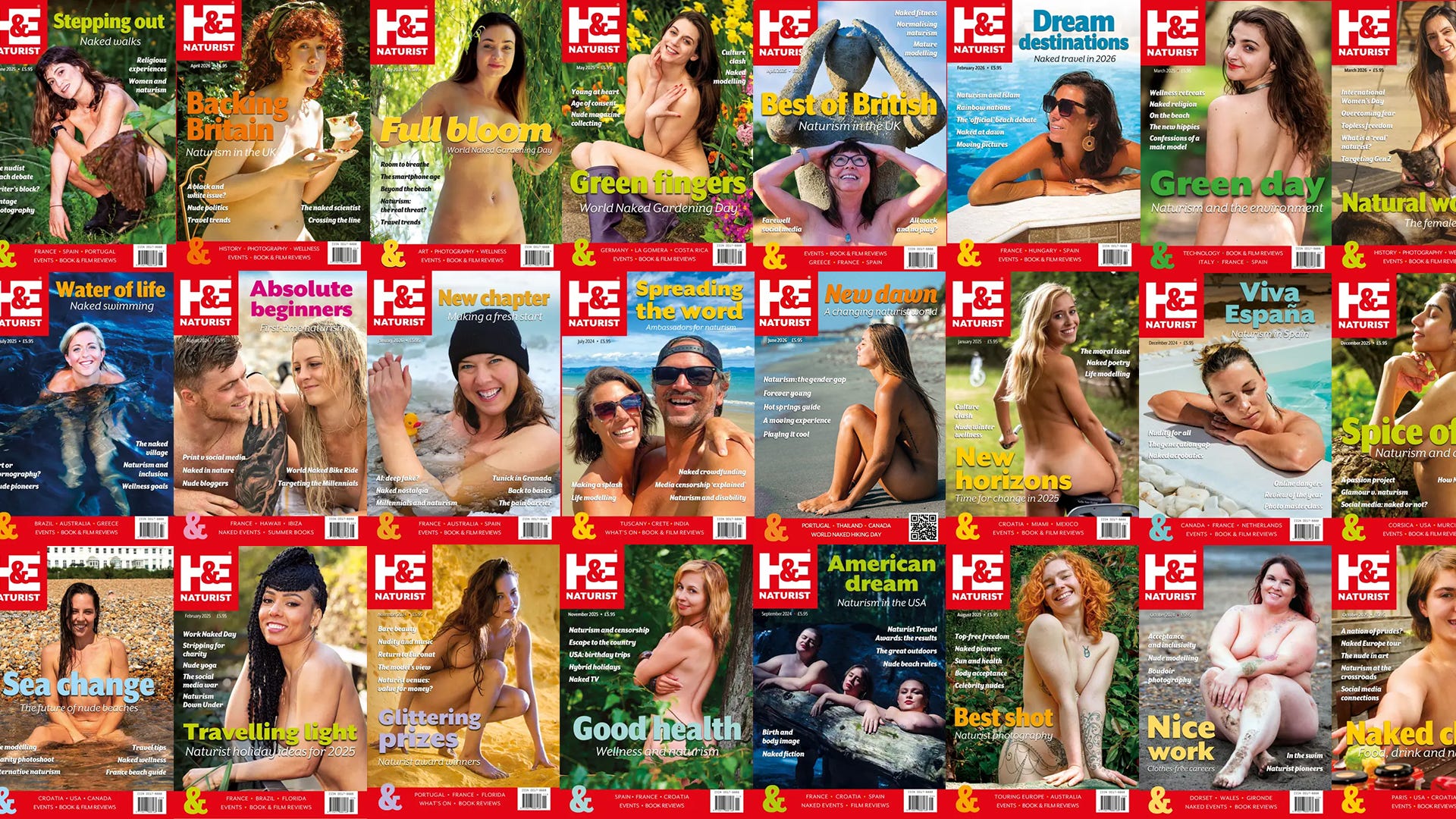
The world’s longest-running naturist magazine is under new ownership and ending its print run—simultaneously.
As of May 7, ownership of H&E Naturist transferred from Hawk Editorial Ltd, long helmed by Sam Hawcroft, to EJS Communications Ltd, a company owned by editor Paul Rouse and his wife and business partner Kate Rouse. Rouse, who has been involved with H&E for 19 years and has served as editor for the past four, continues in that role and assumes the publisher title as well.
The ownership change comes with two significant announcements. Beginning with the June issue, available online June 1, H&E will be a digital-only publication, ending its print edition after a continuous run that is unmatched in the history of nudist publishing. Beginning with that same issue, the magazine announced it will also no longer carry adult services classifieds or personals. “We do not feel that this content has anything to do with genuine naturism,” Rouse wrote in a statement accompanying the announcement.
The economics of the print decision are straightforward. Subscriptions declined significantly after COVID, distribution costs rose, and a specialist title on a relatively small print run couldn’t sustain it. H&E has offered a digital edition alongside print for some time, so the readership was already there. The digital edition will continue through Pocketmags, with archive access dating back to 2007.
The move also reflects where naturist media broadly has been heading—though H&E is going further than most. British Naturism’s quarterly BN Magazine—the closest peer H&E has in its home market—offers members both print and digital editions, with a digital archive going back to 2004. Across the Atlantic, AANR’s The Bulletin and The Naturist Society Foundation’s N Magazine have both added digital editions while maintaining print. Podcasts, blogs, and digital-only publications like Planet Nude have built substantial audiences and a larger nudist media ecosystem entirely outside the print world. H&E is now making the commitment those organizational titles haven’t: dropping print altogether.
H&E is also the oldest among its print contemporaries. The magazine’s official founding claim is 1900, though publishing historians have placed the actual date closer to 1902, when a British health publication called Vim first appeared. It became Health & Vim, then Health & Efficiency in 1918, covering diet, exercise, and herbalism before nudism was anywhere in the picture. Whatever the correct founding date, no other nudist magazine still publishing comes close to this run. By the 1920s, as British sun clubs began to form, the magazine was already championing the nudist cause, running reader letters, articles, and photographs. By the postwar era it had absorbed several competing naturist publications and earned a reputation as the nudist bible.
That the magazine is still here, still publishing, and now navigating a digital transition under committed new ownership is itself a remarkable fact. Rouse, for his part, seems clear on what he's inherited. “H&E has always been about more than nudity,” he wrote. “At its best, it represents freedom, confidence, nature, travel, culture, friendship and the simple pleasure of being comfortable in your own skin.” 🪐
Health and Efficiency and The Farmer’s Almanac gone from print in the same year. That long 20th Century really is over.
Will they digitize the older issues? I’m talking about before they even digitized as an option.