


The club is named for a wind. The chinook is the warm "snow-eater" that rolls down off the Rockies and can lift a January afternoon in southern Alberta forty degrees in an hour, melting the drifts and baring the ground. It is the right emblem for a club that has been buried and thawed out again more times than most survive: chased off rented farmland, flooded off its first owned acres, and in 1990 evicted from the ranch it had held for a quarter-century—and back on its feet each time. Seventy-plus years on, the members still drive out past Sundre in summer and still swim, in the dead of an Alberta winter, in a rented Calgary pool. Here's the place, and the wind it was named for.
The Place
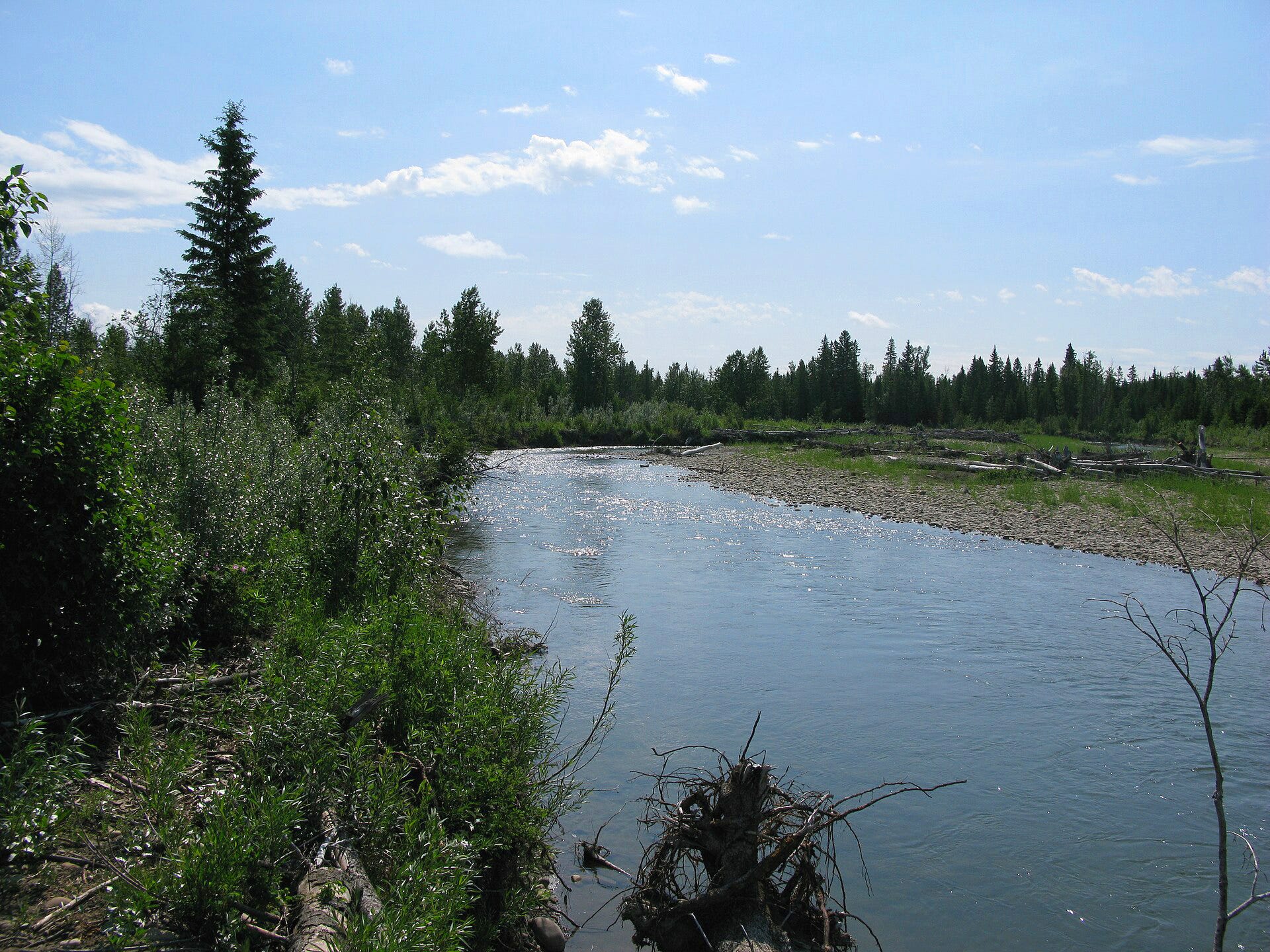
The current grounds are a roughly 7-hectare parcel (18.5 acres as purchased in 1992), mostly wooded, about 12 km (7½ miles) north of Sundre in the Rocky Mountain foothills—roughly an hour and a half, or some 145 km (90 miles), northwest of Calgary. The defining feature is the James River, which the property fronts for about a quarter-mile and which supplies the club's informal river "nude beach." The plant is deliberately modest and camping-oriented: a clubhouse of about 110 square meters (1,200 square feet), a wash house with hot-water showers, RV sites with water and 30-amp power, a central sanitary dump, a hot-tub gazebo, an outdoor shower, a rental cottage, and a community garden of roughly 280 square meters. The season runs summer camping plus a winter that never fully closes—the club has kept up monthly nude swims at a rented Calgary pool since the late 1960s.
The Story
Sunny Chinooks begins with a name and a wind. By the club’s own account in Going Natural (Fall 1989), “a group of nine people decided it was time to make the club official and chose the name of Sunny Chinooks Association” in June 1952, affiliated with the American Sunbathing Association, and obtained a charter. The earliest primary trace matches that to the month: a Sunny Trails “Group Roll Call” for June 1952 records the decision in the club’s own voice—”We have decided to call our club the Sunny Chinooks and apply for registration under that name.” The early organizers were Bob and Jean Stratychuk of Calgary, Jean serving as first recorded secretary. The name honours the chinook wind; later AANR-era accounts credit Ray and Mildred Connett—the founders of California’s Glen Eden and themselves products of the BC scene—with suggesting it, though the 1952 source shows the club naming itself.
For its first years the club had no land and moved constantly: a 1952 site on “Mr. Cox’s farm on the Banff highway,” then a lease at Priddis and a purchase at High River, each lost in turn. The strain nearly finished it. Its own 1962 history records a 1958 collapse during which “we changed the name to San Helios in hopes that recent trouble would be forgotten.” The revival came in 1959, when Rod Flack—a member since 1956—was elected president, dropped the San Helios name, and restored the original.
