



In 1980 a poet named Harold Dull floated a student in the warm pool at a half-ruined Victorian spa in the Mayacamas Mountains, applied the shiatsu stretches he'd learned in Japan, and invented a form of bodywork now practiced in more than forty countries. That is the kind of thing that happened at Harbin. It was never a nudist club—never joined a federation, never held a convention, never elected an Outdoor Club Person of the Year—and it became, for several decades, the most recognizable clothing-optional place in Northern California anyway. The Lake Miwok called the site eetawyomi, the hot place. Here's the place, and the improbable community that rose out of its springs and burned down with them.
The Place
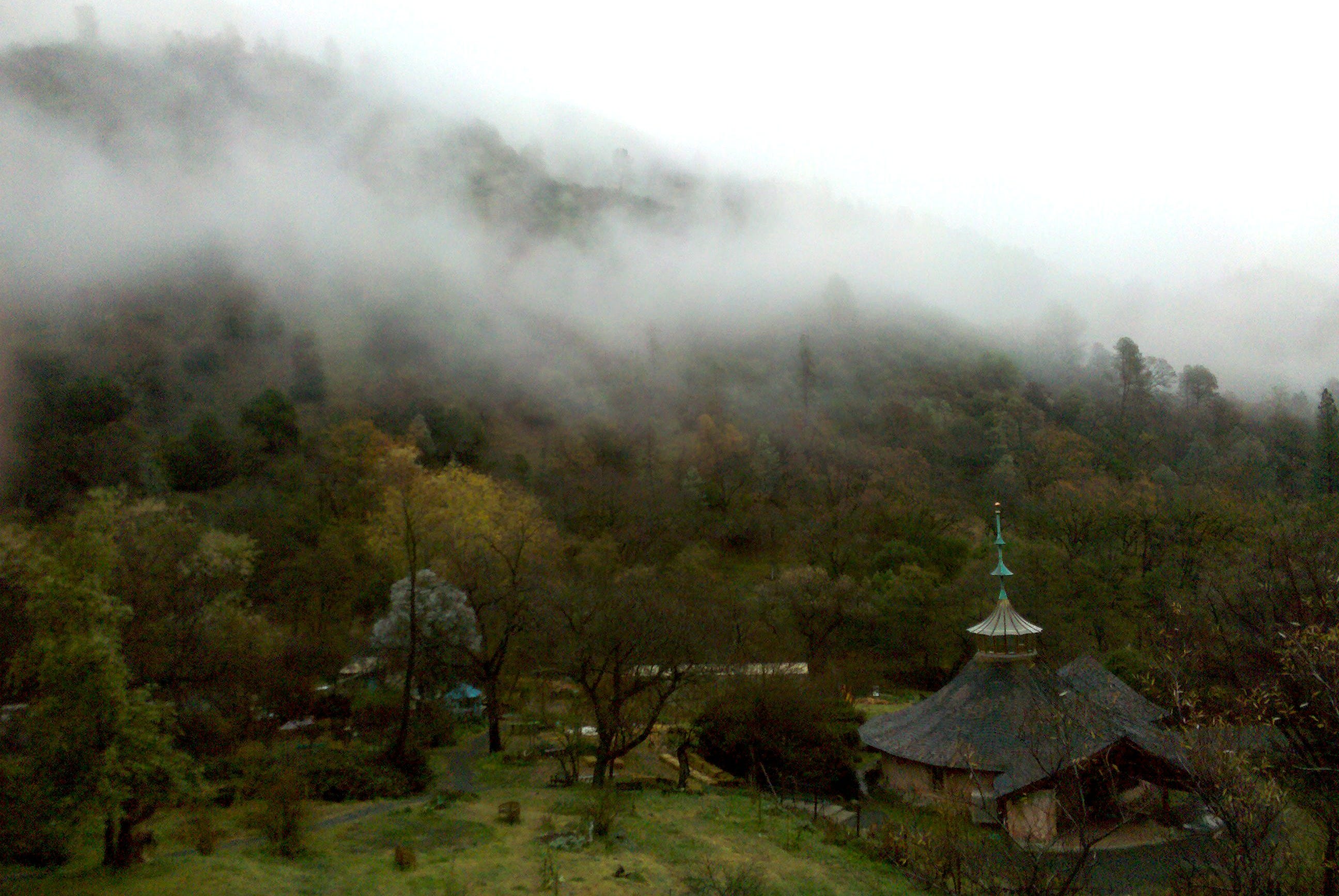
Harbin sits in a high mountain canyon about two miles up a winding road from Middletown, in Lake County, roughly ninety miles northeast of San Francisco and just north of the Napa wine country. The terrain climbs steeply—visitors have reached for the same comparison for forty years, that you approach it the way you'd approach Delphi, walking upward through ascending foothills toward a sanctuary. The land runs from chaparral into open pine and oak forest, carved, as one account put it, from ancient volcanoes and the constant friction of the continental plates. That geology is the whole point: the same fissures that make the ground restless heat subterranean water and push it to the surface as soda, iron, and sulphur springs.
The Story
The springs were sacred ground to the Lake Miwok, who used eetawyomi for centuries before white settlement. By the tradition Harbin itself keeps, the paths to the springs were held as neutral territory—members of all nations knew they could come, use the healing waters, and abide in peace—and indigenous people gathered at a creekside “Grandmother’s Circle” for ceremony. After the Miwok were pushed out under Spanish and Mexican rule, the canyon passed through a series of land-grant owners more interested in ranching than soaking. An American, Archibald Ritchie, took over the grant in the 1850s and is said to have “discovered” the springs just before his death in 1856. James M. Harbin, who came to California in 1846, acquired the land in his wake and gave his name to both the water and the mountain above it; sources credit him with the springs from 1852 and place his buyout of a partner in 1860. In 1865 he sold to two Welsh immigrants, Richard Williams and Hugh Hughes, who saw the commercial possibility. By 1869 they could house a hundred guests, and around 1870 Williams formally established the Harbin Hot Springs Health and Pleasure Resort, a large hotel built on the slope below the springs, advertised as Northern California’s answer to Marienbad or Saratoga.
For the rest of the century it ran as a fashionable Victorian spa. Guests came by stagecoach—nine hours from San Francisco—and later by rail and automobile; the heavyweight champions James J. Jeffries and Bob Fitzsimmons trained in its gym, boxers swearing the clean air and altitude gave them harder workouts than the city. Fire was the recurring hazard: most of the resort burned in 1894 and was rebuilt larger, with a gym and bigger pools. When Lake County went dry in 1912, Harbin kept serving liquor on the sly, a practice it reportedly carried straight through federal Prohibition, with illegal slot machines running in the hotel into the 1940s. Then the rail lines faded, the Depression and two world wars came and went, the resort burned again in 1943 and was rebuilt as a weekend getaway—now with gender-segregated nude sunbathing on the grounds. When the county attached the property for back taxes in October 1960, the hotel burned within days, and a tangle of claimants fought over the title through the early ‘60s. Harbin limped along as a resort until about 1966, then closed to the public.
