

Virgil Tibbs remains cool
Rereading John Ball’s 'The Cool Cottontail' through a nudist-history lens

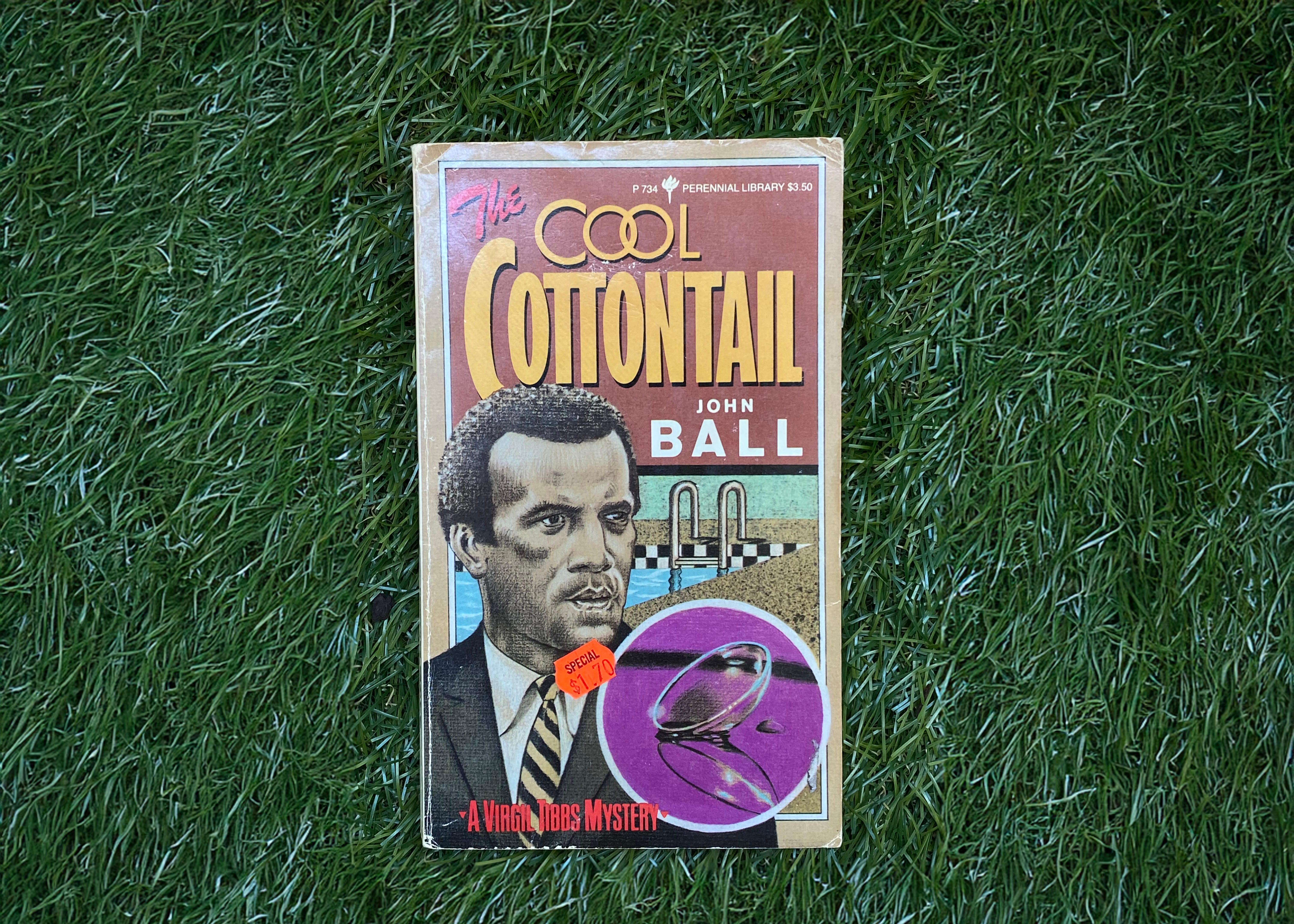
The Cool Cottontail is the second novel in the Virgil Tibbs series by American author John Dudley Ball, also known—less famously—by his nudist nom de plume, Donald Johnson. Compared to his award-winning In the Heat of the Night, it’s not surprising that Cottontail, first published in 1966, never achieved the cultural staying power as the former. Removed from the racial tensions of the deep south in In the Heat of the Night, and placed instead in a fictional nudist camp in Southern California called Sun Valley Lodge, this Virgil Tibbs detective procedural treads playfully into pulp territory.
Calling the novel pulp is not to say it’s a bad book. If anything, The Cool Cottontail is a brisk and engaging read, and in some ways a more compulsive page-turner than its better-known predecessor. The vintage 1960s southern California setting evokes all sorts of warm, nostalgic vibes. The plot centers around the investigation of a murdered “cottontail” who was found floating in a nudist camp pool. The titular cadaver is already “cool” to the touch, but the novel’s nudists—always portrayed as upstanding and good—attempt resuscitation anyway.
Detective Virgil Tibbs, true to form, is pretty cool himself—characteristically restrained and always holding his cards close to his chest throughout the investigation. As a confident Black police officer during the civil rights era, Tibbs represents an anomaly, a kind of moral litmus test for the people he encounters. Their reactions to him quickly reveal whether they are decent or cruel. This device can feel formulaic at times. It becomes easy to identify the bad actors by the way they prejudge Tibbs, and before long you may find yourself anticipating the story’s general trajectory.
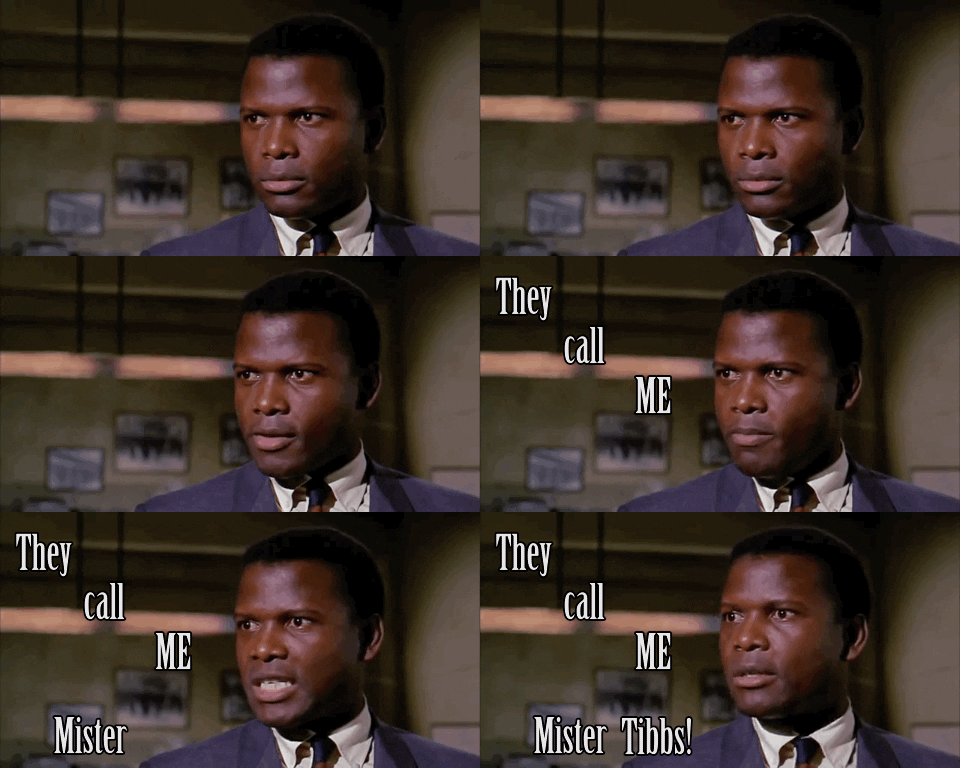
Still, if the plot occasionally feels transparent, the protagonist does not. Virgil Tibbs is a quiet figure, and when he does speak, his words carry weight. Popularly cemented by Sidney Poitier in the film adaptations, Tibbs emerged as one of the first Black detectives in American popular culture to command authority without apology or caricature. He is observant, patient, and perpetually underestimated—a combination that allows him to notice what others miss. Like Columbo and other great screen detectives, he reveals truths that were present all along, hiding in plain sight.
At the same time, Tibbs remains a figure shaped by the limits of his creation: a Black man navigating the civil rights era as imagined by a white author writing within it, rendered with dignity and care—and remarkably progressive for the time—but still filtered through a polished idealism where prejudice is present but manageable, and Tibbs’ intelligence and restraint are always enough to prevail.
Of course, in detective fiction, the hero must always ultimately prevail. In In the Heat of the Night, that victory is qualified and uneasy—Tibbs solves the case, but the deeper question lingers. Has anything truly shifted in the people around him, or are they even capable of change? The Cool Cottontail offers no such ambiguity. Its resolution is clean and affirming, a straightforward happy ending that leaves little emotional residue. One could imagine an even lighter denouement—Tibbs skinny-dipping alongside the nudists at Sun Valley Lodge—but that would run against his nature. Tibbs remains deliberately aloof.
The novel also allows itself a few twists. In one of my favorite moments, Tibbs gets to whoop some ass in a climactic karate fight before catching the killer. John Ball, trained in aikido himself, describes the action with delightful precision. Whether he’s writing for nudist magazines and reporting on the governance of organized nudism under the name Donald Johnson, or in his more commercially popular novels and novellas, Ball’s prose is as easygoing and unadorned as an actual nudist. Ball’s books—and Johnson’s alike—always tended to be short. The man wasted no time with frivolous adjectives.
Perhaps the downside to such precision prose is that some characters, particularly among the nudist community, feel broadly sketched, their goodness bordering on idealized. If the nudists seem flatly kind-hearted at times, at least one of them jumps off the page as a little more compelling. I’m referring to the character Linda Nunn, daughter of camp owners Forrest and Emily Nunn. She is described by the author very much in the image of real-life 1960s nudist figure Linda Shockley, who was the real-life daughter of real-life California camp owners.
The parallels between fiction and reality extend further. The novel’s fictional Sun Valley Lodge is a dead ringer for the once-popular Oakdale Ranch, even matching its location at the base of El Cajon Mountain north of San Bernardino. As a Southern California–based naturist myself, inhabiting the same physical landscape this book describes sixty years later—and with the benefit of some knowledge of nudist history—the novel reads like a fascinating time capsule. It’s a chance to see where Ball took inspiration for a story written during the golden years of nudism, set squarely in its western epicenter. Ball references streets in Pasadena that are minutes from my old apartment, presumably not far from where he himself once lived. If you’re familiar with Southern California AANR resorts, you’ll also catch nods to Glen Eden and Olive Dell, two clubs that are still around and still nude today—well, sort of. Olive Dell’s a long story, one with its own murder mystery.
While the book clearly benefits from treading in territory that was personally familiar to its author, Ball also appears to have either experienced or researched every facet of the setting. The result is a dynamic mystery that feels intimate and watertight. Like his hero Virgil Tibbs, John Ball is unyielding in the accuracy of his details, and focused above all on entertainment. The Cool Cottontail has lived on my shelf for years, and it will certainly be one I go back to and re-read every few years—with any luck, in close proximity to the Glen Eden pool. 🪐


Evan, Thank you for this piece and the previous one on John Ball. While in the Air Force, he was stationed in Alaska for a time and subsequently wrote a great boy's adventure book "Arctic Showdown". It is a fine example of how to survive in extreme cold. Also a great read about youth having to counter "adults" who think they know better than those who are well trained.
When I first read "The Cool Cottontail" I wanted to see it made into a movie. That was decades ago. I would have cast Helen Mirren and Harrison Ford as Emily and Forrest Nunn, the owners of the nudist club. HA, if it were made now they could still be cast in those parts.