


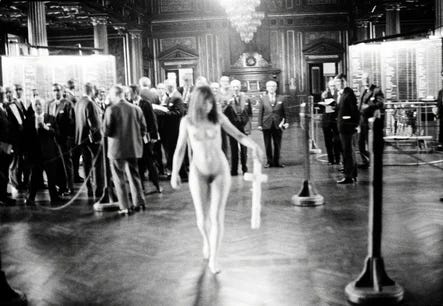
VALIE EXPORT made nudity into confrontation—and confrontation into politics. The Austrian performance artist and filmmaker died May 14 in Vienna, three days before what would have been her 86th birthday. She was 85. Her gallerist, Thaddaeus Ropac, said the cause was complications from a fall at her home.
Born Waltraud Lehner in Linz, Austria, EXPORT spent much of her early life rejecting identities imposed on her by family, religion, and the expectations placed on women in postwar Europe. Around 1967 she adopted a new name, styled entirely in capitals: VALIE EXPORT. Part nickname, part appropriation of an Austrian cigarette brand, the name itself was already an act of refusal.
She became internationally known for two performances staged in 1968. In Action Pants: Genital Panic, she walked through a Munich movie theater wearing crotchless pants, confronting seated audiences with the body they had come to consume at a safe remove. In Tap and Touch Cinema, she walked city streets with a curtained box strapped over her chest, inviting strangers to reach inside and touch her bare breasts—for no more than 33 seconds—while holding eye contact throughout. The response was not gentle: her work drew hate mail, death threats, and court charges of indecency. She was undeterred.
Her use of nudity was always precise—never incidental. In 1970 she had a garter belt tattooed onto her thigh before a live audience, a permanent inscription of patriarchal expectation onto her own skin. In 1971 she rolled naked on shards of glass, forcing a confrontation between the idealized nude of the male gaze and its painful reality. EXPORT understood nudity not as decoration but as a site of power, projection, shame, and control—a place where the politics of looking itself could be exposed and contested.
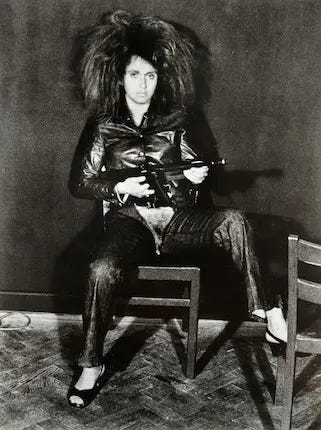
That tension remains strikingly contemporary. Long before social media, surveillance culture, and AI-generated imagery transformed the politics of representation, EXPORT was already asking who controls the image of the body and what happens when the body refuses passive consumption.
Her work existed in a different tradition than organized naturism, but it moved through the same cultural fault lines: censorship, bodily autonomy, public nudity, and the assumption that the unclothed body is inherently obscene. Where naturism often seeks normalization, EXPORT sought confrontation—though for her, confrontation was never separate from liberation.
Her career extended far beyond her most famous performances. She published “Women’s Art: A Manifesto” in 1972, co-founded the Austrian Filmmakers Cooperative, and represented Austria at the Venice Biennale alongside Maria Lassnig in 1980. In 2017 she opened the VALIE EXPORT Center Linz, dedicated to media and performance art archives. Near the end of her life she reflected that her work would face even greater suppression today—that the struggle for an authentic representation of women’s bodies was far from finished. 🪐
Hmmmm!