

The truth-telling time capsule
Sixty-five years later, Doris Wishman's argument is still unfinished

Editor’s Note: Planet Nude has previously published a review of Diary of a Nudist (1961)—Brett Marcella’s close reading of Doris Wishman’s filmography, written as a fan and critic. This piece by Dustin comes at the same film from somewhere else entirely, part cultural argument, part queer history, and part personal essay. A film this strange can hold more than one reading.
Haven’t seen it? We’re screening Diary of a Nudist live on Discord next Friday, May 15th. Doors open with trivia at 7:15pm (Eastern Time / 4:15pm Pacific); film starts at 7:30pm. Watch a nude movie in the nude, with other nudists. There are worse ways to spend a Friday.
Sixty-five years ago, a low-budget film shot at a Florida nudist resort was considered so dangerous it required elaborate legal cover just to be screened. A 1957 New York Appeals Court ruling had loosened restrictions enough to allow films depicting nudism in theaters — but only if they carried implied educational merit. Doris Wishman, a recently widowed New Yorker who had borrowed money from her sister to start making movies, understood exactly how to use that loophole. The result was Diary of a Nudist, a 72-minute argument dressed up as a scandal.
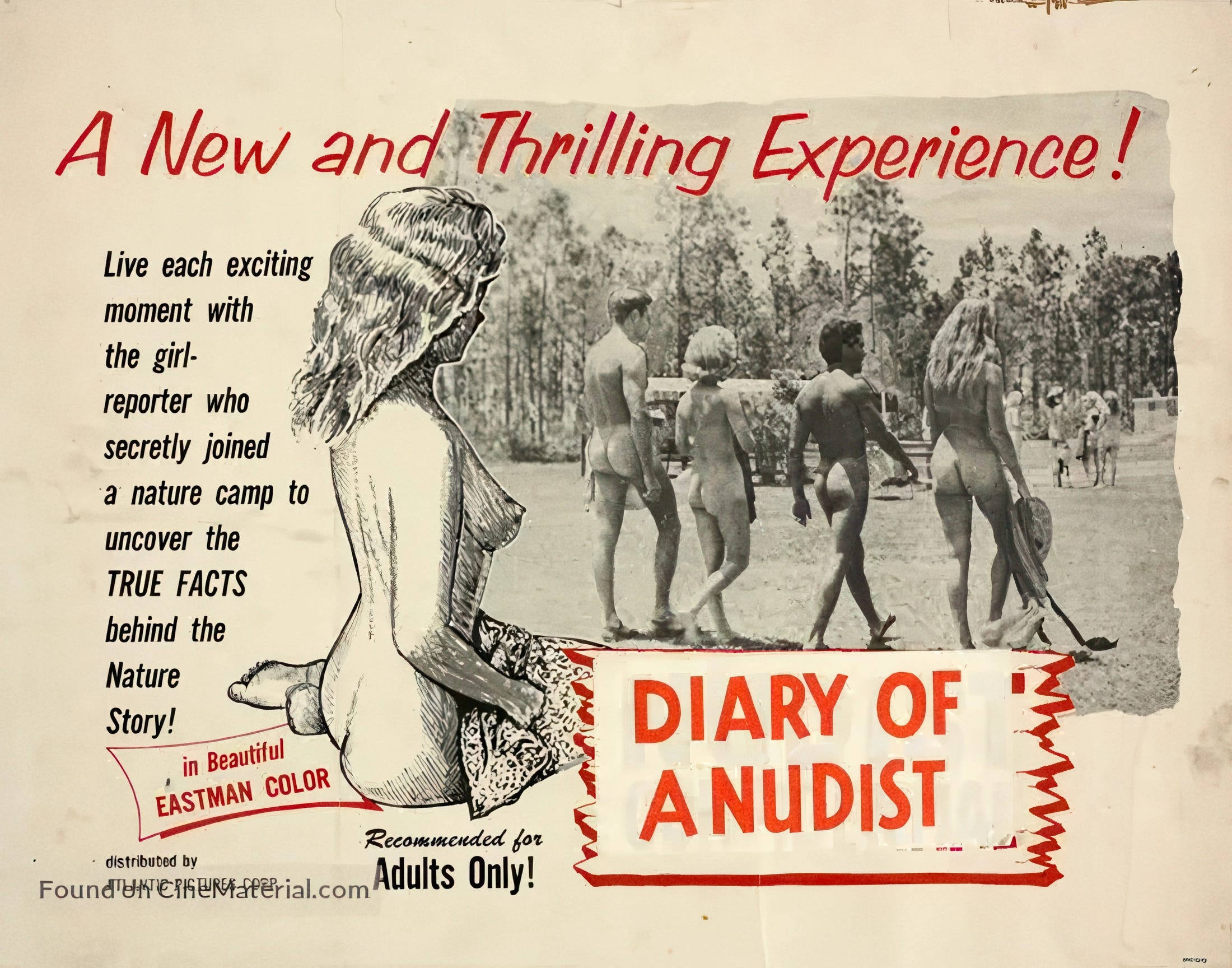
Watching it now, as a gay naturist, is a disorienting experience. Not because it’s shocking — but because it is so thoroughly, almost defiantly, not.
The plot is simple: a newspaper editor stumbles upon a nudist club and assigns his best reporter, Stacy Taylor, to infiltrate it and write a damning exposé. Stacy becomes convinced of the sincerity of the nudist philosophy, refuses to file a negative report, and the editor eventually joins the club himself. Two skeptics walk in and come out converts. It will not surprise you.
But the predictability is almost the point. Beneath its creaky mechanics and post-dubbed dialogue, Diary of a Nudist is making a sustained, deadpan case for the radical normalcy of the human body. The film opens with a figure reciting the credo of the American Sunbathing Association — asserting that sunshine and fresh air produce genuine physical and mental benefits. Film historian Elizabeth Purchell has described this as a deliberate legal maneuver, a classic exploitation-era “square-up” designed to give censors an educational justification for what follows. It worked. Watching it today, it also reads as a thesis statement.
As Wishman biographer Michael Bowen has noted, nudism at the time was, in some ways, a sexually conservative ideology. People at nudist clubs weren’t supposed to become aroused. They were there to reconnect with their bodies as a natural fact rather than a charged one. That framing sits oddly against the film’s reputation as a skin flick — but it’s also exactly what the film depicts. People play shuffleboard. They drink coffee. They throw pebbles into a stream. In one of the film’s most telling scenes, two men relaxing poolside are approached by an attractive woman. They give her a few polite words and go back to discussing the Dodgers. Wishman plays it for a gentle laugh. The subtext is the whole argument: in a naturist space, a body stops being a distraction.
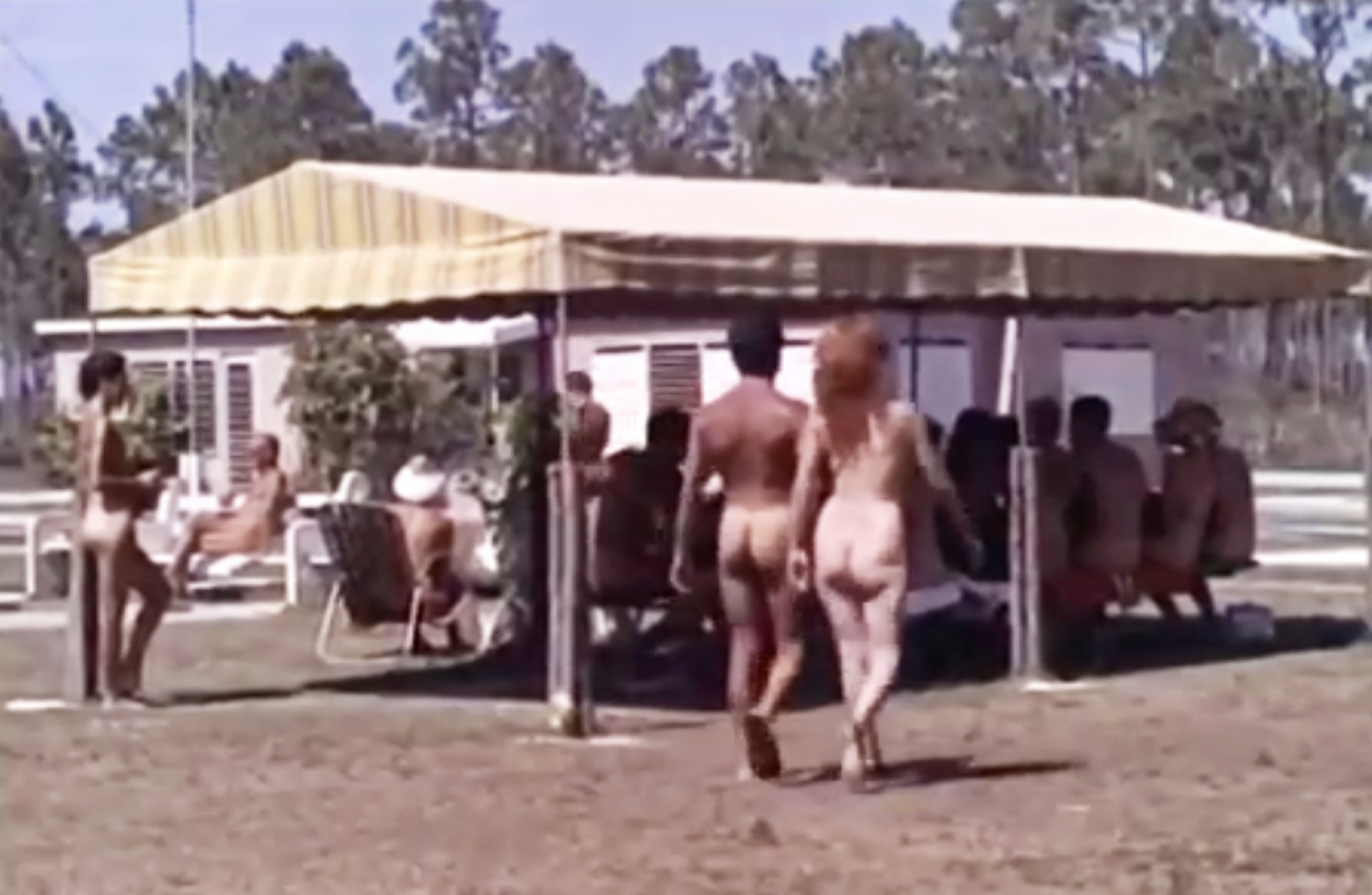
As a gay man, that argument lands differently than it might for others. The gay male body has spent decades being weaponized in the culture — alternately hypersexualized and criminalized, held up as evidence of deviance or desire depending on who was doing the framing. Naturism, for me, has always been a corrective to that. A space where the body is neither spectacle nor accusation. Watching Diary of a Nudist, even through its considerable limitations, I felt a kinship with its central insistence: that undress is not inherently erotic, and that the conflation of the two is a cultural choice, not a biological fact.
Wishman’s wide-shot cinematography keeps a respectful distance from her subjects. The approach invites you to look without leering — less titillation than observation, almost ethnographic in its patience. There’s something genuinely generous in that, even now.
The technical limitations are real. Since the cast were amateurs, all dialogue was post-dubbed at Titra Sound Studio in New York, producing a dreamlike remove — not unlike a Godzilla picture where the mouths and the words have stopped cooperating. Censorship laws meant the camera was in constant negotiation with the human body, resorting to strategic shrubbery and elaborate angles to keep certain anatomy perpetually off-frame. There is a volleyball game between clothed and unclothed players that becomes almost avant-garde in its commitment to filming everyone exclusively from behind.
And yet. There’s something genuinely moving about a film that had to fight this hard just to say that a naked body in the sun is not a moral failing. In 2026, naturist content still gets flagged and removed from social media platforms that happily host far worse. Nudist venues still fight zoning battles with neighbors who have never set foot on the property. The argument Diary of a Nudist was making in 1961 has not been won. It has just moved to different platforms.
Wishman succeeded repeatedly in a male-dominated film industry at a time when almost no women were permitted to produce or direct at all. She didn’t wait for permission. She borrowed money from her sister and started making movies. That fact gives the film an additional layer when viewed today. A woman director, using the only genre available to her, made a film arguing that ordinary human bodies deserve to be seen without shame. The exploitation context was real. So was the argument.
Diary of a Nudist is not a great film. It is a curious, cozy, occasionally absurd film with a jazz-lounge soundtrack and a plot you can summarize in a sentence. But it is also a document of something that still matters: the long, slow, unfinished project of convincing a culture that bodies are not inherently dangerous. For a gay naturist watching in 2026, that feels less like history and more like homework. 🪐
We’re hosting a live screening of Diary of a Nudist on our Discord next Friday, May 15th (doors at 7:15pm ET / 4:15pm PT with trivia; film at 7:30).
A restored 35mm print is also available on the Vinegar Syndrome/AGFA Blu-ray set The Films of Doris Wishman: The Daylight Years. It’s also available to stream for free at archive.org
Notes
Purchell, Elizabeth. Commentary track on Diary of a Nudist. AGFA/Vinegar Syndrome, The Films of Doris Wishman: The Daylight Years, 2022.
Bowen, Michael. Interview with Terry Gross. Fresh Air, NPR, March 25, 1998. Archived at freshairarchive.org.
“Remembering Doris Wishman, a pornographer 60 years ahead of her time.” InsideHook, February 24, 2021.
“The female gaze of Doris Wishman.” Crooked Marquee, March 3, 2024.
“Wishman, Doris.” Senses of Cinema, Great Directors series, 2002.
Diary of a Nudist (1961). Directed by Doris Wishman. IMDb.
Wikipedia contributors. “Doris Wishman.” Wikipedia, last updated February 2026.
Wikipedia contributors. “Nudity in film.” Wikipedia, last updated April 2026.
This was on YouTube for a time
It is incredibly amazing that she made this film in 1961. I was just talking to my GF about becoming an adult in the 70s. Women couldn't have a credit card, buy a car or a hold a mortgage without a male cosigner. How were any women able to achieve success in such an unbalanced society.