

The thing about Naked Attraction
Why this controversial British dating show gets bodies exactly right


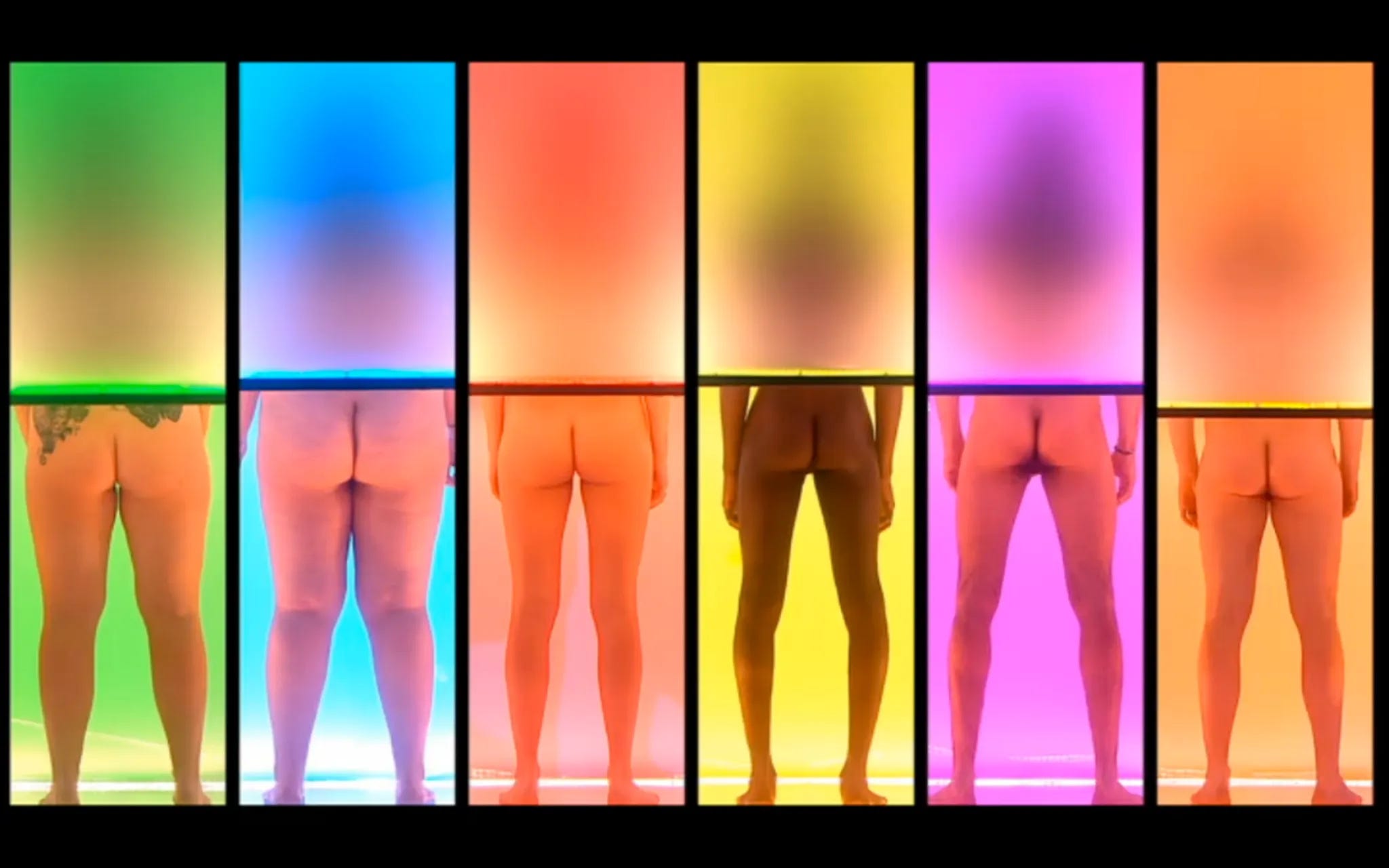
Let me paint you a picture. It’s late on a Tuesday and you’re scrolling HBO Max looking for something, anything, to turn your brain off after a long day. You stumble onto a show where six people are standing in colored pods, completely naked, while a single person slowly eliminates them one by one. The pods lift from the feet up. First the legs, then the torso, then the face. And somehow, improbably, you are absolutely riveted.
That’s Naked Attraction for you. The British Channel 4 dating show launched in 2016, landed on HBO Max in 2023 without so much as a trailer, and has been causing exactly the kind of pearl-clutching hand-wringing it deserves ever since. The Parents Television Council reportedly called for its removal, critics at The Telegraph asked “how low can this dating show go?”, and conservative watchdog groups lost their collective minds. Meanwhile, the rest of us have been watching it in our living rooms, alternating between laughing, gasping, and learning something genuinely new about ourselves and our bodies.
I’m here to tell you that the pearl-clutchers got this one wrong.
Here’s what critics keep misrepresenting: Naked Attraction is not pornography. It’s not even close. Host Anna Richardson — a clergyman’s daughter who also hosted Channel 4’s The Sex Education Show for years — presides over the whole thing with the matter-of-fact cheerfulness of someone who has genuinely made peace with the human body in all its strange and varied glory. The nudity is frank, yes. But it’s treated as a natural state, and different body types are celebrated throughout. If that sounds familiar to anyone who’s spent time in naturist spaces, it should.
The format is simple: a contestant picks from six prospective dates standing on a soundstage in individual color-coded pods. Their bottom halves are revealed first. One person is eliminated. The dividers rise further, revealing torsos, then faces and voices, until only two of the six prospects remain. For the finale, the original contestant strips bare in front of those two before choosing one person to date. There is something almost refreshingly utilitarian about the whole exercise. No one is performing a personality yet. No one is running a hustle. It’s just bodies, honestly present, waiting to be seen.
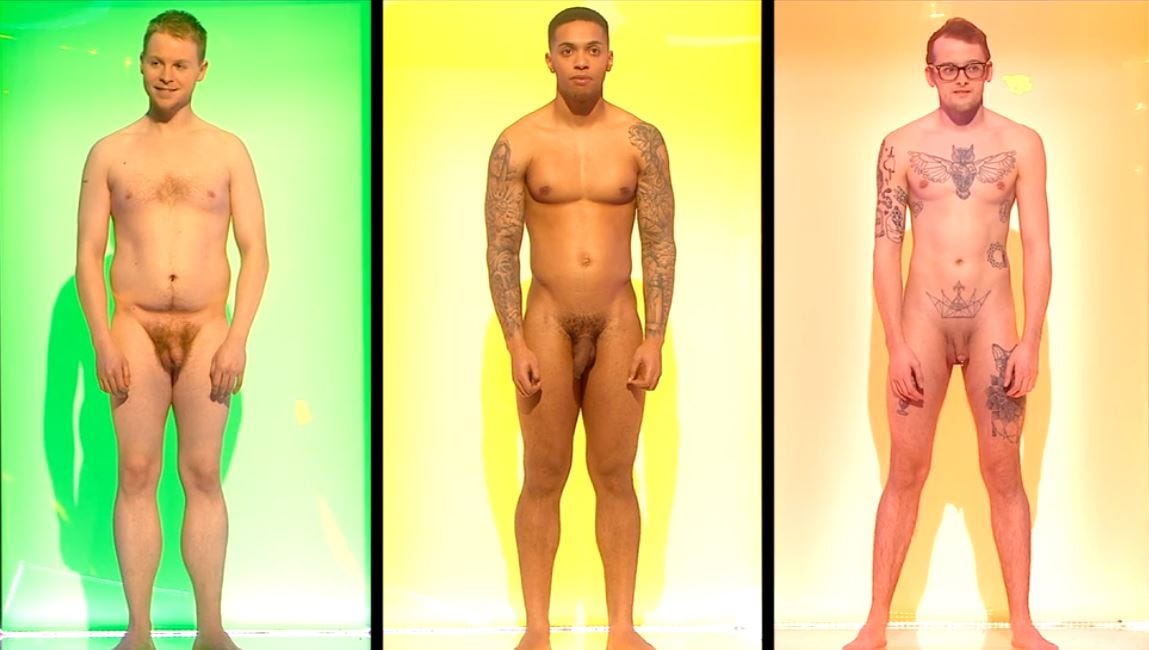
Those of us who’ve been clothes-free in communal spaces for years have always known something that mainstream culture is still slowly arriving at: when you remove clothing from an environment, you also remove a massive amount of social performance. What remains is something much more honest. And surprisingly, much less sexual than most people assume. The bodies on screen are real bodies — stretch marks, asymmetries, surgical scars, amputations, all the textures of a life actually lived in a physical form. More than one contestant lineup includes an amputee or person with some other disability. From a virgin to a polyamorous couple looking for a third, the show runs the gamut in representing different experiences with intimacy and attraction. Compare that to every other dating show on television, where everyone has apparently just stepped out of a fashion ad. The contrast is not subtle.
I want to be precise about the body positivity question because that phrase gets thrown around so casually now it’s lost half its meaning. What Naked Attraction does is something more specific and arguably more useful. The show treats its diverse cast as naturally chill — inclusive of sexualities, ages, skin colors, body types, and people with medical issues — and it doesn’t make any of that feel forced. That restraint matters. Performed wokeness on television tends to be more alienating than affirming. This show just puts real bodies on screen and lets that be enough. Woven into each episode are factoids, statistics, and taboo-breaking bits of information about anatomy, the history of certain sexual practices, trends in grooming and body hair, and tips for intimacy. That sex education component is earnest and if you go in without defensiveness, actually kind of delightful. Richardson delivers these facts with the tone of a slightly bawdy favorite aunt, and it works.
Honesty compels me to acknowledge that the show is not without its contradictions. If the concept is to normalize regular bodies and lead with physical attraction, the casting process complicates that somewhat. Producers still hand-select candidates, and there are patterns that suggest some degree of conventional TV logic at work behind the scenes. The show is imperfect. Television is a commercial product, and it can’t fully escape that gravity, even when it’s trying to push against it.
The show can also feel rather jaw-droppingly brutal at times, with contestants being dismissed for every superficial reason imaginable. Rejection is part of any dating show, but watching someone walk off a stage naked after being eliminated because of the shape of their ankles is a particular flavor of uncomfortable that even the most body-confident among us might wince at. Still, contestants are required to take a psychological evaluation during the audition process to ensure they can handle public response afterward. That’s more care than most reality formats bother with.
The real reason Naked Attraction makes Americans so uncomfortable has nothing to do with the nudity itself. America’s deep discomfort with the unclothed body — a legacy of Puritanism — has always treated nudity as inherently shameful or sexual. The show is a direct challenge to that framework, and the discomfort people feel watching it is actually quite diagnostic. It’s telling you something about how thoroughly you’ve been trained to fear your own body.
Naturists have been pushing back against that framework for generations. The idea that a naked body is not automatically a sexual body — that flesh can simply exist without being either sanitized or eroticized, that seeing diversity in bodies makes you more comfortable in your own skin rather than less. Naked Attraction gets there sideways, through the vehicle of a dating format, but it gets there.
There’s real courage in what the contestants do. Stepping into that pod, whatever your reasons, whatever your confidence level, takes something. The show honors that, mostly, and if it sends even a handful of viewers to bed a little more at peace with what they see in the mirror, then it’s doing something worth defending.
Put it this way: I’ve heard far worse arguments for keeping your clothes on. 🪐

Despite several people suggesting that I take a look at this program, but until this article this show managed to stay on the To Do List. As the article clearly suggests, much of what is in Naked Attraction can slip right past you. For one thing, it does confront much of the Puritan strain in UK and US life head on. It also, as someone suggests, makes that the point that there is more to being simply naked when "attractiveness" is a factor. The followup dates were an interesting and important aspect of the show. That they included a female cancer survivor with a selection of older men was a big point in the show's favor.
The many negative influences of the Puritans on both sides of the Atlantic (and elsewhere for that matter...) are deeply ingrained in U.S. (and U.K.) culture, with the topic of nakedness being one of its primary issues. While there were more than a few aspects of the show that did not go over well, despite that it did make many good points, even if they sorta had to wedge themselves into that column.
Many of my fellow cultural scholars tend to gnash their teeth when the Puritan legacy is being discussed, but it should be mentioned that it was several from those ranks that recommended the show and had many positive things to say about it. Thanks for the nudge to finally watch it.
I discovered the show recently and thought it would make me sad for humanity by dehumanizing people - making them physical objects. And I was worried it would inflame my own insecurities. I was surprised to find it was not really like that. I agree with your article - they handle things with grace. The physical is just the beginning. And the follow-up dates show the people rarely mesh, proving further how important the real person and values etc. are beyond the physical.