

The German wheel
On the Rhönrad, a century-old German gymnastic apparatus that once stood at the center of naturist physical culture

Somewhere on the grounds of Sky Farm, the oldest continuously operating nudist club in America, there is a large steel wheel. It has been there since the club’s earliest years—since the 1930s, when the place was still being built by German immigrants who had carried their FKK philosophy across the Atlantic and were trying to plant it in U.S. soil. Most visitors today walk past it without knowing what it is. It looks, at first glance, like something between a sculpture and a piece of forgotten playground equipment, but it is neither. It is a Rhönrad, and it is one of the oldest known examples of the apparatus in the United States.
What the wheel is, where it came from, and how it ended up in a nudist club in New Jersey is a history worth knowing.
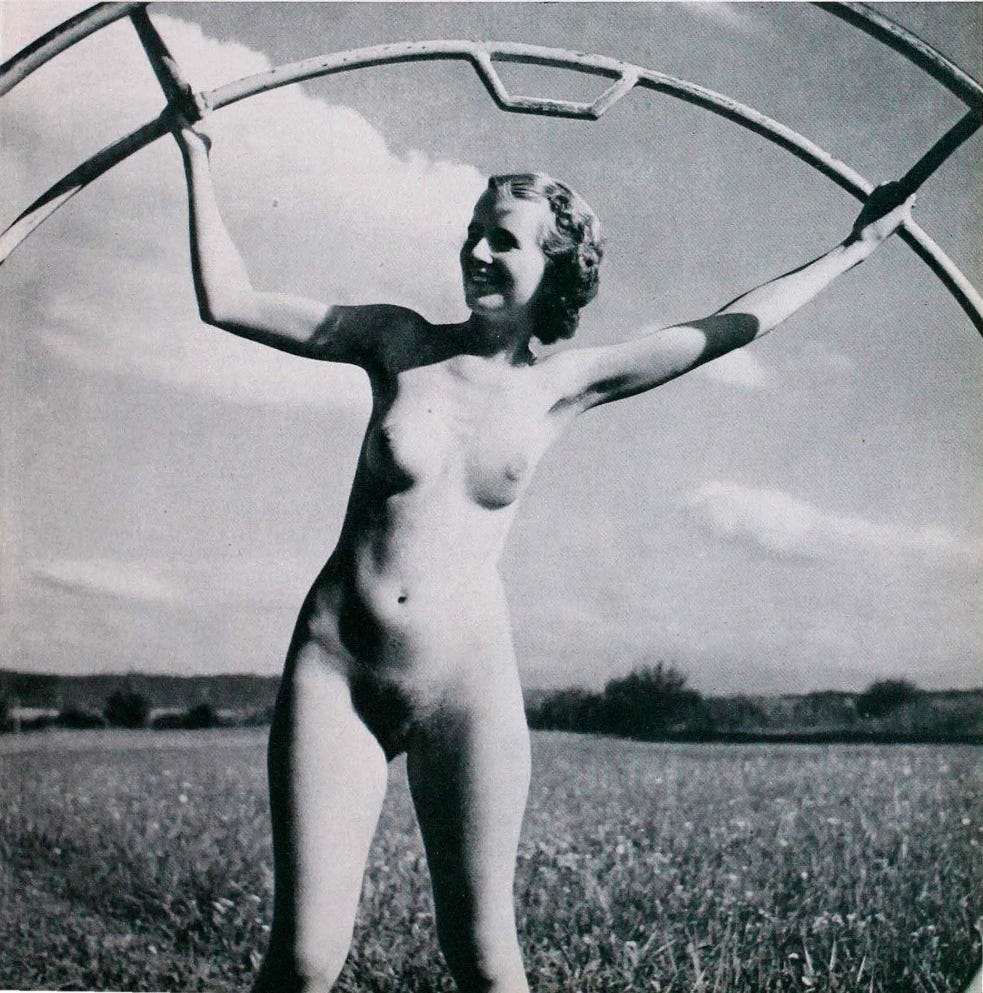
Otto Feick was a locksmith and railway worker, a union man, born in 1890 in the Palatinate. In 1921, French occupation forces imprisoned him in Mainz for passive resistance. Sitting in his cell, he remembered something from childhood: two iron hoops his grandfather had made, connected with crossbars, down which the young Feick had rolled himself down a hill. He began working out the geometry of a gymnastic version in his head. After his release, he moved to Schönau an der Brend in the Rhön Mountains, set up a metalworking shop, and built what he had been imagining in prison. He named it for his new home. The patent was issued on 8 November 1925.
From the start the Rhönrad had two lives running in parallel. In schools and gymnastics clubs it became a training apparatus, valued for building coordination, strength, and spatial awareness. In variety theatres and public exhibitions it was spectacle. Feick toured a performance troupe through German variety venues, including the Berliner Wintergarten, and brought the wheel to London in 1927, France in 1928, and New York in 1929. A women’s Rhönrad race appeared in a 1929 MGM film. At the 1936 Berlin Olympics, 120 performers gave a demonstration before a global audience. By then, some 20,000 wheels had been manufactured.
All of that was clothed. The Rhönrad was a mainstream German gymnastic apparatus with an active public life well before it ever appeared at a naturist gathering.
Feick’s personal story ended badly. His son Fritz was killed in the war. Feick sold his patent and spent his final years in poor health and poor circumstances in Schönau. The sport was officially recognized by the German gymnastics federation in 1959. Feick died that October, before the first German championship was held.
The wheel outlasted him.
The Lebensreform movement from which FKK grew was a response to industrial modernity—to the sedentary, unhealthy body that factory life and urban crowding had produced. For working-class Germans especially, access to fresh air, sunlight, and physical movement was not an aesthetic preference but a genuine health reform, aimed at bodies made sick by poverty and grueling labor conditions. Nudism was one expression of that impulse, and physical culture—gymnastics, hiking, outdoor exercise—was central to FKK practice from the beginning.
Adolf Koch was the most influential figure in early nude gymnastics. He came from the socialist left, and his schools were explicitly working-class institutions, holding nude gymnastics sessions across thirteen branches in Germany by the late 1920s and enrolling thousands. In 1929, his Berlin school hosted the first International Conference on Free Body Culture, drawing 200 delegates from 23 countries. The Rhönrad, already well established in German gymnastics culture, was adopted into this world—performed at FKK gatherings, youth camps, and INF congresses through the postwar decades, documented in publications like Licht und Schönheit and Die Neue Zeit.
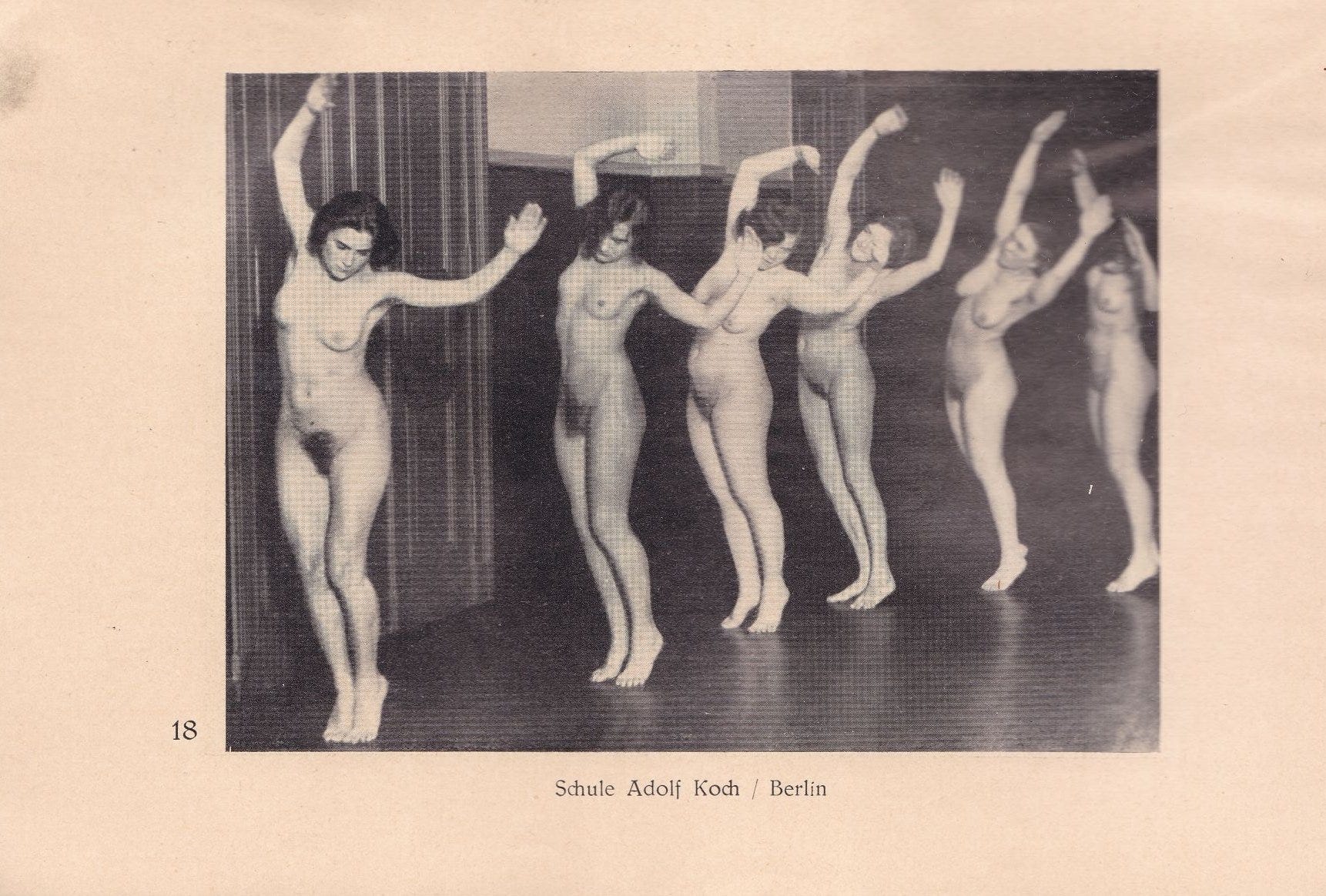
But the Lebensreform tradition Koch drew from was ideologically wide. The vocabulary of the healthy, active, unencumbered body was shared across a political spectrum that ranged from working-class health reformers to völkisch nationalists for whom physical culture was inseparable from ideas about racial fitness. These were not the same project, but they used overlapping language, and that overlap proved consequential. When the Nazis came to power in 1933, they banned Koch’s schools as Marxist. Under pressure, he rebranded and published language about racial hygiene in a failed bid for tolerance. The regime shut him down anyway. He was cleared after the war. The episode is a reminder of how contested the body was as a site of political meaning in that era—and how the same ideas about health and physical freedom could be put to very different ends.
In 1929, the same year Feick brought the Rhönrad to New York, a German immigrant named Kurt Barthel founded the American League for Physical Culture, advertising first in Berlin nudist magazines and later in American newspapers. On Labor Day of that year, Barthel led the first organized nudist outing in the United States—seven people in the Hudson Highlands in upstate New York. In 1932, he purchased property in Liberty Corner, New Jersey, and founded Sky Farm.
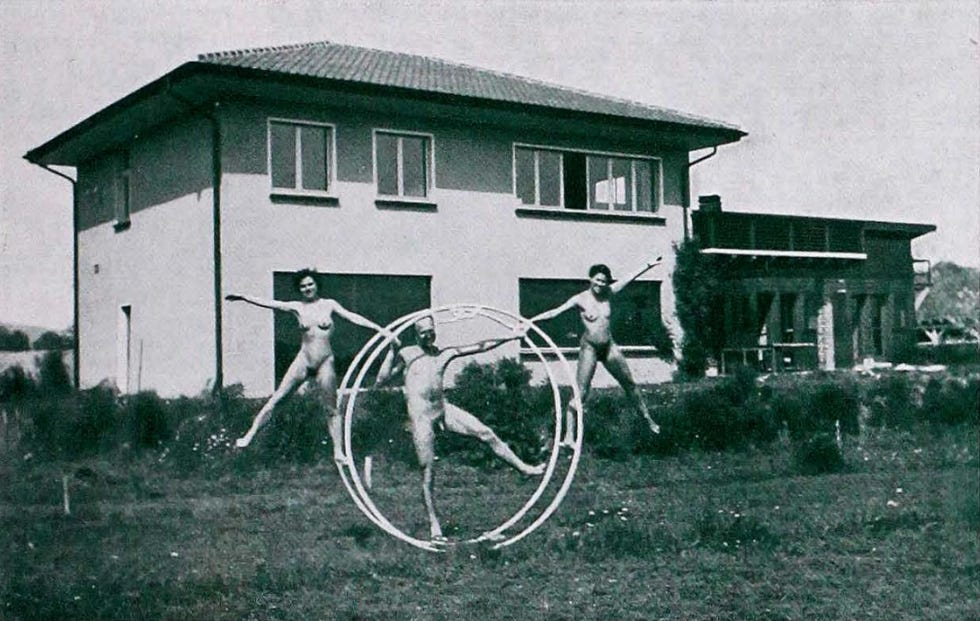
The steel wheel on those grounds is part of that migration. Whether Barthel brought it himself or it arrived through some other early channel, it belongs to the same movement of people and ideas that carried FKK practice westward—the gymnastics, the philosophy, the physical culture, and the objects that went with them. Most visitors walk past it without knowing any of this. 🪐