

The "ChatGPT flyer pandemic" comes to nude recreation
Naturism has spent a century convincing the public we're real. Why are we suddenly advertising ourselves with fake people?

AI-generated promotional art is everywhere these days. You’ve seen it. If you’re like me, you’re seeing it everywhere, even in naturism. Club newsletters. Association communications. Social media. The graphics are immediately recognizable because they all share the same visual vocabulary.
I come from a media background. Before launching Planet Nude, I spent years working professionally in advertising, filmmaking, design and visual communications, and I’ve also served in public relations roles for several naturist organizations. Watching this trend spread through naturism has convinced me that we’re making a serious marketing mistake.
The art is bad.
Yeah, I said it. It’s bad. I don’t mean technically. AI can produce technically competent images all day long (now that it has finally figured out how many fingers go on a hand). I mean it’s artistically bad. In fact, it shouldn’t ever even be called “art” at all. Art comes from observation and lived experience. It reflects personality and perspective. AI doesn’t observe anything. It predicts what an image should look like based on patterns in millions of images made by other people. The result may be polished, but it has no lived experience behind it. It can imitate human expression, but it literally cannot express anything of its own.
That’s important to understand because advertising is creative work too. It’s art and copy working together to communicate something about the people behind a brand. If AI can’t observe or understand the human experience—and naturism is inherently a human experience—it can’t communicate it very well either. That’s why I think AI-generated promotional art is bad marketing, bad public relations, and something naturist organizations are embracing at exactly the moment they should be leaning into the one thing AI cannot possibly reproduce: themselves.
Earlier this month, Jason Koebler at 404 Media coined the phrase “ChatGPT flyer pandemic” to describe the explosion of AI-generated posters, advertisements, menus, and event flyers that have flooded social media and physical bulletin boards alike. His point was simply that AI-generated graphics are becoming so common that they’re becoming instantly recognizable as a genre. Once people learn the visual cues, they begin spotting them everywhere, pervading coffee shops and food trucks and college campuses and workplaces and beyond. They’re everywhere.
I’ve had the same experience in naturism. Over the last several months I’ve been seeing so many examples from clubs, regional associations, festivals and events, people and organizations. Viewed individually, most of them are competent posters, I suppose. Viewed together, they become strangely interchangeable. Remove the logos and I suspect many readers would struggle to identify which organization produced which graphic. That’s a branding problem.


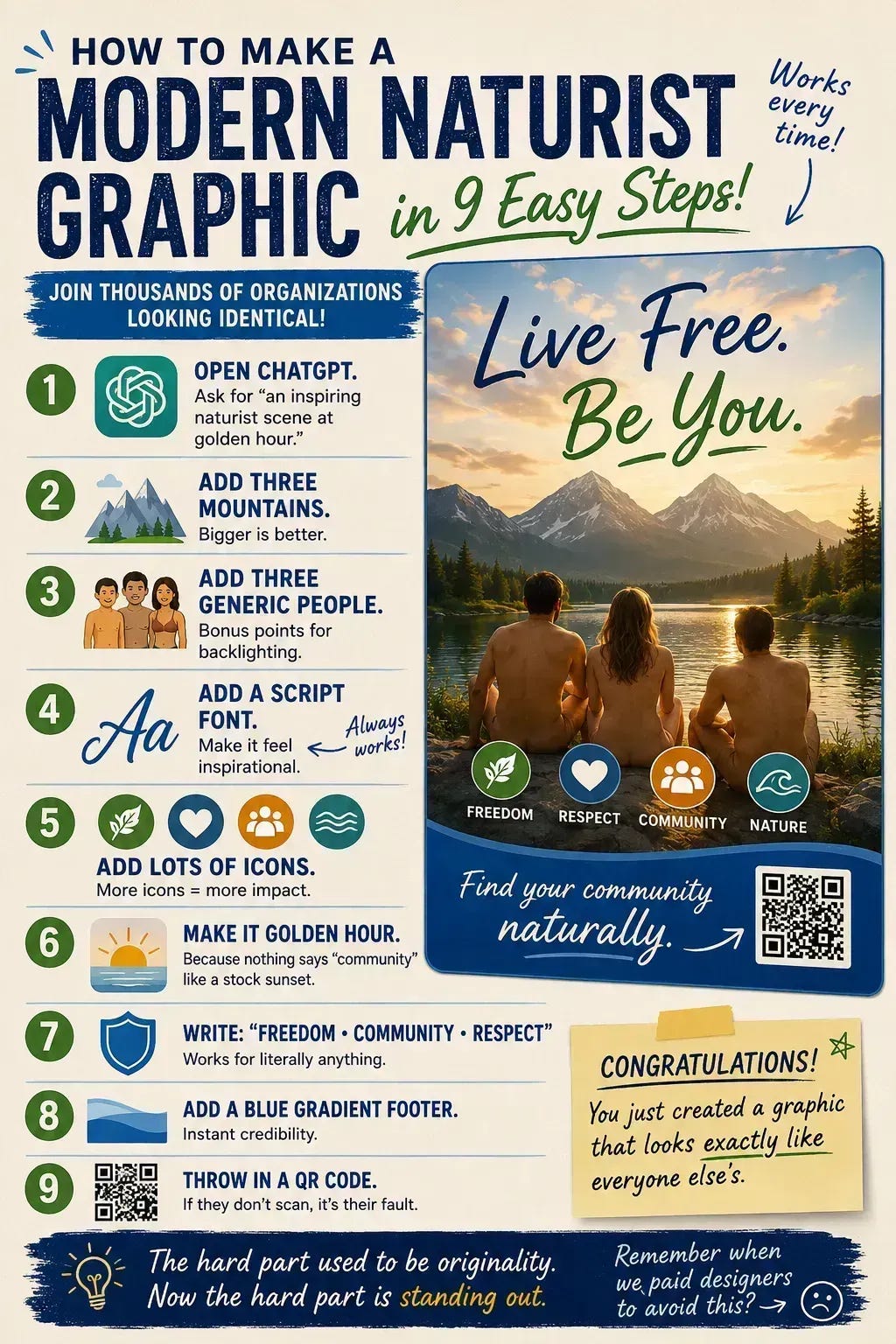
Branding is supposed to distinguish one organization from another. It gives people a reason to remember you instead of your competitors. Good branding develops a visual identity that people begin to recognize before they even notice the logo. AI is remarkably good at producing polished graphics, but it tends to produce them from the same small collection of visual conventions. In naturism, this results in many of the same tired cliches. The mountain lake at sunset. The small group of smiling people who look far too similar (and usually far too athletic). The handwritten script fonts and sunshine graphics. The row of circular icons. The generic inspirational headline. None of those choices are necessarily inherently bad marketing cliches, but together they’ve become so common that they no longer communicate anything distinctive. People are attracted to novelty, and put off by the mundane.
That is an important point, because naturist organizations aren’t selling a product. They’re inviting people into a community. Every club already has a personality. Every club has different traditions, different members, different landscapes, different history, and different strengths. Those differences are the story; they’re what might make a community uniquely attractive. Marketing should amplify them, not smooth them away.
Ironically, volunteer organizations often have a tremendous creative advantage if they’re willing to use it. Every nudist club I’ve ever belonged to has been full of talented people. Photographers and designers. Builders and artists. Woodworkers. Musicians. Retired newspaper editors and writers. Teachers. People who make things because they enjoy making them. That’s part of what makes communities interesting and vibrant and diverse. When a member illustrates your event poster, even if it’s not highly polished, you’re showing prospective members and visitors something about the people they’ll meet if they join. When your newsletter features photography taken by someone in the club, it’s evidence that this is a real place with real people who care enough to contribute their talents. On the other hand, when your event poster is clearly generated by an AI, it tends to advertise the opposite.
I understand why organizations are turning to AI instead. Most clubs run on volunteer labor, and the same handful of people are often responsible for organizing events, maintaining websites, answering email, and posting to social media. AI is fast, free, and available at two o’clock in the morning when nobody else is around to help.
But audiences are changing too. People are becoming increasingly media literate. They recognize AI-generated imagery almost immediately, particularly younger audiences who have grown up online. Recent consumer research suggests that skepticism toward AI-generated marketing is growing, especially among Gen Z and Millennials, who are more likely to say they prefer brands that communicate with authentic human voices and imagery. Gartner recently found 49 percent of consumers believe generative AI has made online content worse, and 57 percent of Gen Z and Millennials expressed even greater concern. That should give naturist organizations pause, because attracting younger members has become one of the movement’s biggest long-term challenges.
Planet Nude readers appear to feel much the same way. Last year, we asked whether AI-generated imagery has a place in naturist media. Opposition outweighed support by a significant margin, while a large number of readers remained uncertain, suggesting that people are still trying to work out where these tools belong. The comments were even more revealing. Readers repeatedly returned to the same themes: authenticity, consent, diversity, and the importance of showing real people living real lives. One reader wrote that “our (real, imperfect) bodies are the means of our resistance.” Another argued that AI images cannot tell the story of naturism because the story is the people themselves.
Being thoughtful.
I’m not an AI hardliner. I use AI myself. It’s great at transcribing interviews, cleaning up audio, removing backgrounds, and all sorts of repetitive production work. I even think it has a place in design. But somewhere between “helpful tool” and “public face of the organization,” a line gets crossed. Is your communication being shaped by a human, or generated by a machine from end-to-end? Is it strengthening your brand, or replacing it? And what does that choice tell the people you’re trying to attract?
Naturism is uniquely vulnerable to this failure because its entire philosophy is grounded in the lived human experience. The strongest marketing asset a naturist organization possesses is the community it already has. The photographs, artwork, writing, and stories created by its own members are impossible to copy because they belong to that community alone. They’re the culture. They give people something no AI image can: a glimpse of the place they’re actually being invited to join. I think that’s where people increasingly want to spend their money.
In advertising, as Marshall McLuhan famously observed, the medium is the message. The tools we choose communicate something before a reader has absorbed a single word. A festival poster illustrated by a local artist says something about the community behind it. An AI-generated graphic says something too. Whether that’s the message you want to send is worth thinking about. 🪐
and I want to add, the best quote on naturism, written and should have a bumper stick and plastered all over everything is this:
"Naturism has spent a century convincing the public we're real. Why are we suddenly advertising ourselves with fake people?"
I do not have time to do anything fancy, but I am going to give that quote to everyone I meet at the AANR Convention next week.
Going to put it on the back of my AANR Trustee business cards and with Evan's permission, add
"Just say no to AI marketing photos and yes to real naturist photos." to it Open for a better sentence
Okay, this has bothered me to0, just check the feeds on your substack account, well, I get AI porn with sometimes some stories. Why even post this crap if it is not at least as a marketing aide for a story?
Truth be told, I have done book covers that are AI, my current novel series (I have done two books) one is a model and one is not, it is AI (the one with Jupiter in background), and I have done cover art on Nudetopian Nightmares that is AI and Burnett County Revisted. I have also done my own cad drawing etc, but AI is easier and quicker.....I have hired a cover artist to do 4 of my covers, but that was not cheap....I got a cool painting, I guess.....AI almost free!!!
On brochures......models are expensive, photo shoots are uncomfortable at a nudist club and u need waivers, and a photographer and sometimes a board of directors meeting, and then everyone has to look at every photos because maybe too much nipple or to much penis or God forbid, she looks under 18 (even if she is not)....I just went to an AANR Midwest convention where I can almost guarantee no photos were taken by anybody.....so 1) no marketing for next year, 2) nothing to archive for history and so then 3) if there is no record of it, did it even ever exist in 20 years say?
Everyone is afraid, and rightly so, most nudist sare afraid of being naked or seen naked, look on Ebay, someone is selling "Nudes a Poppin" Ponderosa (IN) 1979 photos for $30 a piece taken by some random guy in the audience whose photos ended up at some photo reseller.....One is a good history piece of a woman doing nude sword swallowing as her talent I guess, but I am not paying $30 for a 4x4 fading in color.....
But at our club very few photos between 2000 and now exist, I did some shoots for website but those are now dated and again, I should have paid models $500 to come and be shot because no one wanted to be in them that were members
Many of our members still have never told their adult children who may have children that they are members......and in Photo Field Trip in 1964 #6, many of our members got outed and some fired and one young girl eventually killed herself over the taunting in High school. Having photos taken are risky...so why would they agree to photos
AI has at least allowed nude people to be pictured at nude resorts/ clubs.
I would love to put together a marketing shoot for many of these clubs, even something like a taking retro photos using old scenes, old cars, old campers, with roles reversed from standard 1960s nudist photos (man delivering drinks wearing apron etc) and use it as marketing even put them in the Nude Nite art exhibit, make it in a calendar, use then for club ads and websites, but how many clubs could you even be able to do that at and who would ever want to be in them, and okay, we hire models...who would even believe you?....I could probably do it at a few places in Florida but you know anything has a risk, and ???? Would the president of Carolina Foothills even answer my email? I cannot get a woman who has 1981 photos of Tree House Fun Ranch in California with photos archived at Claremont College to agree to use her photos for anything at all, not even with payment, not that I needed them that badly. Michael Cooney has retired, what photographer has replaced him? I take bird and butterfly photos professionally, I can work on my skills, I guess.....
So here I am saying no one is ever going to want to be in a picture so why not AI? And I can also say, AI does is a horrible thing to use in promoting nudism/naturism, so who would want to use an AI photo on a brochure? ...someone tell me something positive. I prefer watercolor AI images not realistic setting btw