

Out of the closet and out of their clothes: The history of Gay Naturists International
GNI took the naked gay man—a concept that a puritanical society had sexualized, criminalized, and shamed—and placed him back into the hands of nature.

The history of organized naturism has long been tied to a distinct philosophical premise: that stripping away clothing removes the artificial social structures, class distinctions, and commercial vanities that divide humanity. Yet, for much of the 20th century, the mainstream nudist movement harbored a blind spot (more than one actually, but that’s a subject for another article).
In its desperate bid for social acceptance amid mid-century puritanism, mainstream nudism aggressively marketed itself as a sanctuary for the traditional, heteronormative nuclear family. For gay men, who already moved through a world of hyper-vigilance and hidden identities, this meant entering a standard nudist park required stepping into yet another closet—that is, if they could even find a park that would accept an unmarried man.
The birth of Gay Naturists International (GNI) disrupted this dynamic. Emerging from a fragile network of local groups and formalizing out of a mainstream affinity group in the early 1980s, GNI grew into an established institution of the nudist movement.
It provided a space where gay men could experience the liberating vulnerability of social nudity in a more organized way without hiding their identities. GNI’s story is the tale of how a marginalized group within a counterculture carved out its own sanctuary, establishing a global legacy of body acceptance and freedom that is still growing and developing today.
Gay nudism pre-Stonewall
Long before any official organization carried the “gay naturist” banner, gay men were seeking out the liberating joy of bare skin in nature. In the pre-Stonewall era, public space was heavily policed, and homosexual assembly was criminalized. Consequently, gay men sought out geographical margins—isolated beaches, riverbanks, and coastal dunes—where they could strip down and build clandestine communities of their own.
As early as the 1940s, Hanlan’s Point Beach on Toronto Island became a legendary refuge. Hidden behind shifting sand dunes, gay men and lesbians alike sunbathed naked, creating an oasis of freedom despite the persistent threat of police arrests and social stigma.1 By the 1950s and ’60s, a similar culture took deep root on the east coast of the United States, specifically within the secluded dunes of Cherry Grove and Fire Island Pines off Long Island, New York.2
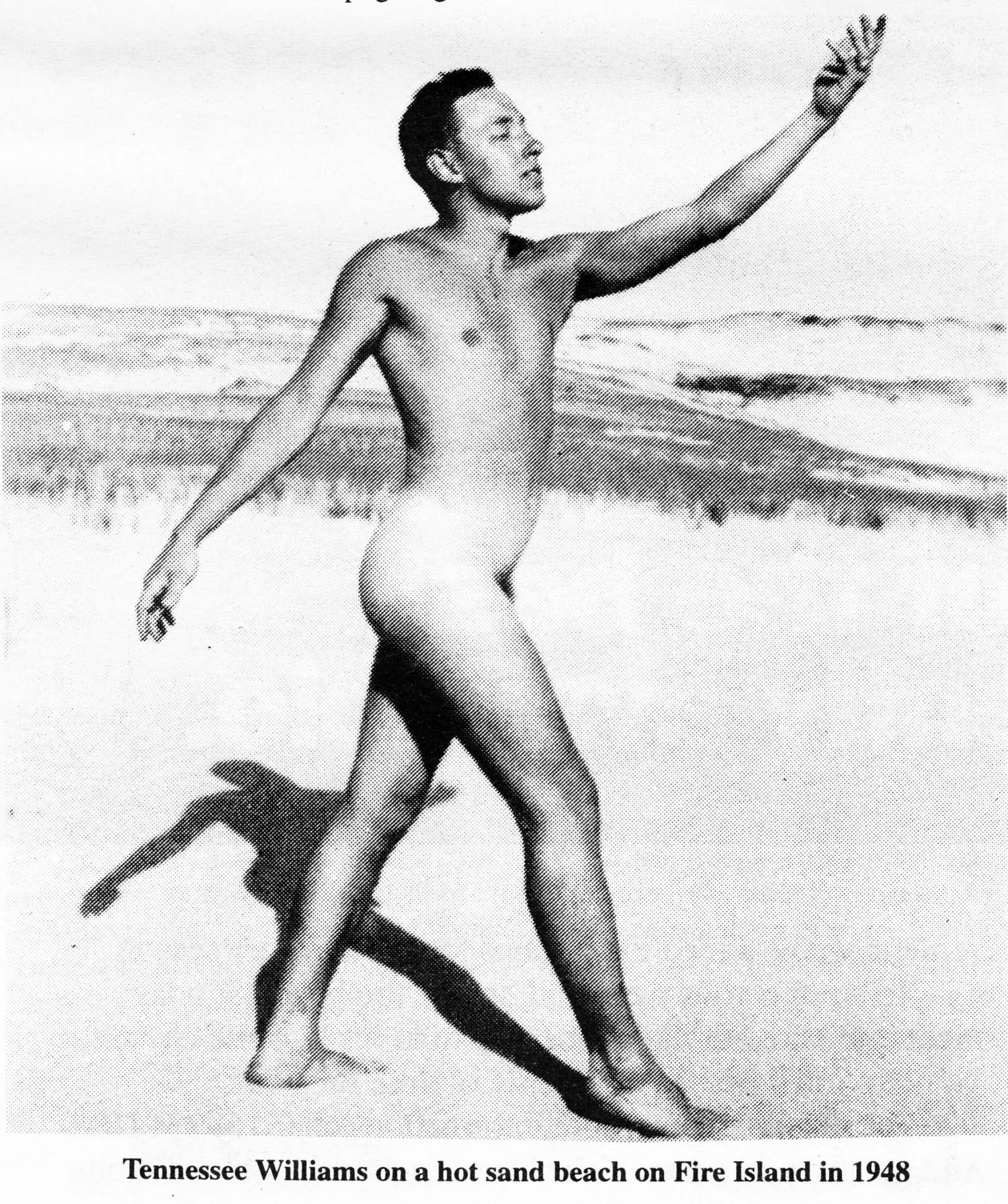
These early spaces were entirely informal, sustained through word-of-mouth networks. They provided a sharp contrast to the dark, urban, and heavily monitored spaces—like underground bars and bathhouses—to which gay life was mostly confined. Out on the sand, the light was bright, the air was clean, and the nudity was recreational, peaceful, and communal—though always vigilant, as well.
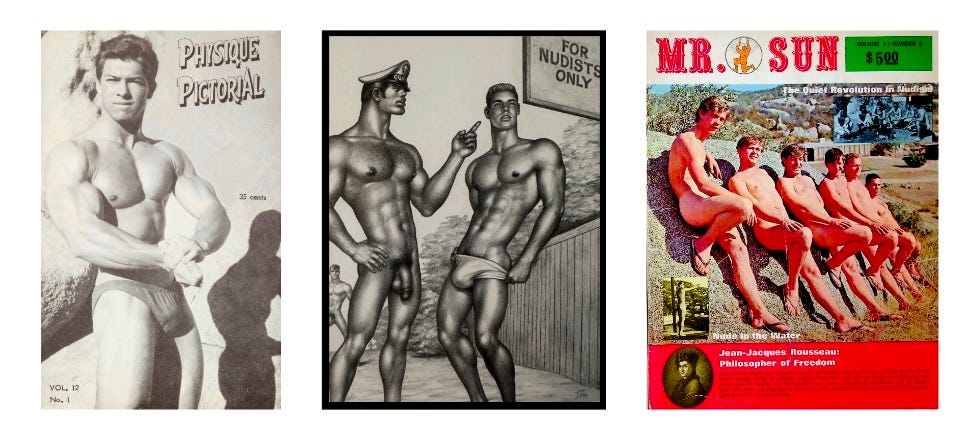
Parallel to these physical spaces was a powerful visual precursor: mid-century physique photography. Spearheaded by pioneers like Bob Mizer and his Athletic Model Guild (AMG), from the 1940s through the 1960s, magazines like Physique Pictorial circulated images of minimally clad (and eventually nude) men under the legally necessary guise of “artistic posing,” bodybuilding, and health promotion.3 These publications frequently utilized outdoor backdrops—forests, rivers, and beaches—subtly intertwining the concept of male homoerotic appreciation with the clean, uninhibited freedom of the natural world.
They also helped bring artists like “Tom of Finland,” who specialized in the exaggerated and hyper-masculine nude male form, to a global audience. The nudity and sexuality that was so abundantly on display in his work has been called “the most effective propaganda for a gay utopia produced to date.”4 Though dismissed by some as mere pornography (it was often that, but not only), his drawings—which frequently featured naturist and nudist themes—depicted confidence and encouraged gay men to find affirmation in their own naked bodies.
In the 1960s and ’70s, gay male nudism also found expression in various “skin” magazines of the era, including Mr. Nudist, Mr. Sun, M.A.N. (Male Athletic Nudist), International Nudist Sun, MAN (Male and Nudism), Male Nudist Portfolio, and others. Some were simply venues for nude male photography, but several expressed an earnest commitment to forging a space for gay naturism.
An editorial in the first issue of Mr. Nudist in January 1968 expressed the frustration that “the single male nudist” (gay was a word the publishers still did not dare to use) felt when facing “the prejudice against groups of single men at nudist parks”:
“The single male nudist is certainly no new phenomenon, but what is new is the fact that the single man is no longer waiting at nudist park gates until park owners ‘have room for them.’ The single male nudist is joining the growing numbers of casual nudists who, begrudging the time and energy it takes to get to a nudist park, begin to practice nudism at home and in isolated outdoor areas of their own choosing.”5
Similarly, the editors of Mr. Sun predicted that the days of the “family nudist park” would be numbered if operators stuck to their “sheltered atmosphere,” forcing interested people who didn’t meet their strict standards to find other outlets for nude recreation and socializing. “Anything as beneficial as nudism just could not be limited to the formal grounds of a nudist park,” they said as they surveyed the previous few years. “What was good for a weekend was soon found to be enjoyable at home, off in the mountains, or down at the beach. And thus, the quite revolution towards a broader scope of nudism was born.”6
Gays on the frontlines of the Free Beach Movement
Despite the unwelcoming attitude of the parks and resorts, mainstream nudism ironically gained greater traction with the public in the 1970s thanks in large part to the efforts of gay nudists. The free beach movement of that time relied heavily on gay men to secure its most critical victories: public, clothing-optional beaches. With the establishment of nude beaches, nudism secured a greater degree of legitimacy in the public eye and shed at least a bit of the stigma which it carried.
Lee Baxandall, the straight founder of The Naturist Society (TNS) and a leader in the fight for free beaches, frequently gave explicit, public credit to the gay community for doing the heavy lifting in early free-beach activism.
“Gays on the nude beach have often led because of more experience at defying intimidation on behalf of values too central to abandon,” Baxandall wrote in an editorial in the November 1981 issue of Clothed With the Sun.7
While heteronormative families often feared the public exposure or legal risks of protesting on beaches, gay activists—already seasoned by the post-Stonewall gay liberation movement—understood how to organize, face down police harassment, and fight for public space. From the shores of Cape Cod to the dunes of California, gay men were often the shock troops of the free beach movement, establishing public beachheads that benefitted all naturists.
Despite taking the lead in fights that brought wins for the broader naturist movement and enabled wider access to nude recreation for all, gay men continued to be ostracized by much of mainstream nudism. The magazines and newsletters of the movement could be counted on in this era to periodically remind readers of homosexuality’s unacceptability and its supposed incompatibility with wholesome family nudism.
Some writers focused on religious and moralistic reasons for rejecting gays, though plenty of other rationales were also offered. One author, Michael Sands, M.D., argued that raising children as nudists, giving them plenty of visual exposure to both male and female bodies from a young age, would keep them from becoming “inverted.” He wrote that “nudism may offer a path to a normal, heterosexual way of life,” in Nudist Newsfront.8
Another adherent of the movement, a person named Michael Stanley, declared “homosexual nudism” the “plague of America,” pinning blame on it for alcoholism, narcotics addiction, paranoid schizophrenia, “psychopathic states,” and crime generally.9
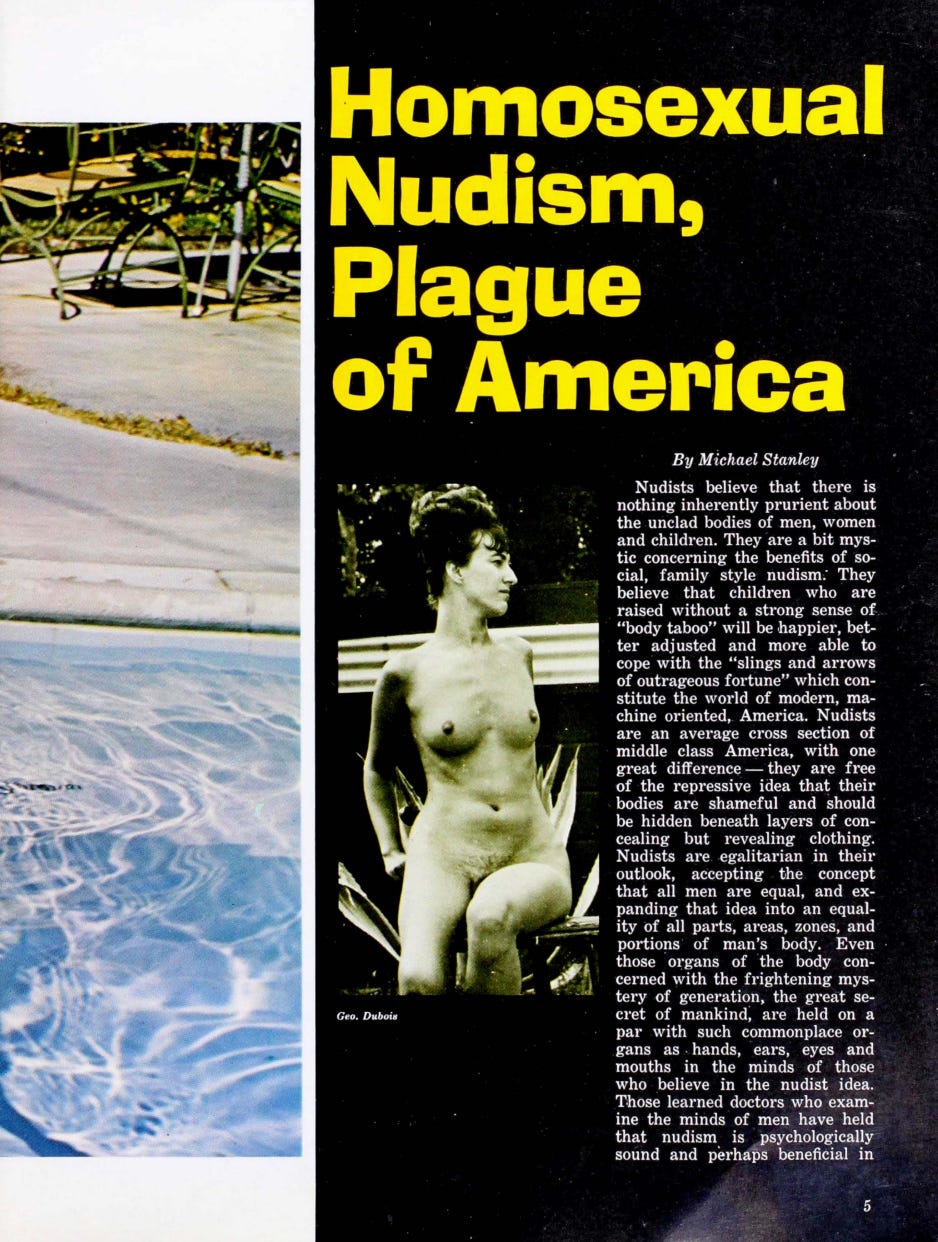
“There is nothing finer” to fix these problems, he wrote, “than adult, well-adjusted, satisfying heterosexuality” combined with “public acceptance of the nudist idea,” as if the latter were an easy thing to achieve. Ironically, the same author felt it appropriate to include in his article the statement that “Nudists are egalitarian in their outlook, accepting that all men are equal.”
Baxandall would later make opposition to such nonsense a key point of distinction between TNS and the rest of mainstream nudism and its landed clubs. “‘Family nudism’ (the rigid ideology, not the practical experience) generally clings to the most bankrupt of patriarchal standards,” he said, “and to the nuclear family, which is a creation of 20th Century industrial society and statistically is on the way out.”10
The Naturist Society and the birth of GLN
By the late 1970s, the post-Stonewall explosion of gay liberation collided with the growing countercultural interest in nudism. Small, local, and explicitly non-sexual gay nudist collectives began to coalesce independently. Groups like the Gay Bares of Philadelphia, the Everglade Rawhides in Miami, Key West Naturists, and Lambda Soleil near Washington, D.C., emerged as regional safe havens.
The newspapers and magazines that popped up around the United States as part of the wave of gay liberation movements became places where nudist groups started to advertise and recruit members. However, these groups operated in isolation, lacking a unified national framework.
The turning point arrived in 1980 when Baxandall founded TNS. Unlike its predecessor, the American Sunbathing Association (ASA, later renamed AANR), which leaned culturally conservative and strictly policed family dynamics, TNS was built on a foundation of free expression and diversity. Baxandall welcomed the formation of “special interest groups” (SIGs) within TNS’s structure, and essentially from the first days of TNS, a gay naturists SIG was in the works.
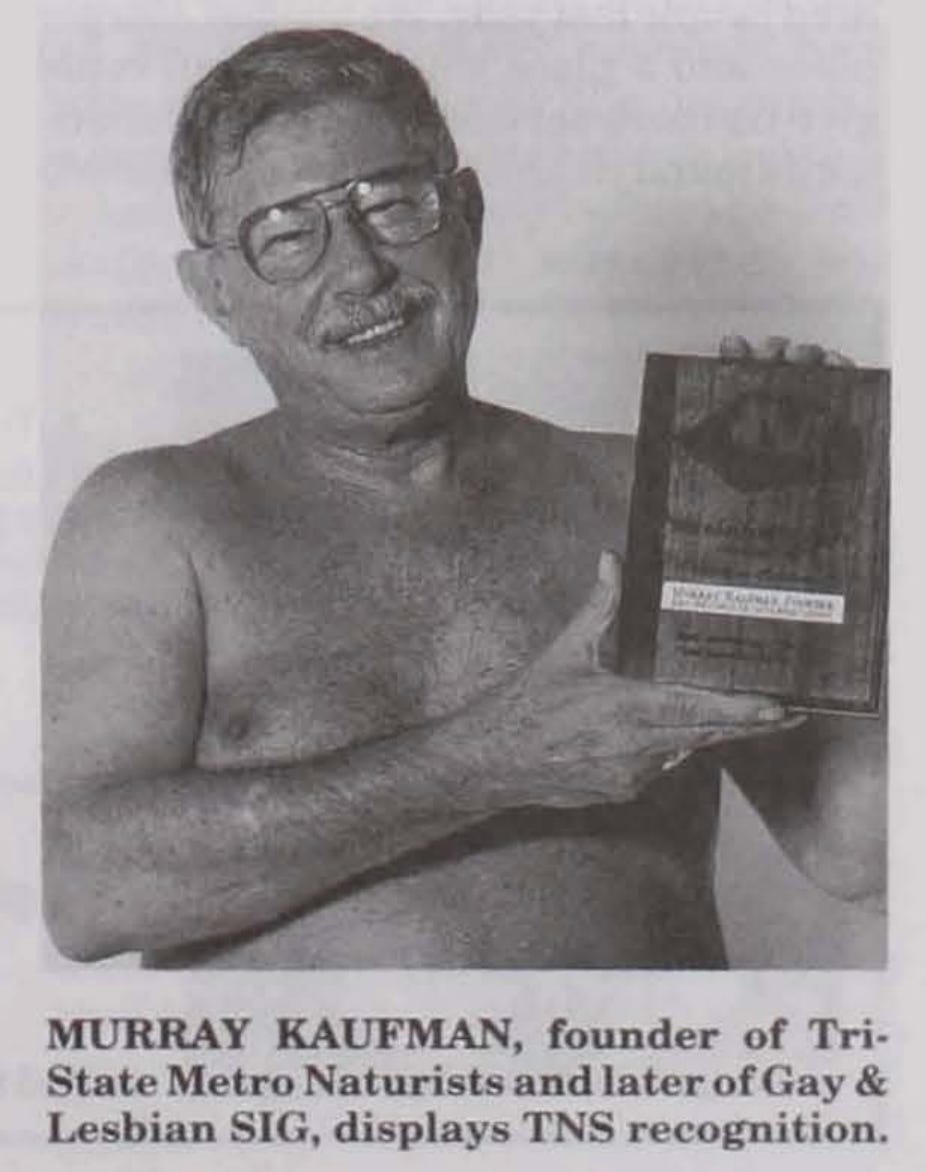
From the organization’s founding, Baxandall received an influx of inquiries from gay men looking for a dedicated space within the movement. Recognizing the need, Baxandall approached Murray Kaufman, a gay New Yorker who had been organizing private nude socials for gay men on the sidelines of the mainstream group he led, the Tri-State Metro Naturists.11 Kaufman was known among fellow gay New York nudists, but he was generally still closeted to the other Tri-State members. Baxandall urged him to “come out” and take the lead on mobilizing a gay and lesbian group within TNS.
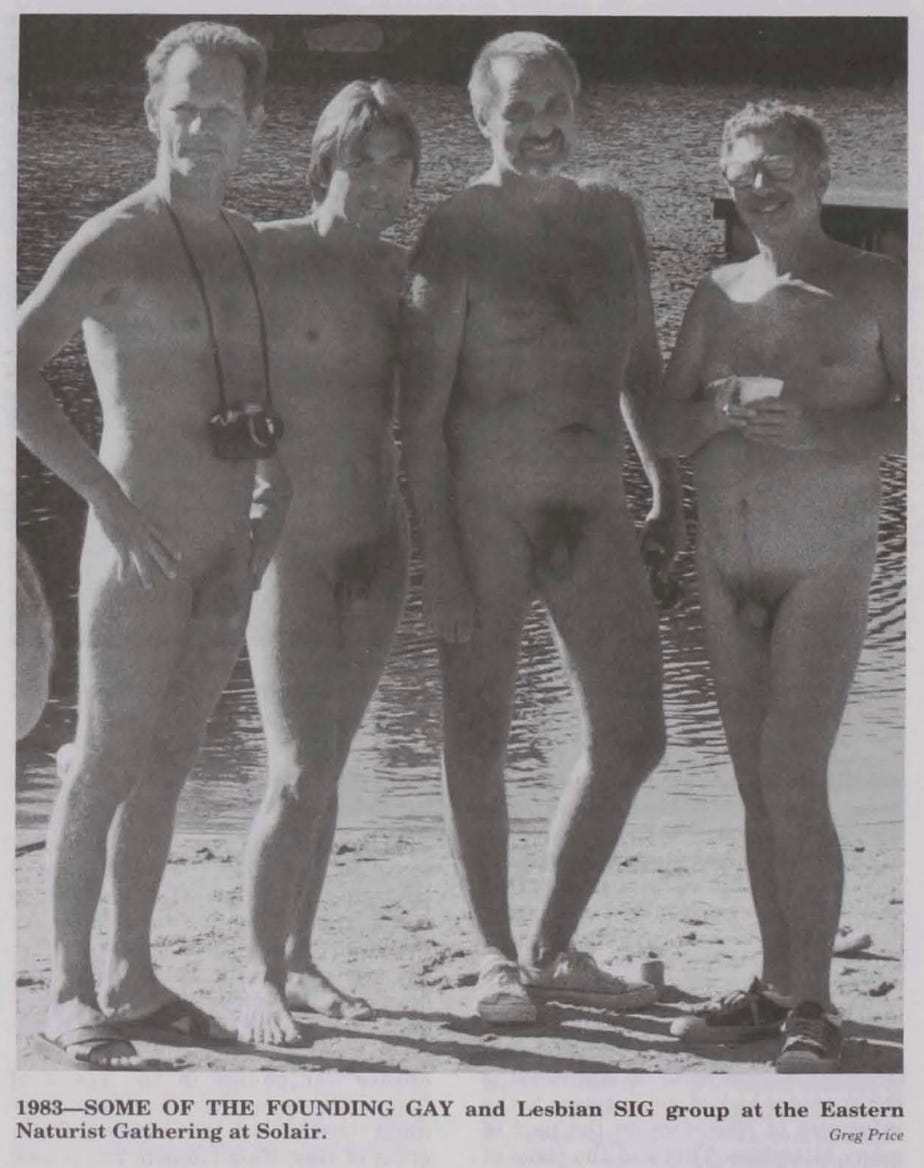
At the TNS Solair Conference in 1983, a group of gay and lesbian naturists met face-to-face and concluded that they needed an explicit, recognized presence to counter the heteronormative dominance of mainstream resorts. In the spring of 1984, Kaufman, alongside Cheryl Auger of New England Naturists, went public, formally founding Gay and Lesbian Naturists (GLN) as an official Special Interest Group under TNS.
Using $75.00 of start-up money provided by TNS, a list of 30 names and addresses given to him by Baxandall, and a little extra cash of his own, Kaufman and three other associates published Volume 1, Number 1 of Gay and Lesbian Naturists, an eight-page newsletter that included the announcement of the SIG’s founding, a list of gay nudist groups, and articles on a variety of topics.12
Tragically, Sheldon Seidman, a brilliant young activist who was slated to co-coordinate GLN with Kaufman and who passionately advocated for absolute equal rights for gay naturists, passed away from Hodgkin’s Disease at age 31 just weeks after the group’s formation. His vision, however, infused the early movement with a profound sense of urgency.
A tribute in that first newsletter pledged to stick to the lessons he taught: “To be open about what we are and to fight for acceptance on our own terms,” and “to be loving and caring and to treat all others as real human beings worthy of respect.”
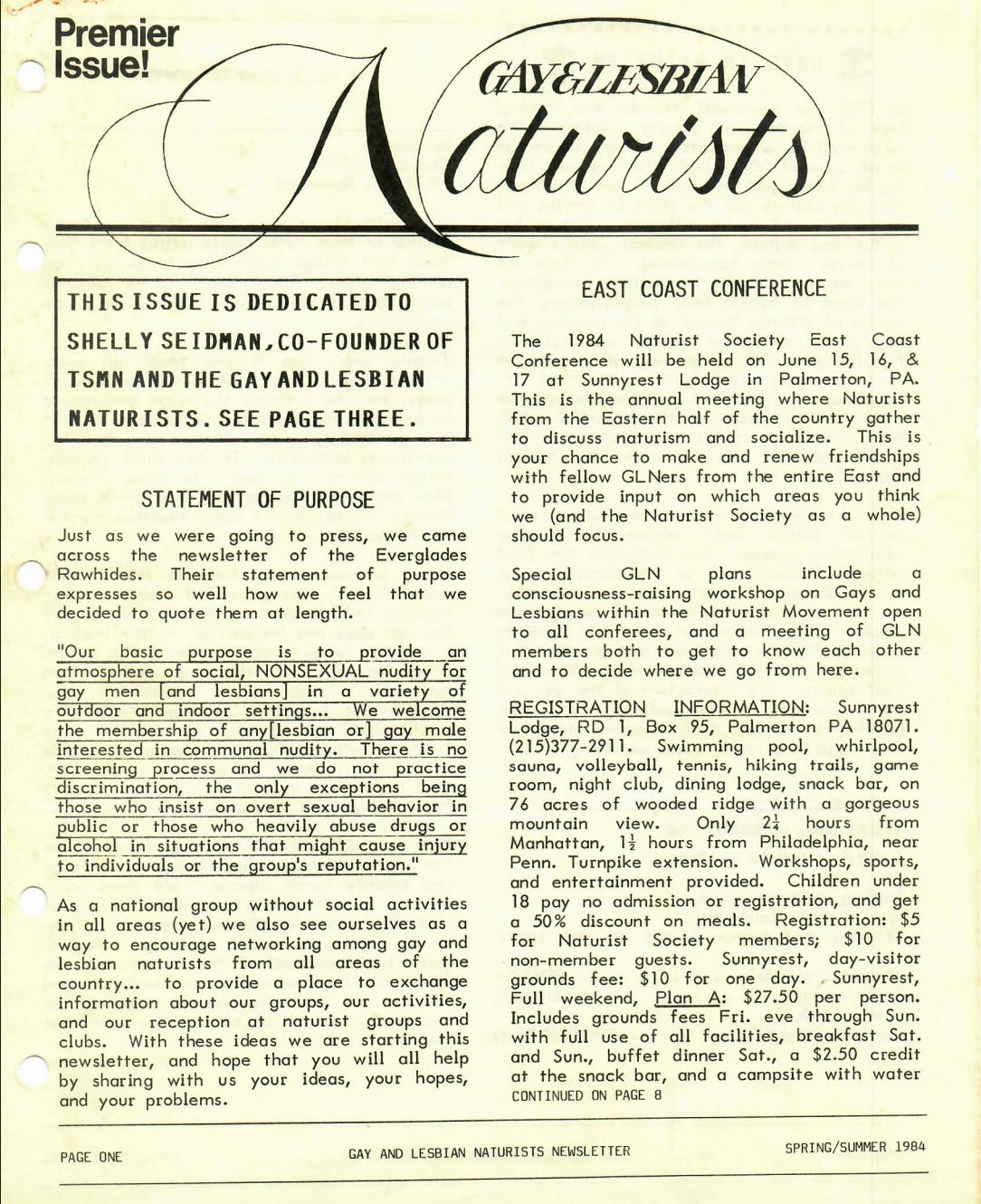
GLN adopted its primary statement of purpose from the Everglade Rawhides, a group based in Miami: “Our basic purpose is to provide an atmosphere of social, nonsexual nudity for gay men and lesbians in a variety of outdoor and indoor settings…. There is no screening process, and we do not practice discrimination….”
One member named Blake expressed the optimism of those early days of organized gay naturism, writing in the newsletter: “The Gay and Lesbian Naturists organization will provide options…. Twenty years from now, all of the corners [of this country] may be filled with the laughter of sunkissed men and women of all persuasions joined in community. It is up to us to create that reality.”
From interest group to independence
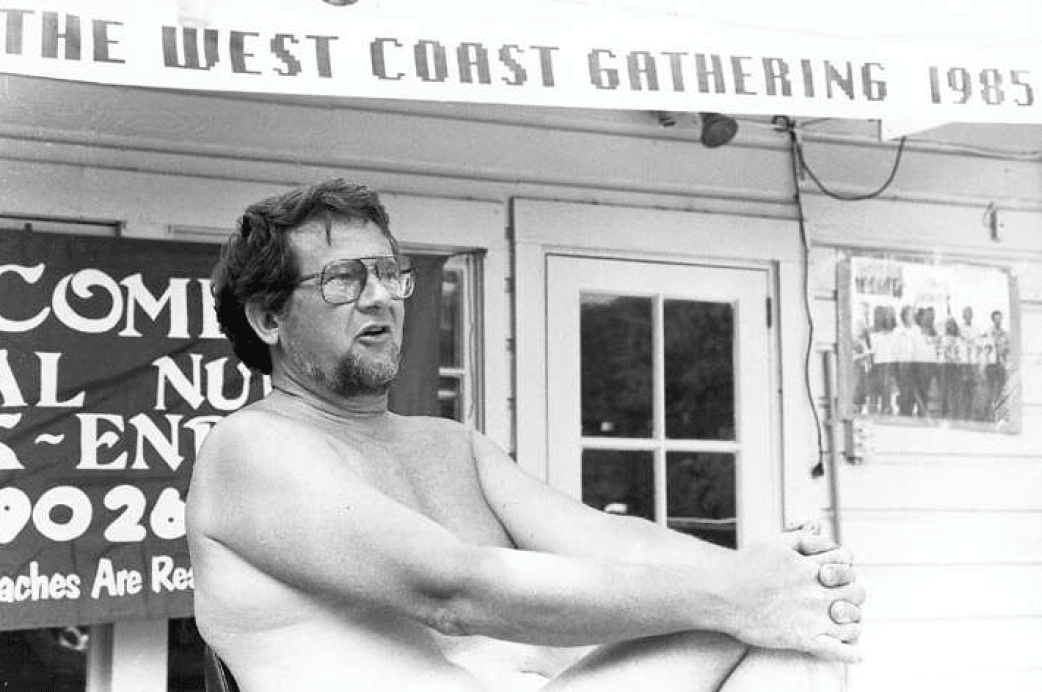
In 1985, GLN hosted its first national gathering at the country’s best-known gay nudist resort at the time, Summit Lodge, in Rockbridge, Ohio. Approximately 60 members attended—all of them men. Over the subsequent years, these annual gatherings grew rapidly, with hundreds of individuals converging for a week of nude communing.
The rising popularity of the group exposed a structural reality, however. While founded as a co-gender space, GLN had quickly become a de facto all-male environment, as lesbian naturists predominantly chose to organize within separate, lesbian-feminist collectives.
By 1992, the group stood at a crossroads. It had outgrown its status as a mere subsidiary affinity group of TNS and required autonomous legal and financial control. The organization restructured, officially splitting from TNS to become an independent entity. In what was both a recognition of its evolving demographic and an acceptance of reality, the organization dropped “Lesbian” from its title and rebranded as Gay Naturists International (GNI), a name that also reflected its growing reach beyond U.S. borders.13
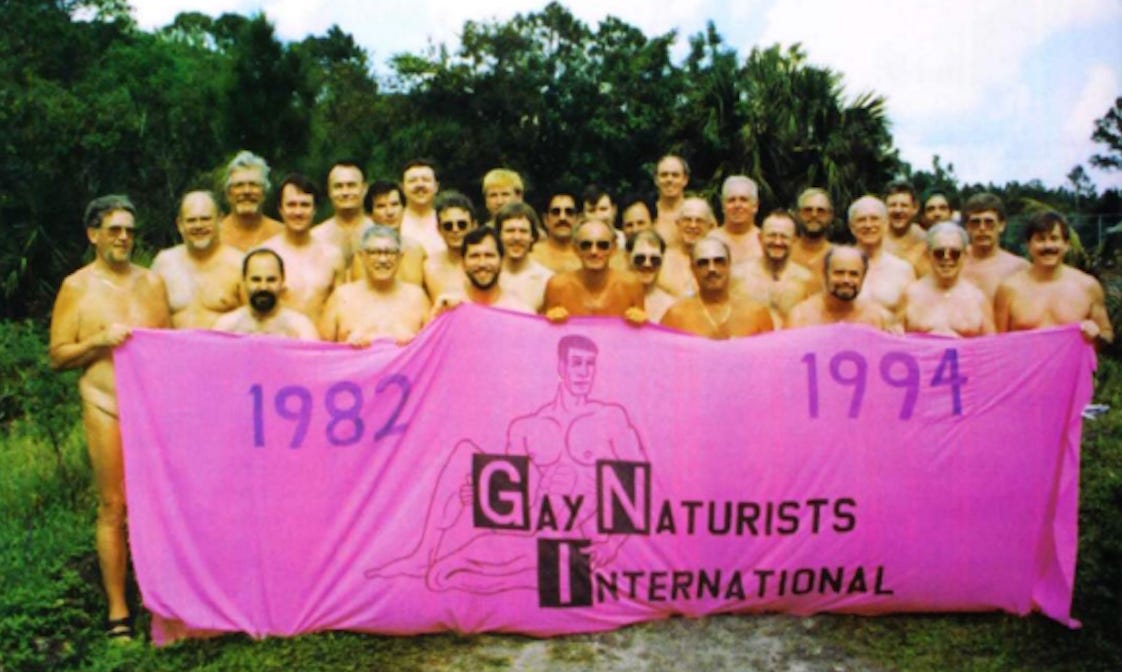
GNI established itself as the central hub for gay nudists and as a clearinghouse for gay naturist news, publishing GNI Quarterly, Gay Naturist Informer, GNI E-former, and other titles over the years. It also acted as an umbrella organization, networking local clubs in the U.S. and around the globe. By the late 1990s and early 2000s, boosted by the dawn of the internet, GNI’s registry swelled to include well over 100 affiliated groups, spanning major metropolitan areas across North America, Europe, and Australia.
The Gatherings: Sanctuary in an age of crisis
The crown jewel of GNI’s operation has always been The Gatherings—massive, multi-day annual events that draw hundreds of men from all over the planet. Starting out as tent-and-trailer affairs, over the decades these events shifted to commercial gay-owned clothing-optional campgrounds, eventually finding a long-term home in the Pocono Mountains of Pennsylvania.
To understand the astronomical growth of GNI’s Gatherings in the late 1980s and 1990s, they must be viewed through the devastating lens of the HIV/AIDS epidemic. During an era when the media, the government, and the medical establishment demonized gay male bodies as vectors of disease and corruption, the Gatherings offered a radical counter-narrative.
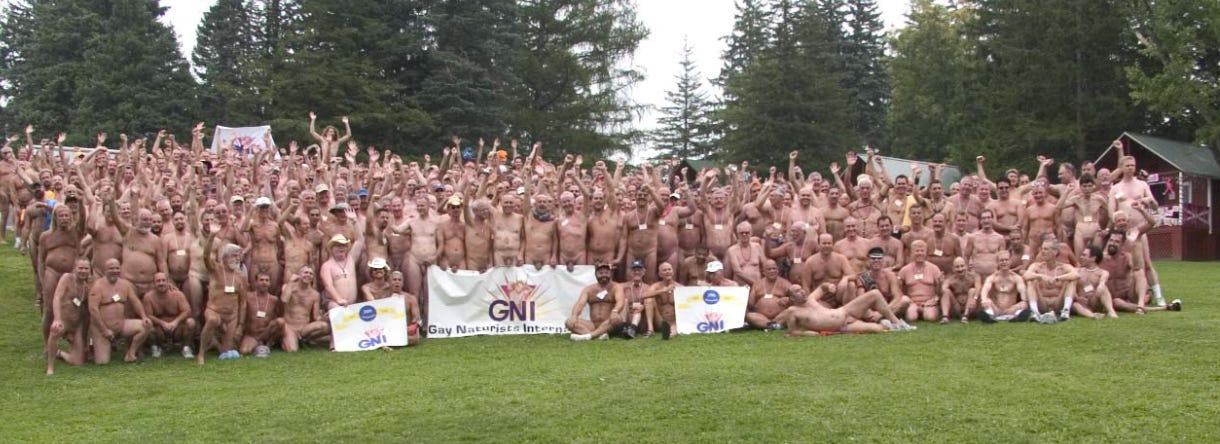
On the grounds of a GNI Gathering, the gay male body was restored to a state of innocent, natural beauty. Men of all ages, sizes, and abilities—including those bearing the physical scars of illness—walked together in equality. The nudity was social and non-sexual in the public and common areas, a parameter protected by organizers. This distinction was critical; it allowed men to experience physical intimacy, touch, and deep emotional bonding without the performance anxieties or sexual expectations of the bathhouses or bar scenes. It was a space of profound communal healing.
Dan Smith, an attendee from Sydney, Australia, recounted his first Gathering in an issue of The Gay Naturist Informer: “I felt a real camaraderie. It’s amazing how being naked breaks down so many barriers. It’s been over a month now since I’ve been home, and I’m still carrying the acceptance and happiness I experienced at the Gathering with me. I am so glad I overcame my hesitations.”14
The Gatherings also represented the first time that many gay nudists were able to enjoy the social atmosphere and large group recreation that had already been the norm for straight nudists for decades—a problem already highlighted in the “single male nudist” magazines of the sixties and seventies. Leslie Rollins explained the issue, again, in Nude and Natural in late 1992:
“Gay men don’t often have the opportunity to visit well-equipped nudist camps and resorts because of the widespread ‘single man’ policy. Fearing harassment of female guests, most clubs severely restrict or outright prohibit single men.”15
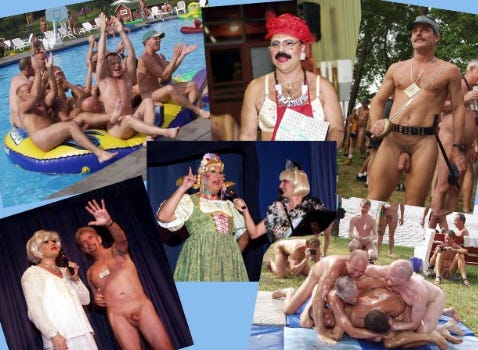
Murray Kaufman was always irate about such policies. “This effectively excludes gay men and is discriminatory,” he told Rollins. “Even male couples are not admitted.” The few clubs which in those days did admit gay men were still places of prejudice.
“Gay men are often singled out as being promiscuous,” Kaufman said, even though, he said, he had witnessed overt heterosexual public sex at a resort being allowed with no response from management while the mere sight of two pairs of men’s legs behind a shower stall curtain brought complaints about “the behavior of Murray’s boys.”
Navigating social nudity and sexuality
While GNI has always protected the “social, non-sexual” parameter of its official events to keep them relaxed, safe, and accessible to men who want to sunbathe or swim without the pressure to perform, gay naturism as a broader movement does not shy away from sexuality. For gay men, sex and nature have long been intertwined through the historical necessity of cruising—which meant for a long time that beaches and parks were the only places gay men could find one another.
The magic of gay naturism lies in its ability to hold space for both. In designated social zones—the pool, the volleyball court, the dining hall—nudity is an equalizer, completely decoupled from sexual intent. This allows men to look each other in the eye without an immediate sexual agenda, fostering platonic brotherhood.
However, gay naturists also acknowledge that a gathering of naked gay men will naturally involve attraction, flirtation, and sexual desire. Rather than adopting the puritanical anti-sex attitudes of early mainstream nudist resorts, the gay naturist community embraces a healthy pragmatism. In appropriate times and private or designated adult spaces—such as certain trails, workshops, or resort cabins—cruising and sexual expression are accepted as natural, healthy extensions of body freedom.
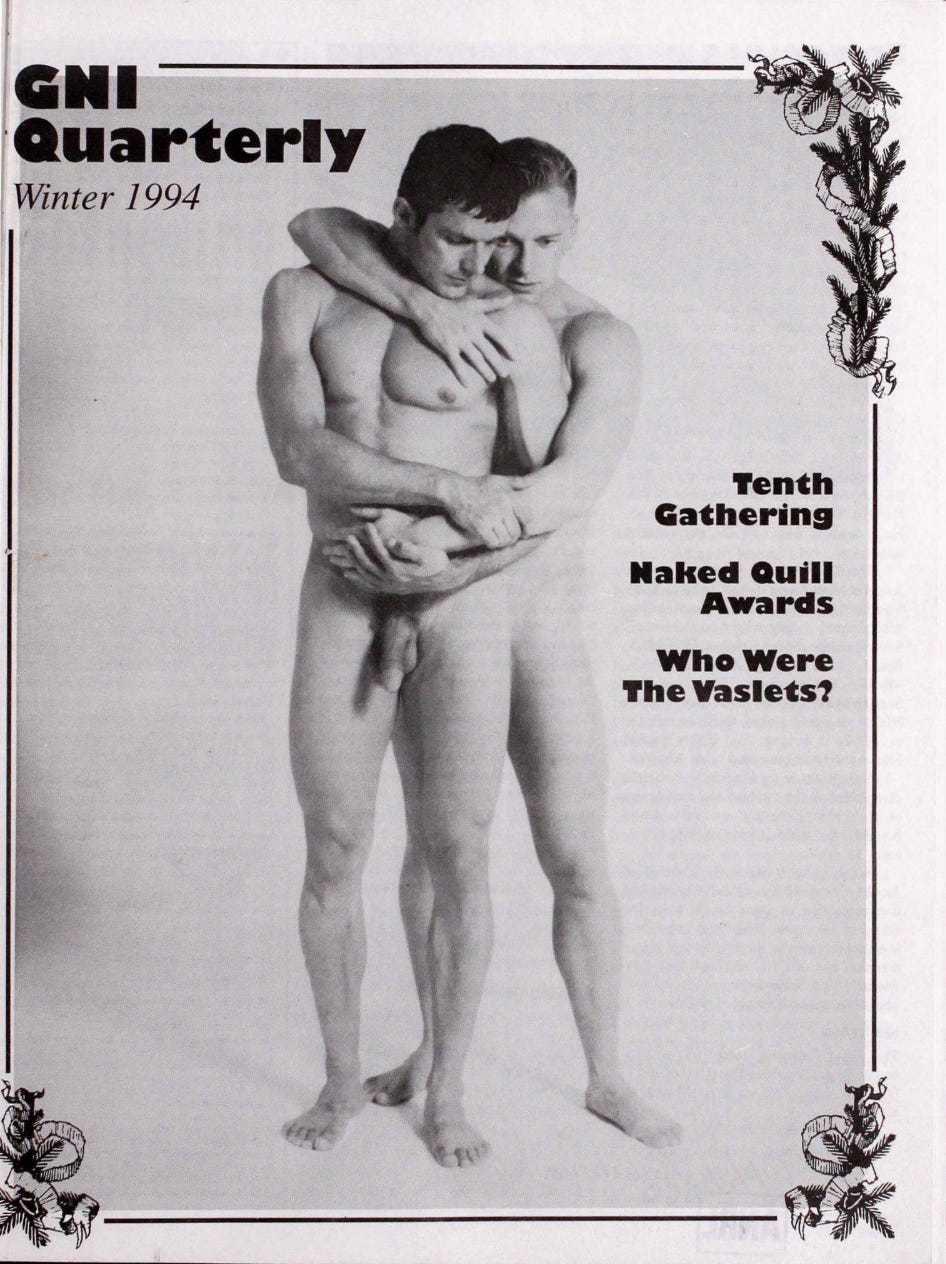
Tom Scott, a member of the group Gay Male Nudists in San Francisco, summarized the philosophy in Clothed With the Sun back in November 1981: “We feel that the entire body is a marvelous creation to be enjoyed all over, not with the straight pretense that it does not exist below the waist. We don’t believe in putting constraints on each other, as long as no person feels coerced into doing what he does not really care to do.” If one or more men at one of their local gatherings felt like sex, he said, they “fragment into groups.”16
The meetings, Scott said, “are not orgies, though on the other hand they could not be mistaken for church socials. We do photography, yoga, drink wine, and share food and talk…. We enjoy being gay and being together, and we delight in nudity and being open. And the group, despite its wide range of interests and ages, is perhaps the most congenial I’ve ever experienced. We can smile, and share, and feel refreshed, as if we have touched on our essential humanity.”
As for GNI, it codified its position on the subject in simple terms:
“GNI acknowledges that sex is natural, but sex is not equated with naturism. GNI respects all its members for their individuality, whether or not they choose to express their sexuality, and shall endeavor to respect individual sensibilities as may be appropriate, and encourages its members to do the same.”17
Putting the “International” into Gay Naturists International
While GNI remains a U.S.-based anchor of the organized gay nudist movement, it has also developed deep philosophical and structural connections to global expressions of queer naturism.
In Europe, where public nudity enjoys a far higher degree of societal acceptance, gay naturism evolved along a slightly different track. To a significant degree, European gay naturists seamlessly integrated into the continent’s vast network of public Freikörperkultur (FKK) beaches, even if they could not always do so openly.
But today, from the sun-baked shores of Mykonos in Greece and Ibiza in Spain to designated sections of the English coast, European networks like France’s Naturistes Gays function alongside GNI, sharing resources and cross-promoting international travel.
In Canada, gay naturists took the fight out of the woods and directly into urban environments, leading to landmark legal battles. In 1997, a Toronto-based non-profit organization called TNT!MEN (Totally Naked Toronto! Men Enjoying Nudity) began hosting naked dances at a local gay club, The Barn & Stables.
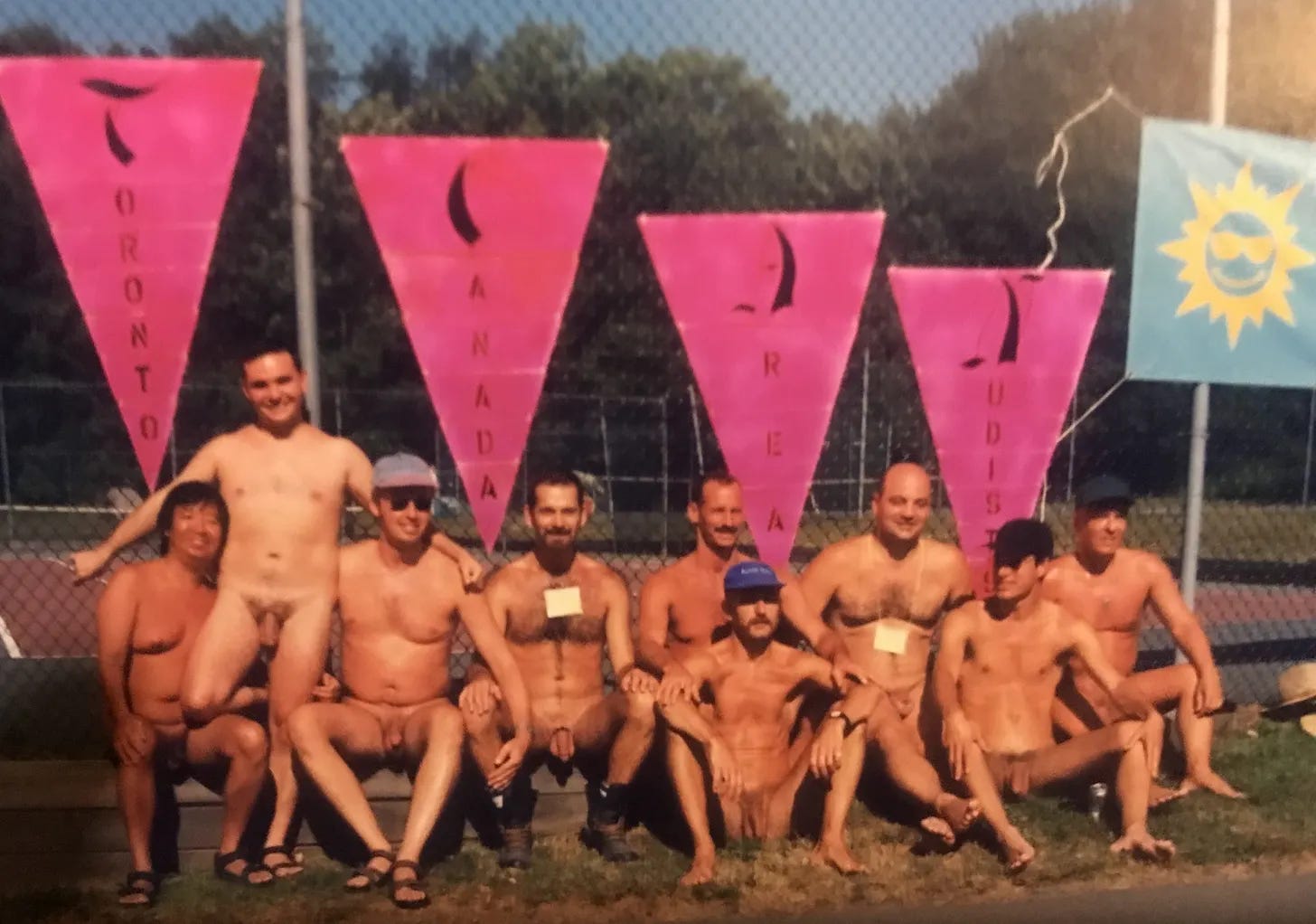
The group—which started off in 1995 as Toronto Canada Area Nudists (TCAN)—had GNI connections. “When I heard about GNI Gatherings,” founding member Peter Gray said in an interview for a previous Planet Nude article, “I couldn’t get there fast enough.”18
In August 1992, he and another gay Toronto nudist, David Drascic, spent a week with 600 others at the GNI summer camp in the Pennsylvania woods. The experience proved galvanizing. The two men, by now partners, started hosting naked parties at their home in Toronto the following summer, filling the guest list largely through contacts accumulated at GNI.
Eventually, TCAN became TNT!MEN and dedicated itself to “fostering the growth of gay-positive social nudism” and “amending the Criminal Code of Canada provisions related to being nude in a public place.”19
A short time later, Toronto police forces launched a wave of targeted raids against the group’s indoor events. TNT!MEN refused to retreat into the shadows, however. They enlisted local attorney Peter Simm—the same lawyer who successfully restored the official clothing-optional designation at Hanlan’s Point Beach in 1999—to fight the charges.
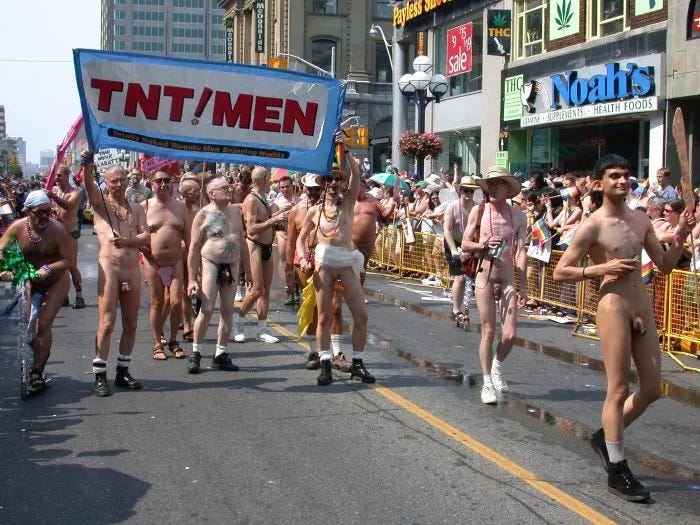
In a historic legal victory in the year 2000, Simm successfully defended TNT!MEN and won the decriminalization of indoor naked bar events in Canada. This monumental case proved that social nudity among consenting adults in an adult space was entirely lawful. The legal momentum generated by TNT!MEN directly paved the way for the City of Toronto to permanently carve out and legally protect the clothing-optional beach at Hanlan’s Point in 2002 and opened the way for legal nudity at events like Toronto Pride and the annual World Naked Bike Ride.
Why gay men choose naturism
The enduring, passionate interest of gay men in naturism is rooted in a unique psychological reality. Growing up gay in a world built for straight people means learning to live behind protective layers; the “closet” isn’t just an abstract concept. From adolescence, gay men learn to guard their posture, mask their voice, and police how they present their bodies out of shame and a fear of rejection.
Stripping off your clothes at a gay naturist gathering or even just among a group of friends at a beach becomes something deeper than simply enjoying the comfort of the open air and sun. It echoes, physically, the act of coming out.
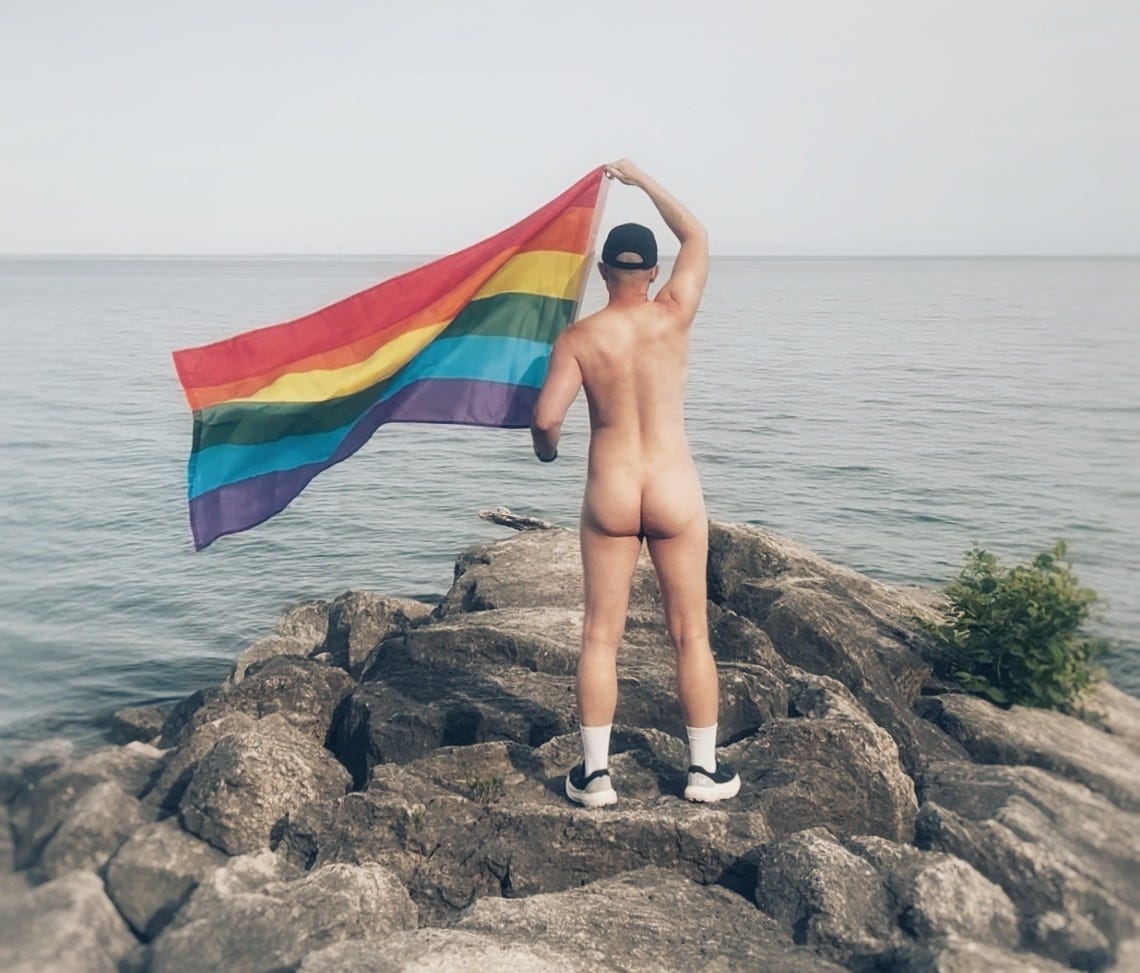
When you take off your clothes, you shed—at least to some degree—the societal labels, social classes, and textile camouflage that a closeted life demands. In a group setting, this can create a feeling akin to collective liberation. Walking, swimming, and simply socializing with other men in your most natural state creates a kind of healing.
It totally turns the tables on the image of the gay male body that mainstream society created—a body that carried stigma, shame, and guilt. Social naturism thus offers a freedom for gay men, a place where the exhausting job of trying to “fit in” eases somewhat and where they can step out of the shadows.
Decades after Murray Kaufman and Lee Baxandall mapped out the blueprint for GLN, Gay Naturists International remains a vital force.20 While the proliferation of digital apps and shifting societal acceptance have changed how gay men find community, the physical experience of outdoor communal freedom cannot be replicated on a screen.
GNI did something profoundly subversive: It took the concept of the naked gay man—a concept that a puritanical society had thoroughly sexualized, criminalized, and shamed—and placed it back into the hands of nature. In doing so, it proved that when you take off your clothes among friends, you don’t just lose your garments. You lose your defenses, your shame, and your isolation, stepping out into the bright, healing light of self-acceptance. 🪐
Special thanks to the American Nudist Research Library and the Western Nudist Research Library for access to the archival nudist publications referenced in this article.
Dale Barbour, Undressed Toronto. Winnipeg: University of Manitoba Press, 2021, p. 219.
Fire Island Pines Historical Society, “The Meat Rack on Fire Island, Est. 1950s.” https://www.pineshistory.org/the-archives/the-meat-rack-est-1950s
Wayne E. Stanley, “Introduction,” The Complete Reprint of Physique Pictorial. Köln, Germany: Taschen, 1997, pp. 6-17.
Micha Ramakers, Dirty Pictures: Tom of Finland, Masculinity, and Homosexuality. New York: St. Martin’s Press, 2000, xi.
Editorial, Mr. Nudist, Vol. 1, No. 1, January 1968, p. 5.
“The Quiet Revolution in Nudism,” Mr. Sun, Vol. 1, No. 3, January 1967, pp. 16-27.
Lee Baxandall, “Gay Awareness,” Clothed With the Sun, 1.3, November 1981, pp. 42-3.
Michael S. Sands, M.D., “Nudism: Counterforce To Aberrations,” Nudist Newsfront, Vol. 2, No. 1, 1964, pp. 24-25, 50.
Michael Stanley, “Homosexual Nudism, Plague of America,” Nudism’s Golden Days, 14, March-April 1966, pp. 5-19.
Baxandall, “Gay Awareness.”
Leslie Rollins, “Murray Kaufman and the Gay Naturist Movement,” Nude and Natural, 12.2, 1992, pp. 77-81.
Gay and Lesbian Naturists, Vol. 1, No. 1, Spring/Summer 1984. Available from the GNI archives: https://www.gaynaturists.org/files/documentlibrary/history/1984_spring_summer.pdf
Leslie Rollins, “A SIG of The Naturist Society Becomes an International Organization,” Nude and Natural, 12.2, 1992, pp. 73-7.
Dan Smith, “An ex-newbie gets off the fence,” The Gay Naturist Informer, October 2009, pp. 42-3.
Rollins, “Murray Kaufman and the Gay Naturist Movement.”
Tom Scott, “Gay Male Nudists,” Clothed With the Sun, 1.3, November 1981, p. 43.
GNI, cited by Garth Barriere, “Gay Nudism in Canada,” Going Natural, Spring 2004, pp. 46-7.
See the full history of TNT!MEN here: Curtis Atkins, “TNT!MEN: The gay nudists who helped Canada get totally naked,” Planet Nude, June 27, 2024. https://curtisatkins.substack.com/p/tntmen-the-gay-nudists-who-helped
TNT!MEN By-Laws. Archived here: https://web.archive.org/web/20070304090249/http://tntmen.abuzar.net/tnt/constitution.html
“GNI: Gay Naturists International,” The Naturist Living Show, episode 159, Sept. 22, 2024. https://www.naturistlivingshow.com/2024/09/gni-gay-naturists-international.html
The first "out" Nudist "gay" or men only nudist venue that I have tracked down, is /was ...Sun Lake Camp for Men in extreme northern Hillsborough County (2 miles south of Lake Como) that ran circa 1948-1953 ish. I have a couple of photos. Owned by a gay naturopath from St Pete and ran by a younger gay man who was a music teacher. The famous naturopath was outed (can't believe he was not out before) when he was arrested on a "morals" charge somewhere else.....I assume soliciting a male prostitute but it was not worth my time to track down the case if the paperwork exists. The manager just disappeared to the extent that a friend took out an ad looking for him a decade later.....as the famous naturopath owner subsequently sold the property of the camp rather quickly and that was that. I have a couple of his party lists from the late 40s which was a who is who of nudists/ naturists from the era. The first national organization MENSUN, based in Chicago, same era. I do not know for sure if it was Gay, or gay friendly or what, but their first convention was scheduled to be at Sun Lake, but not sure if it occurred or not. The info on Mensun is rather sparse and digging for it has not been a priority for me. not being a gay man, it is hard for me in 2026 trying to determine where the Sawmill, a huge clothing optional gay campground NE off Tampa and ones in Tennessee and Georgia fit into everything or not at all
Thanks a lot for the very interesting article, I understand that you have invested a lot of time and effort. Important documentation of significant parts of the history and development of the liberation process for us homosexuals, but also for the history of naturism.