

Ohio bill would redefine indecency by targeting the female breast
One year after raising concerns about HB 249, the threat has moved from committee to the Senate floor

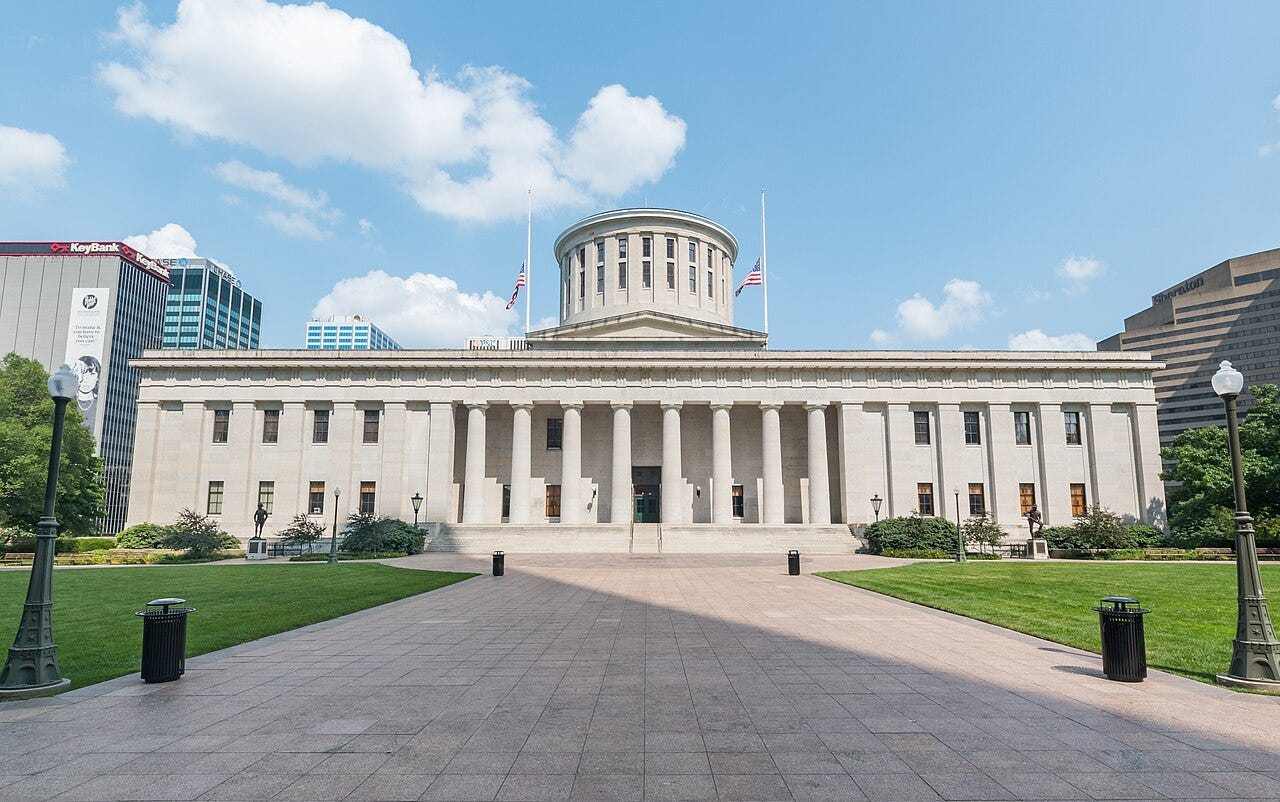
When Ohio’s House Bill 249 was introduced last spring, Planet Nude raised concerns about its vague language, its expansion of obscenity definitions, and what it could mean for naturists and others whose bodies defy conventional dress norms. At the time, the bill hadn’t been assigned to a committee. It has now passed the Ohio House.
On March 25, 2026, HB 249—the Indecent Exposure Modernization Act—cleared the House by a 63–32 vote, largely along party lines. It now sits in the Ohio Senate Judiciary Committee.
From suggestion to definition
What’s sharpened since our initial coverage is a specific statutory change that moves the bill from vague threat to explicit one. The bill replaces the term “private parts”—never defined in Ohio’s public indecency statute—with “private area,” a term already defined elsewhere in the Ohio Revised Code to include the genitals, pubic area, buttocks, and female breast below the top of the areola, whether nude or covered only by an undergarment.
Under the old undefined language, the legal status of topfreedom existed in genuine legal ambiguity that courts navigated case by case. Under the new language, the female breast becomes a named, codified body part whose exposure constitutes indecency. Rather than relying on vague standards like “affront” or “mature themes,” this version draws a direct anatomical line.
Laws that define indecency by specific body parts tend to reinforce longstanding asymmetries—male chests treated as neutral, female chests as regulated. For advocates of topless equality and body freedom, this is a familiar battleground. For naturists, the concern is less about any single body part and more about how expansively such definitions get applied once they’re in statute.
A topless sunbather, a nude figure at an outdoor art event, or a remote skinny dip can all become vulnerable to prosecution—not because of sexual conduct, but because of how a body is categorized under the law.
No exemption for naturist clubs
The bill’s only carve-out for breast exposure is narrow: a woman breastfeeding is not in violation if the exposed area is the breast. There is no exemption for private naturist clubs. There is no exemption for consensual adult recreational nudity. Ohio’s longstanding naturist resorts—several of them AANR-affiliated, some operating for decades—appear nowhere in the bill or its legislative record.
The statute does require that conduct be “likely to be viewed by and affront others” in the person’s proximity—language that offers private resorts some implicit protection, since guests at a clothing-optional facility can hardly claim to be affronted by the nudity they came to participate in. But that protection is factual and arguable, not codified. It depends on a jury’s reading of “affront,” on whether any portion of a resort is visible from neighboring property, and on the discretion of whoever decides to bring a charge in the first place. An explicit private-club exemption would make that protection real. The bill contains none.
Three committee hearings in the House Judiciary Committee focused almost entirely on the bill’s drag performance and gender-identity provisions. The ACLU of Ohio, in opponent testimony, raised concerns about enforcement discretion, noting that determinations of what is “patently offensive” are left entirely to the arresting officer and the charging prosecutor. That concern applies just as directly to a naturist resort as to a drag venue.
As we noted in our original coverage, this is Lovejoy’s Law in action: the appeal to child protection does real political work, keeping scrutiny fixed on drag performers while the broader definitional changes move through without comment. Rep. Angie King (R-Celina), the bill’s primary sponsor, called overbreadth concerns “the peak of fear mongering”—a response directed at critics arguing the bill could criminalize bikinis and sports bras, not at naturist concerns, which haven’t warranted a response at all. Organized naturism is watching. In a recent communication to members, AANR Executive Director Erich Schuttauf confirmed the organization is preparing to weigh in with the Senate Judiciary Committee directly.
The window
Senate Judiciary is where this can still be addressed. An amendment carving out private naturist clubs and consensual adult recreational settings would preserve the bill’s stated goals while ensuring Ohio’s naturist community isn’t collateral damage. Whether the Senate moves quickly or lets the bill sit is an open question—the 136th General Assembly runs through the end of 2026.
What’s no longer in question is the direction of travel. Over the past year, HB 249 has moved from a broad and ambiguous expansion of obscenity law to a more direct attempt to define where the boundaries of the body itself are drawn. Ohio naturists, and anyone tracking the legal landscape for body freedom, should be paying attention now. 🪐


What should naturists in Ohio be doing at this stage?
What’s about Breastfeeding? It’s not against the laws. There’s no one is above the laws.