


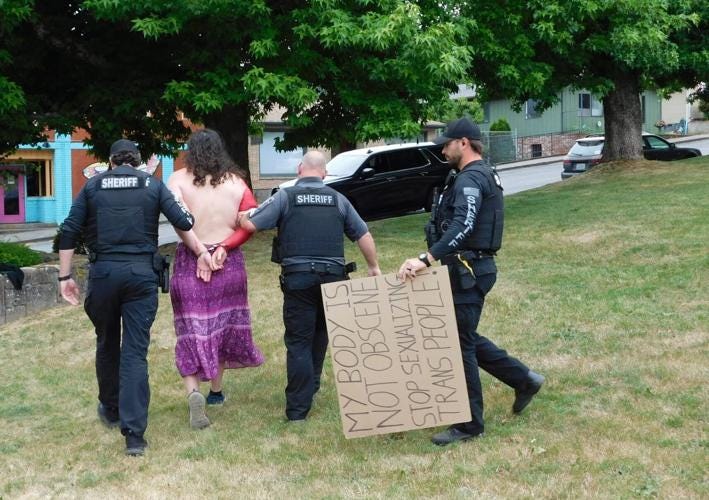
On March 31, 2025, a city councilmember named Lucy Lauser in Stevenson, Washington walked to the courthouse lawn and took off her shirt. It was International Transgender Day of Visibility. She had written four words across her chest in marker: MY BODY IS NOT A SIN.
Lucy Lauser was first elected to the Stevenson City Council in 2023, the first openly transgender person to hold elected office in the town of just 1,400, roughly, where the Columbia River runs just south of downtown. It is not a city where a sitting councilmember typically ends up at the center of a First Amendment case that goes to the state supreme court—but these are unprecedented times, and that is where the councilmember ended up.
What Lauser did that morning was not, on its face, complicated. She stood in public, in daylight, as a political act on a day designated specifically to celebrate transgender people, and she made her body the text of her argument. It was not sexual. There was no lascivious intent. It was not meant to titillate. It was a statement of protest.
What happened next is the story
Not long after the protest, two recall petitions were filed against Councilmember Lauser—both by the same Stevenson resident, Kathleen Fitzgerald. The first petition, based on the March 31 protest, alleged that by exposing her breasts in public, Lauser had violated her oath of office and committed malfeasance. The Skamania County Superior Court agreed, finding the charge legally sufficient—ruling that "malfeasance" required nothing more than commission of a crime, and the crime, in the judge's reading, was indecent exposure. That ruling sent the case to the Washington Supreme Court.
The second petition, filed after Lauser's July 4 arrest, made essentially the same argument on the basis of the new incident. A Skamania County judge dismissed it.
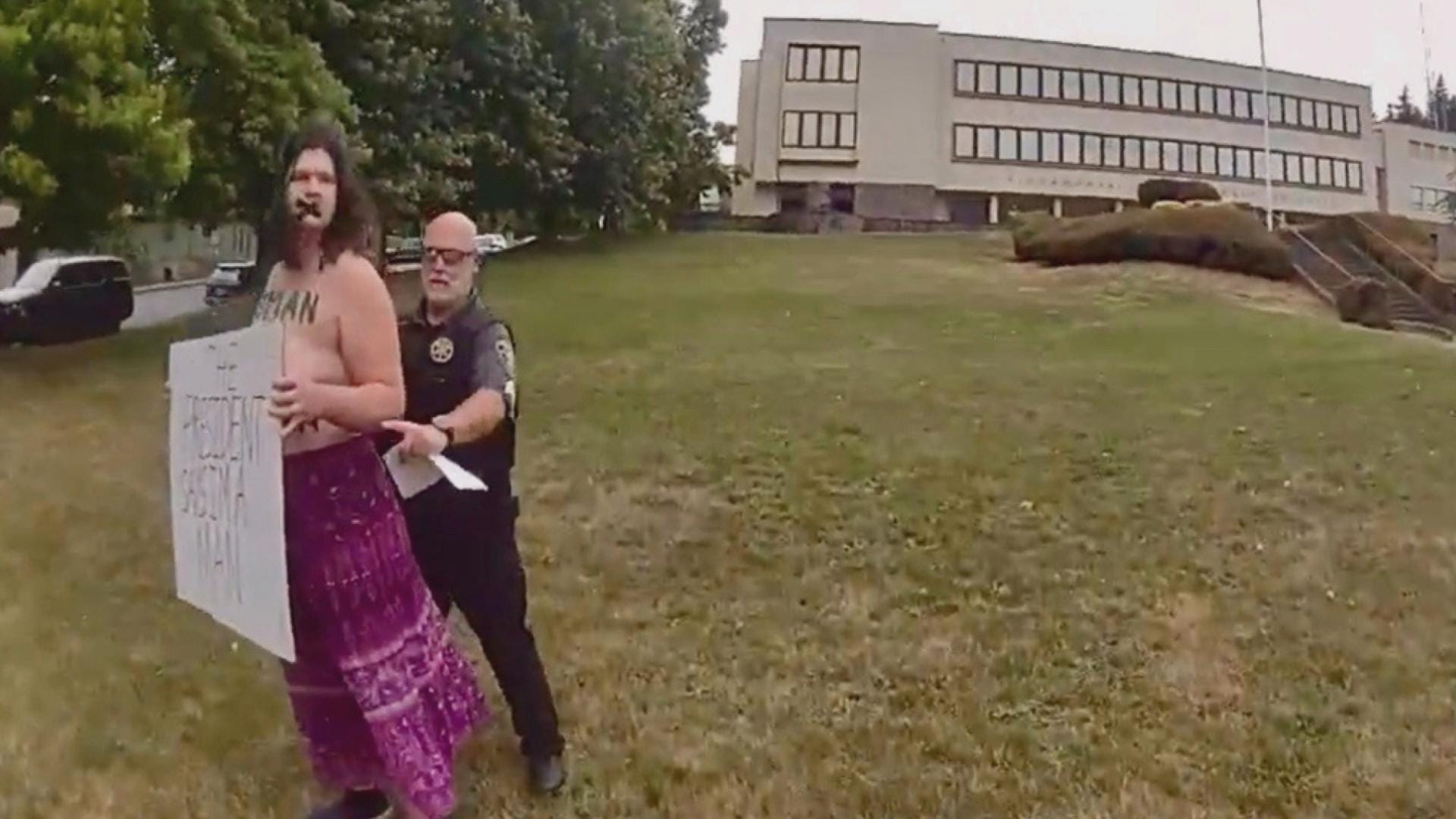
There was also an arrest. On July 4, 2025, Lauser returned to the courthouse lawn for a second protest—this time with her nipples covered in black tape, one arm painted red, mouth taped shut, and “woman, life, freedom” written across her chest. She was taken into custody and charged with misdemeanor indecent exposure—despite the black tape covering her nipples. She entered a not guilty plea. A Knapstad motion—a pretrial mechanism that asks the court to rule that even accepting all the facts, no crime occurred—was heard in Skamania County District Court in November 2025. The judge said the case raised “complicated stuff” and took it under advisement. As of this writing, that criminal charge is still pending.
The Washington Supreme Court, however, was not confused.
In a ruling issued February 26, 2026, the court dismissed the first recall petition and said plainly what the lower court had refused to say: Lauser’s protest was constitutionally protected expressive conduct. Indecent exposure under Washington law requires intentional, obscene exposure. Obscene means sexually motivated, or lewd and lascivious. A topless protest on International Transgender Day of Visibility, at a courthouse, with political text written on the body—that is not obscene in any sense the law recognizes. The recall petition was neither factually nor legally sufficient.
The ACLU of Washington, which had been actively advocating for dismissal throughout the case, called the ruling a vindication.
Despite the win, Lauser resigned from the Stevenson City Council on March 31, exactly one year after the protest that started all of this. She had planned the resignation for months, always intending it as the final act in a deliberate sequence. In her prepared statement, she explained why staying no longer made sense: “I’ve been able to do more to feed the hungry outside this position than in it. I've done more to provide shelter for the homeless outside this position than in it. And I've done far more to defend the constitutional rights of my constituents outside this position than in it.” She did not sound like someone who had lost.
Takeaways and examinations
The Washington Supreme Court found that nudity, on its own, is not obscene. Obscenity requires a sexual element — a lascivious or prurient motivation that transforms exposure into something the state has a legitimate interest in suppressing. Remove that element, and what you have left is a body. A body is not, by itself, a crime.
This distinction matters far beyond the specific facts of Lauser’s case. It is the same distinction at the core of every fight over nude beaches, naturist parks, clothing-optional spaces, and the legal gray zones that body-freedom advocates navigate constantly. The law in most jurisdictions does not say nudity is illegal; it says obscene nudity is illegal. But in practice, nudity and obscenity get treated as synonyms — by prosecutors, by local ordinances, by school boards invoking “community standards,” by social media platforms that algorithmically flag the human body as adult content regardless of context.
What Lauser’s case gives the body-freedom argument is a piece of paper from a state supreme court that says: no. These are different things. And the difference is not a technicality — it is the substance of the law.
Lauser is transgender, and the context of her protest was transgender rights. It would be easy to read her story as purely a trans rights story, and it is that. But it is also something more specific: a case about what the body is allowed to mean in public space, and who gets to decide.
Part of what made her protest legible as a protest at all is the very double standard she was challenging. A shirtless man on the courthouse lawn on the Fourth of July is unremarkable. A shirtless woman is a different matter — potentially criminal, certainly controversial. That asymmetry encodes a presumption that female-presenting chests are inherently sexual, that they require covering not because of anything they do but because of what we’ve decided they mean. For a transgender woman, the double standard becomes a trap with two edges: her body is simultaneously too female to be uncovered in public and, in the eyes of her critics, not female enough to be protected by the same arguments a cisgender woman might make.
That trap is also, in a different register, familiar to naturism. The free speech frame that won Lauser’s case only protects the body when it’s saying something — when there’s a message, a courthouse, a marker on the chest. What naturism has always wanted to establish is harder to litigate: that the body doesn’t need a reason. That nudity isn’t an argument. That it shouldn’t have to be. The ruling protects the protesting body. The body that simply exists is still waiting for its day in court.
That distinction doesn’t diminish what Lauser did. It just clarifies what remains undone. The constitutional record now has something in it that wasn’t there before. The state may still try to convict her on the criminal charge. And the larger argument — that the body doesn’t need a reason — is still being made the slow way, outside courtrooms, one nude beach and one naturist park and one clothing-optional space at a time. 🪐
Nicely written, Evan. The judges have made clear, objective decisions.