


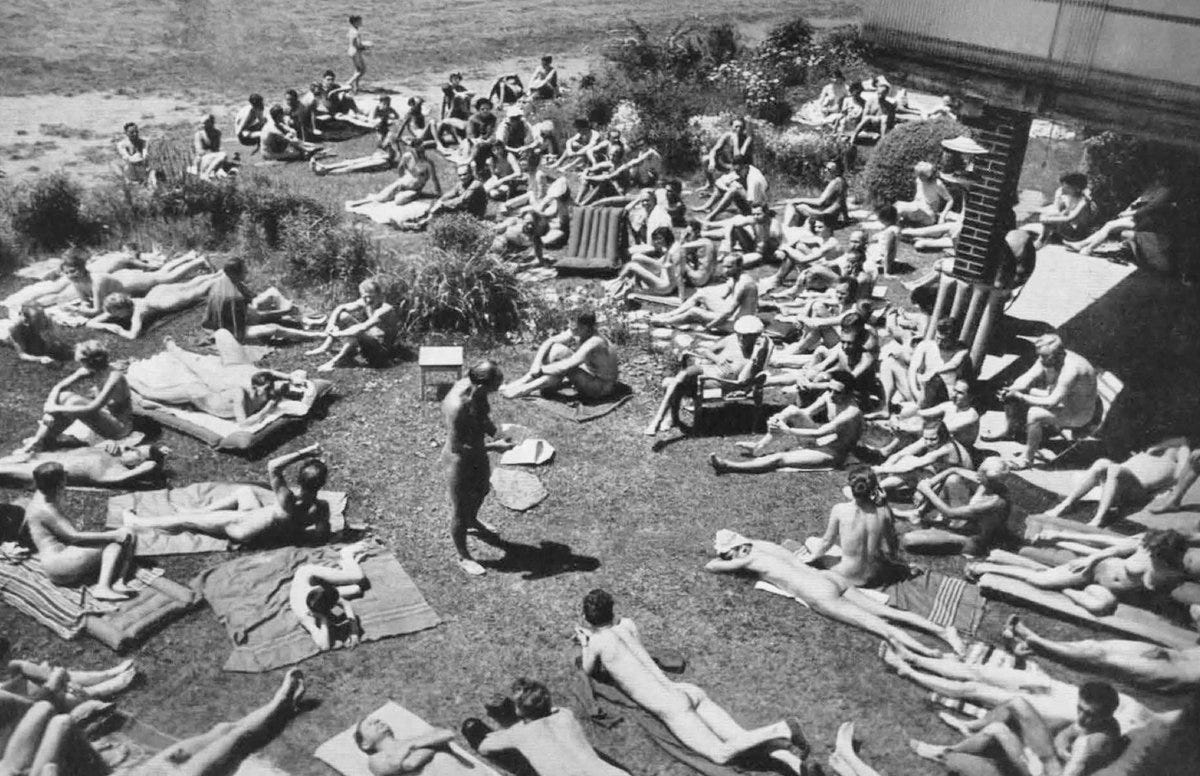
I finally found myself back at my local nudist club last weekend after several months away, and it felt every bit like the propitious return to a familiar sanctuary of serenity and camaraderie that I'd been longing for. Though it had been way too long since my last visit, it felt as if no time had passed as I was again surrounded by familiar faces and warm greetings, igniting an overwhelming sense of community. Since I first became a member of the club almost four years ago, my family and I have felt welcomed by the community there, and now whenever I visit, even after long periods away, I’m met with warmth and kindness. I see friends that I only see when I’m there. We have our own references and jokes. When I go into the cafe, they remember my regular orders. If I’m there alone, they ask after my wife and want to know about how much my son is growing up. The atmosphere hums, and I am always revitalized from this place where I feel my self flourish, unburdened by the stress and weight of the real world, accepted as I am.
Whenever I’m there and witness this vibrant community, I think of the ‘third place’—a term introduced by sociologist Ray Oldenburg in his 1989 book, "The Great Good Place." Third places are distinct social environments, separate from home (the first place) and work (the second place), where people gather to connect, unwind, and exchange experiences. These spaces, like cafes, libraries, and parks, nurture community, inclusivity, and a sense of belonging that fortifies our social fabric. Third places encourage relaxation and unproductive conversation, providing an essential reprieve from the pressures of daily life. These spaces are integral for human happiness and social development, providing a place to exchange ideas and stories. Nudist spaces like my local club exemplify this notion.
Defining the ‘third place’
The following excerpt, from Wikipedia,1 lays out the essential qualities of the ‘third place’, according to Oldenburg:
Neutral ground - Occupants of third places have little to no obligation to be there. They are not tied down to the area financially, politically, legally, or otherwise and are free to come and go as they please.
Leveler (a leveling place) - Third places put no importance on an individual's status in a society. One's socioeconomic status does not matter in a third place, allowing for a sense of commonality among its occupants. There are no prerequisites or requirements that would prevent acceptance or participation in the third place.
Conversation is the main activity - Playful and happy conversation is the main focus of activity in third places, although it is not required to be the only activity. The tone of conversation is usually light-hearted and humorous; wit and good-natured playfulness are highly valued.
Accessibility and accommodation - Third places must be open and readily accessible to those who occupy them. They must also be accommodating, meaning they provide for the wants of their inhabitants, and all occupants feel their needs have been fulfilled.
The regulars - Third places harbor a number of regulars that help give the space its tone, and help set the mood and characteristics of the area. Regulars to third places also attract newcomers, and are there to help someone new to the space feel welcome and accommodated.
A low profile - Third places are characteristically wholesome. The inside of a third place is without extravagance or grandiosity, and has a homely feel. Third places are never snobby or pretentious, and are accepting of all types of individuals, from various different walks of life.
The mood is playful - The tone of conversation in third places is never marked with tension or hostility. Instead, third places have a playful nature, where witty conversation and frivolous banter are not only common, but highly valued.
A home away from home - Occupants of third places will often have the same feelings of warmth, possession, and belonging as they would in their own homes. They feel a piece of themselves is rooted in the space, and gain spiritual regeneration by spending time there.
Nudism as the ‘third place’
Nudism, in its essence, offers a potent third place experience. Nudist clubs, beaches, and events create neutral ground for individuals from diverse backgrounds to unite and engage on a deeper, authentic level. The absence of clothing dissolves social barriers, fostering open, honest communication. This atmosphere cultivates inclusivity, strengthens social connections, and instills genuine belonging. Often, these spaces go hand in hand with a community of regulars, brought together in common reverence for a place they find sacred. In these spaces, freedom from clothing and the inherent acceptance of one's body fosters a sense of ease and tranquility, and an interconnectedness with one another. Casual, unhurried conversations flow naturally, allowing people to leave their worries and stressors at the door.
My club, as I described at the beginning of this essay, ticks all the boxes above. It is a home away from home, a place of joy and respite. A place of community. It’s a cafe, a park, a library, a gym, all rolled into one. Outside of this club, I have primarily my home and my work. When I go to the local cafe, I see some vibrance and community to be sure, but nothing like the experience at my naturist club. In society, people seem to be in their own little bubbles. Many people won’t even make the effort to make eye contact. Usually—and I include myself in this—we’re all looking at our phones.
Third places in decline
In America, many of the institutions which have traditionally served as the third place for urbanites have seen a decline in recent decades. The rise of the internet and social media has shifted many social interactions online. The Covid-19 pandemic has only further isolated us all from one another, driving us online for our social interaction, and putting these essential third places even more at risk of failure. Sadly, our first and second places have also blended as many work from home. Our worlds have shrunk.
These trends only increase the need for humans to have a third place. Loneliness and isolation is killing us. According to studies, loneliness and social isolation can shorten a human lifespan by 15 years.2 As these third places confront these challenges in our rapidly evolving world, nudist clubs and clothing optional spaces are not exempt from this broader decline. It seems there are forces at work to erode the availability and accessibility of these cherished social spaces. Consequently, we risk losing these critical sources of connection and community.
Looking up
Despite the decline in nudist clubs, it helps to remember that there is still a dedicated community of individuals who value and appreciate the benefits of social nudity. As long as there are people who find meaning and connection in these spaces, there will be opportunities to revitalize and sustain them. In these unique environments, we transcend superficial barriers, embracing the very essence of our humanity. These spaces remind us that beneath our external layers, we share common ground—the yearning for connection, acceptance, and belonging. 🪐
https://en.wikipedia.org/wiki/Third_place
https://scholarsarchive.byu.edu/cgi/viewcontent.cgi?article=3024&context=facpub
Brilliant post Evan. I kinda knew which club you were referring to when you mentioned it had a library. I'm also a member of that club and I feel the same way about it. I commuted to work 60 miles each way for 15 years before my wife and I found our third place (nudist) community and it transformed both of our lives. Let me add a few additional observations about our (common) third place. First, for the most part, the friendly dialog is able to rise above the political divide. Our shared love for nudism is a bond that makes us want to avoid discussing "those" topics. Second, the bond goes deeper than simply liking to be naked and shoot the breeze together, to true caring for one another. When our camp was assaulted by fire and flood a few years ago, just about everyone pitched in to help. During the pandemic we maintained our social connections via Zoom. Whatever it takes. Third, there is a sense of empowerment that can be felt even by new members. If you have ideas for how to improve our community and are willing to put in a little sweat equity to make it happen, you will be recognized and appreciated.
Here's an excellent story of our "third place". Going back to the late afternoon/early evening of September 11, 2001. We had friends that lived at our club. We felt so alone, so scared, so unsure. We got in the car and drove to our club. A drive that takes us by an airport that was eerily dark and quiet. The drive normally takes 45 minutes to an hour. On that day, it was 30 minutes. Once we got through the gate, we headed to the restaurant, which had a large crowd for a weeknight. Hugs, handshakes and tears were shared. We had a dessert and coffee, and went to see our friends. The four of us went through the hugs and tears and were glued to the continuing coverage on TV. The sense of community, friendship and strength, of a "third place" was so very evident that evening.