



A few months ago, I had the pleasure of visiting Glen Eden Sun Club in California for the first time, as part of an article I was writing about the making of the film Disrobed and the future of nudist resorts. As a lifelong skinnydipper, it wasn’t a big leap for me, but it was my first time at an actual resort and first time chatting with so many devoted nudists.
Most people I spoke with had a general feeling that the nudist lifestyle was healthy, but they didn’t know about a new wave of research on the benefits of sun exposure, which turns out to be very good news for anyone who likes to get a little skin in the sun. So I’m here to spread the good news.
I’m a science writer. For the past decade, I’ve been researching the science of light and health for a new book coming out this month. My interest began after a series of studies upended the common belief that sun exposure was detrimental to health. One of the first was the Melanoma in Southern Sweden study, which tracked the sun habits of 40,000 Swedish women for 20 years. The goal was to establish the main risk factors for melanoma, and sure enough, the women who engaged in the most sun-seeking behaviors were more likely to contract melanoma. But unexpectedly, they were also much less likely to die than the sun-avoiders. They had lower rates of diabetes and cardiovascular disease, and while they had a higher incidence of melanoma, they were actually less likely to die from that, too.
Other studies have found similar effects. In the UK, researchers attached light-sensing watches to 89,000 volunteers to gauge how much light exposure they received, then tracked their survival over the following eight years. Those exposed to the most light during the day were much less likely to die. (Importantly, those exposed to the most light at night were more likely to die—bright days and dark nights seem to be equally important to good health.) In the U.S., people living in the sunniest regions are far less likely to die from cardiovascular disease or cancer than people living in darker places.
Those patterns were actually noticed a century ago, when scientists began noting that rates of many diseases rose with latitude. That fit well with earlier discoveries that sunlight could cure rickets and cutaneous tuberculosis, and a general consensus arose among doctors that the sun was the foundation of good health. That fed into the sanatorium movement, when patients would head to the Alps or California for the light cure, and it also helped boost the nudist movement.
By the 1980s, scientists were convinced that vitamin D was the key to these benefits. When sun hit skin, it produced vitamin D, which could cure rickets and perhaps a lot more. People with low levels of vitamin D in their blood had higher rates of more than 100 different conditions.
The easiest way to raise your D levels is through sun exposure, but by the 1980s doctors were increasingly concerned about sun-induced skin cancer, so they instead counseled sun avoidance combined with vitamin D supplements. But it didn’t work. In massive clinical trials, D pills failed to reduce the risk of any illness in any meaningful way, and the supplements are now considered unnecessary for any but the most severely deficient.
But that meant that the good health of the people with naturally high levels of vitamin D was due to the sun, not D itself. And indeed, over the past decade, we’ve figured out some of the reasons why. Sunlight hitting skin produces dozens of different molecules that can improve health. They lower blood pressure and reduce inflammation throughout the body, which is one of the keys to healthy aging. They enhance cognition, improve sleep, and flood the brain with mood-boosting endorphins. Perhaps most importantly, the skin acts as an observatory, sending a constant stream of signaling molecules to the rest of the body to tell it what’s happening in the world.
What about skin cancer? Yes, sun exposure definitely seems to raise your risk. But that has a smaller impact on public health than you might think. While skin cancer is very common, and unpleasant, most cases have few serious health consequences. The type of skin cancer that is most dangerous, melanoma, accounts for a tiny percentage of cases, and it isn’t strongly associated with cumulative sun exposure. It’s more closely connected to intermittent exposure, especially sunburns, and with very fair-skinned people, who are the ones who need to be the most cautious about the sun. People with darker skin have much less risk.
In fact, for most people, regular, nonburning sun exposure is actually associated with better outcomes for melanoma. That may be because vitamin D and its related compounds are actually produced by the skin to protect it from sun damage and skin cancer. It’s an incredibly elegant system in which the epidermis produces the solution to the problem in direct proportion to the extent of the problem. When skin receives moderate daily doses of sunshine, it becomes stocked with vitamin D, preparing it for the next day’s dose. (It also makes more melanin, of course, to create a protective tan.) Vitamin D taken orally gets into the bloodstream but not effectively into those outer skin cells, which aren’t connected to the blood supply.
The upshot of all this new science is that it’s becoming clearer and clearer that the best plan for optimal health is a steady diet of moderate, nonburning sun exposure. The nonburning part is important. Every scientist I’ve spoken with agrees that burns are bad news and we should get out of the sun well before they occur. They also agree that trying to get your D and other benefits through nothing but the skin on your face, hands, and arms is a mistake, as that will invariably visit too much sun damage on those parts. Instead, it’s better to spread that job across as much skin as possible for as little time as necessary, so no one section gets overwhelmed.
And that leads us right back to the nudist community, which has been doing a stellar job of this for decades. It turns out that sneaking in small amounts of light exposure outside of the classic beach moments—shade, sunset, whenever—makes a great practice. In fact, once you understand the skin’s role as an observatory, coordinating homeostasis with the brain, immune system, and endocrine system, it calls into question the use of clothes entirely. If you keep your body in the dark…well, you keep it in the dark. 🪐
Editor’s note
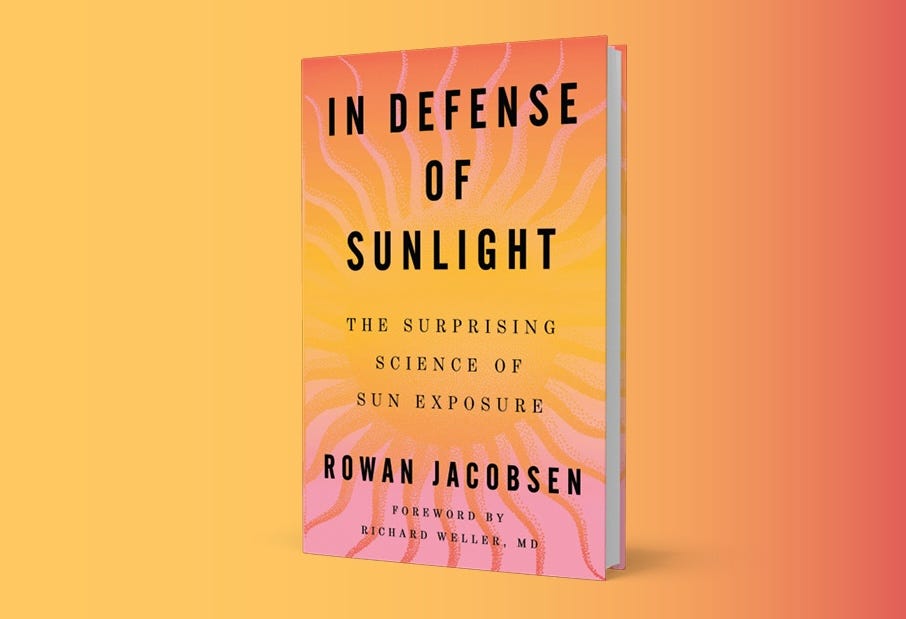
Rowan Jacobsen is a James Beard Award–winning science journalist whose work appears in The Atlantic, Harper’s, Outside, Scientific American, and the New York Times, among others. He’s written nine books, and his latest — In Defense of Sunlight: The Surprising Science of Sun Exposure (Scribner) — is out today, June 16. The essay below grew out of his reporting for that book, and I think it’s essential reading for anyone in this community. We’re lucky to have him here.
—Evan Nix, editor
 | A guest post by
|
Scheduled my first visit to Glen Eden and will be going soon. I can’t wait!
Rowan, At long last a better understanding of how the human body reacts to sunlight. I have just submitted a paper for peer review publication on a different topic but similar in that a century ago the argument that sunbathing improved your mood, well-being, and one's relationship to others as well as to one's own body. The research publications of the late 20th century and now in the early 21st century are documenting that only short exposures to being socially naked or even just seeing normal bodies that are without clothing, improves body-acceptance and self-esteem along with enhancing the acceptance of others. I have included some this work in my recent book "Birthright Bodily Freedom" that has been covered here at Planet Nude. I can feel the synergy taking place.