


Author’s note: With a little luck, there will be more of these. With some time, there could be plenty. With some effort, they may just make a book. But for now, it’s only this, a personal short (true) story just for paid subscribers. Enjoy.
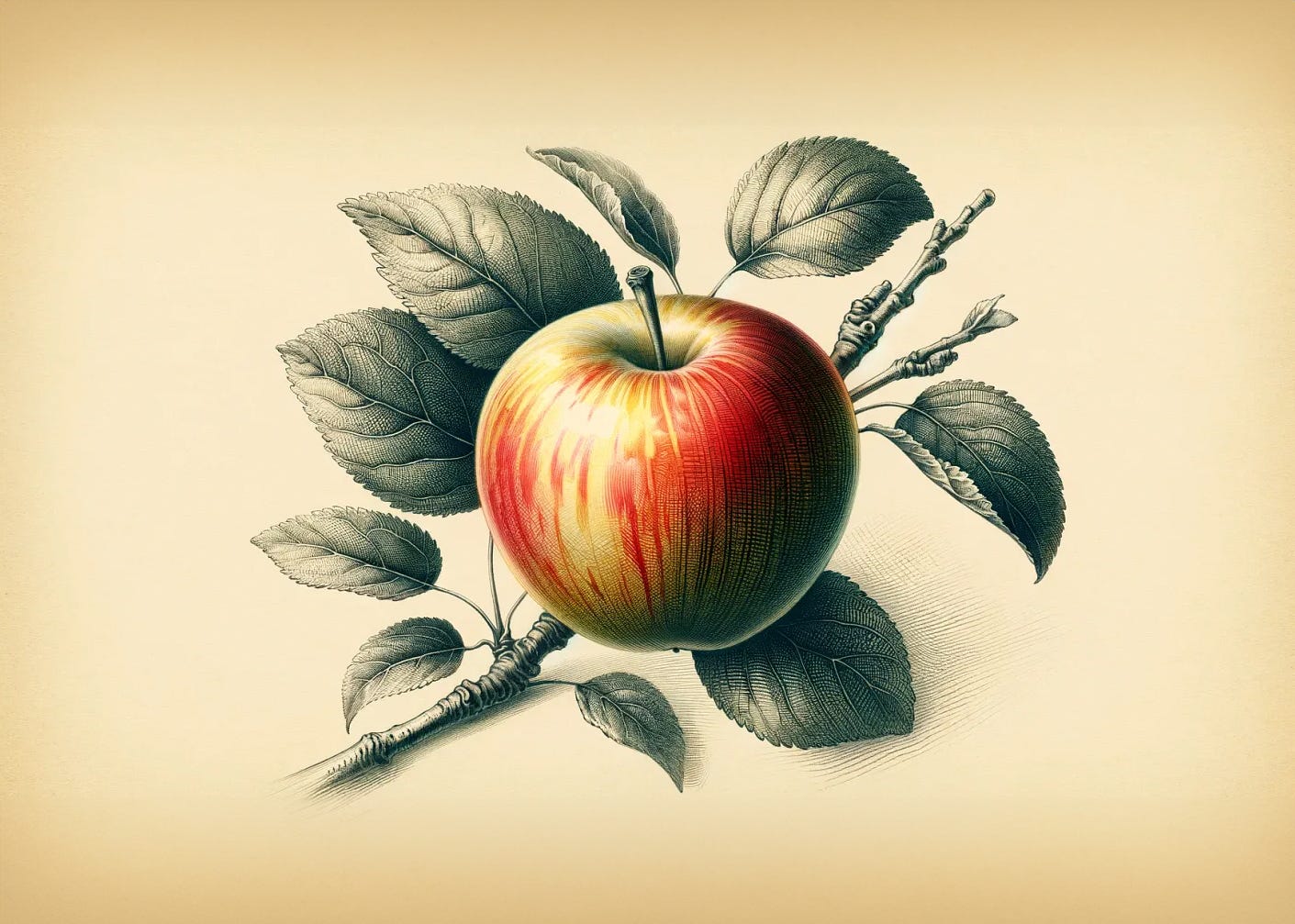
Under Antone’s apple tree is where I pull to a stop, alongside a large front yard on a sprawling plot of land spotted with several distinct varieties of fruiting trees.
The blonde woman who signals for me to park here is Tawnie, my second cousin once removed. I step out of the rental to greet her and I can finally see her up close. I estimate she is probably in her mid-fifties; I couldn’t ascertain her age from our limited interactions on Facebook before this moment. Above our heads are some of the largest apples I’ve ever seen, hanging languidly like cantaloupes. Tawnie doesn’t bother with any kind of introduction which makes me feel like family already despite our having never met. She talks fast. I wonder if she’s nervous.
“This is Zeke,” Tawnie gestures to a man of maybe fifty-eight who is laboring deliberately between a five-gallon bucket of apples and an old fruit press. I gather he’s her husband. Zeke looks up with a casual wave but quickly returns to scooping mashed skins out of the wooden basin of the press.
Tawnie and I chat for a few minutes, quickly getting to know each other and beginning to find the shape of our ancestral connection. The talk is directionless but intentional. We talk about her grandfather, Michael Johnson, and my great-grandfather, Antone Johnson, brothers separated by almost twenty years who both grew up on the land where we now stand.
Zeke’s ears perk up a little when the gab turns to Antone’s apple trees, the ones under which he’s been toiling. Antone had a penchant for transplanting and growing varieties of plants from all over the country onto their Washington property, a passion he inherited from his dad, Rudolph, who used to bring home a specimen of fauna whenever he traveled to a nudist club in another region. Antone was known to graft fruit trees together. One piece of lore I’ve heard ever since I was a kid visiting my grandma here told of a tree that was once on the far north end of the property, which was said to grow five different types of apples on it.
The reason for my visit
Amid a busy two-week camera gig for a corporate video in downtown Seattle, I decided to make the most of my only day off and set out on a fifty-mile drive south to Yelm, Washington, about an hour and a half away.
I went to the rental place right when they opened and drove down Interstate 5 until I’d cleared the urban areas of Seattle and Tacoma. The monolithic peak of Mount Ranier was looming large on my left, swathed in a layer of morning mist. I continued on smaller tree-lined country roads for another 20 miles until things started to look familiar. I couldn’t have picked a better time, I thought; here in the waning days of October, it seemed my trip was timed perfectly to catch the changing colors of autumn.
The land I was determined to find, where I now stand with Tawnie and Zeke, is a couple of acres in the Bald Hills of Thurston County, and it is home to Pat Johnson—Tawnie’s dad and cousin to my ninety-year-old grandma, Lovina. I’m here to meet Pat and for him to meet me. This land, or at least different segments over the generations, has been in my family for nearly 120 years.
In the five years in which I’ve been actively researching the life and legacy of Rudolph Johnson—Lovina and Pat’s shared grandpa and my great-great-grandfather—I’ve collected all kinds of previously undiscovered images, photos, and film footage of him, his writing and writing about him, newspaper clippings; I’ve recorded interviews with Lovina and a few of her living cousins about their memories of him. I’ve come to manage a Facebook group called Descendants of Rudolph Johnson, through which I’ve connected with at least two dozen previously unknown relatives, all of whom, on some level or another, grew up with stories about their crazy nudist grandfather. Through this work, my family has grown.
Despite Lovina’s repeated insistence that her cousin Pat would have some valuable stories about Rudolph, I have yet been unable to arrange that rendezvous until today.
I’ve visited this land multiple times, most recently in 2006, a few years after Lovina had sold her house to Pat and moved south to Nevada to be closer to her kids (my dad and uncles). Growing up in Nevada, I visited her here in Washington multiple times on summer trips. I have vivid memories of picking blackberries on this land with my great grandpa Antone before he died; memories of catching gardener snakes and banana slugs with my cousin Mikey; stories of Rudolph and the nudists frolicking (I assumed) outside the great stone house; memories of watching Lovina, in her sixties, raising chickens, gardening, cooking, doing backbreaking work and cursing up a storm with an intensity that, even with the boundless energy of a kid, I recognized as impressive.
That’s the nature of this side of my family. They’re unbelievably hard-working, feisty, foul-mouthed, crafty folk who have seemingly no upper limit to what they can accomplish on their own with a little grit and gumption, and they know it. It’s Lovina’s nature. Looking around at Pat’s land, spattered with work trucks and appliances—the construction and yard work he manages to keep up on even in his eighties—it seems clear to me that it’s Pat’s nature, too.
It was Rudolph’s nature, and that’s perhaps why so many of his descendants honor him by proudly embodying these same traits they inherited or cultivated.
Rudy the nudie
Rudolph Johnson is a tall tale figure in my family, with many stories, some true, some embellished through repeated telling. What's verifiably true is that he was born in Denmark and immigrated to the United States with his mother and father as a kid. He joined the Navy at a young age, changing his name from Jensen to Johnson. He bought 160 acres of wooded land and married Mary Prock in 1905. They soon were rearing kids, first Andrew, then Antone, Helen, Thurston, Augusta Mae, and finally Michael, each born consecutively every few years over the course of two decades.
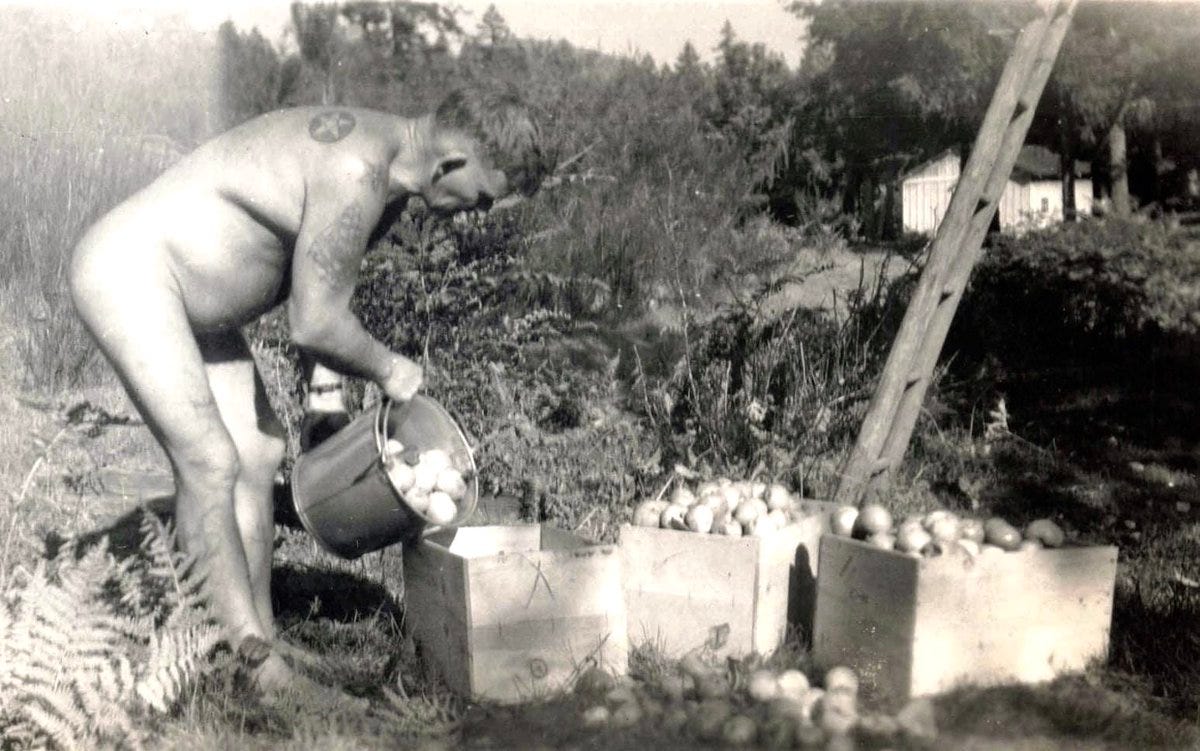
My grandmother paints her grandfather with a palette of boldness and warmth. My late uncle Teddy’s portrayal was markedly more formidable. “His balls clanked,” he would say. “He could freeze the shit in your bowels just by lookin’ at ya. The son of a bitch was so goddamned tough.”
The picture of Rudy that formed in my mind was of a folk figure, the archetypal benevolent tough guy, a man of contrasts. An immigrant carpenter who etched his mark as a pioneering nudist leader.
Rudolph’s most tangible legacy is a great cobblestone house in rural Washington, crafted from river rocks by his own hands, where he raised a family of eight with his dear wife, Mary, before transforming the land later in life into a haven for the freedom-loving nudists known as the Cobblestone Suntanners. This place was a nucleus of natural living, attracting sun-seekers far and wide to bask in the ethos of body freedom. “These people just liked to live naked,” my grandmother would explain as if there was nothing else to say to a curious and confounded inquiring child.
What I didn’t know then—what Lovina didn’t even know because our family’s folksy fables were a more intimate portrait of a family man—but which I would come to learn recently through research is the extent of Rudolph’s impact on the larger nudism movement. His pioneering achievements establishing an organization of nudist leaders in the Pacific Northwest, his ascent to the presidency of the national Sunbathers Association, and his national nudist legacy.
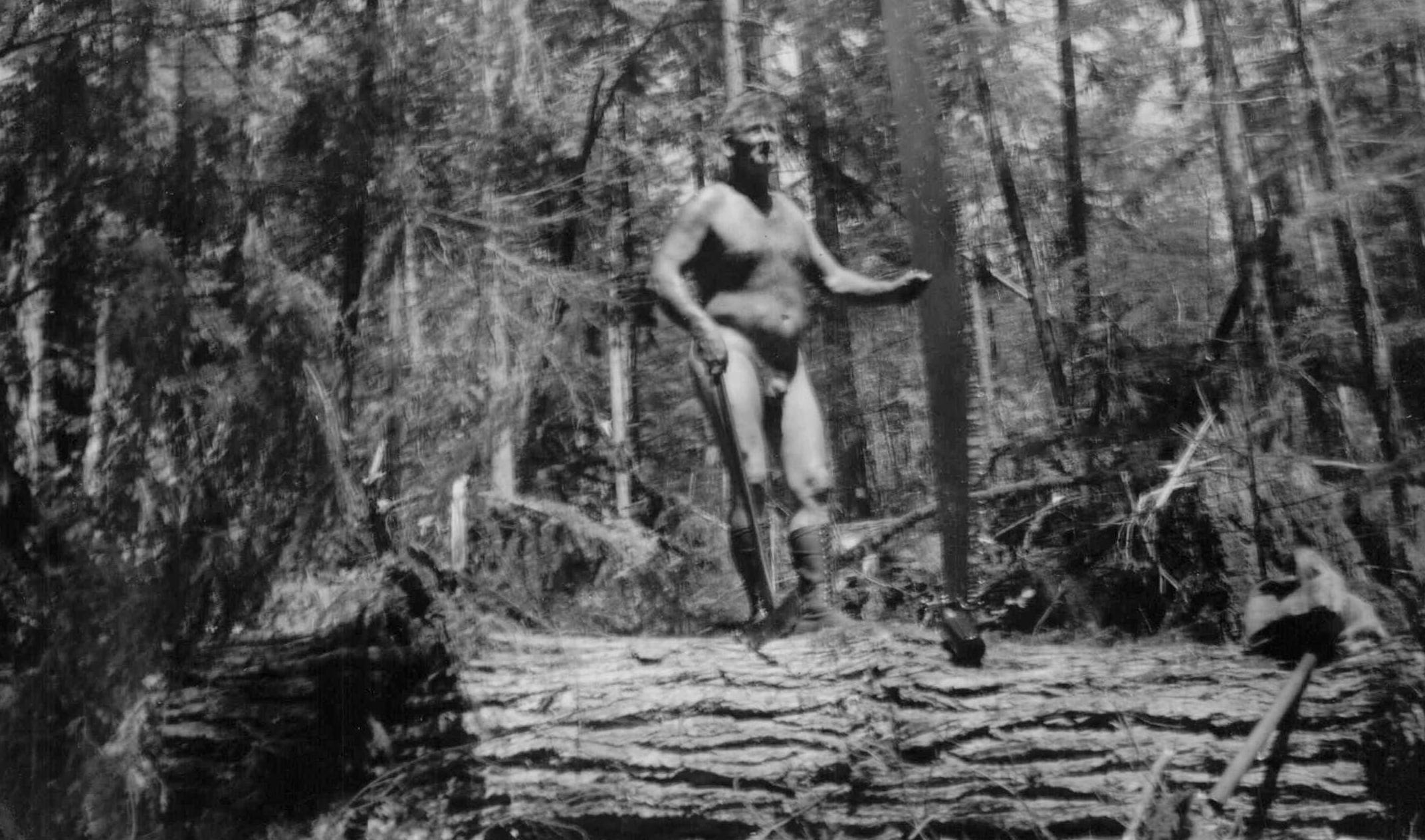
Even without the nudism, Rudy's escapades are legendary: Joining the navy at fourteen; the moonshine he made in underground stills and sold to legislators and cops at the state capital; working alongside his deaf-mute brother to erect a twenty-room mansion out of stones; his years as a logger for Weyerhaeuser taking down trees more than a dozen feet thick; his tattoos! On his feet, the words walk fast, and “a tattoo of an anchor on the end of his pecker,” as my uncle Mike loves to say; his artistic photography and creative images; his handcrafted furniture made from tree shaping; laboring nude through harsh winters to construct a massive pool, refusing to shave or shear until the job was done. His hands shaped his world, and his world became home to many.
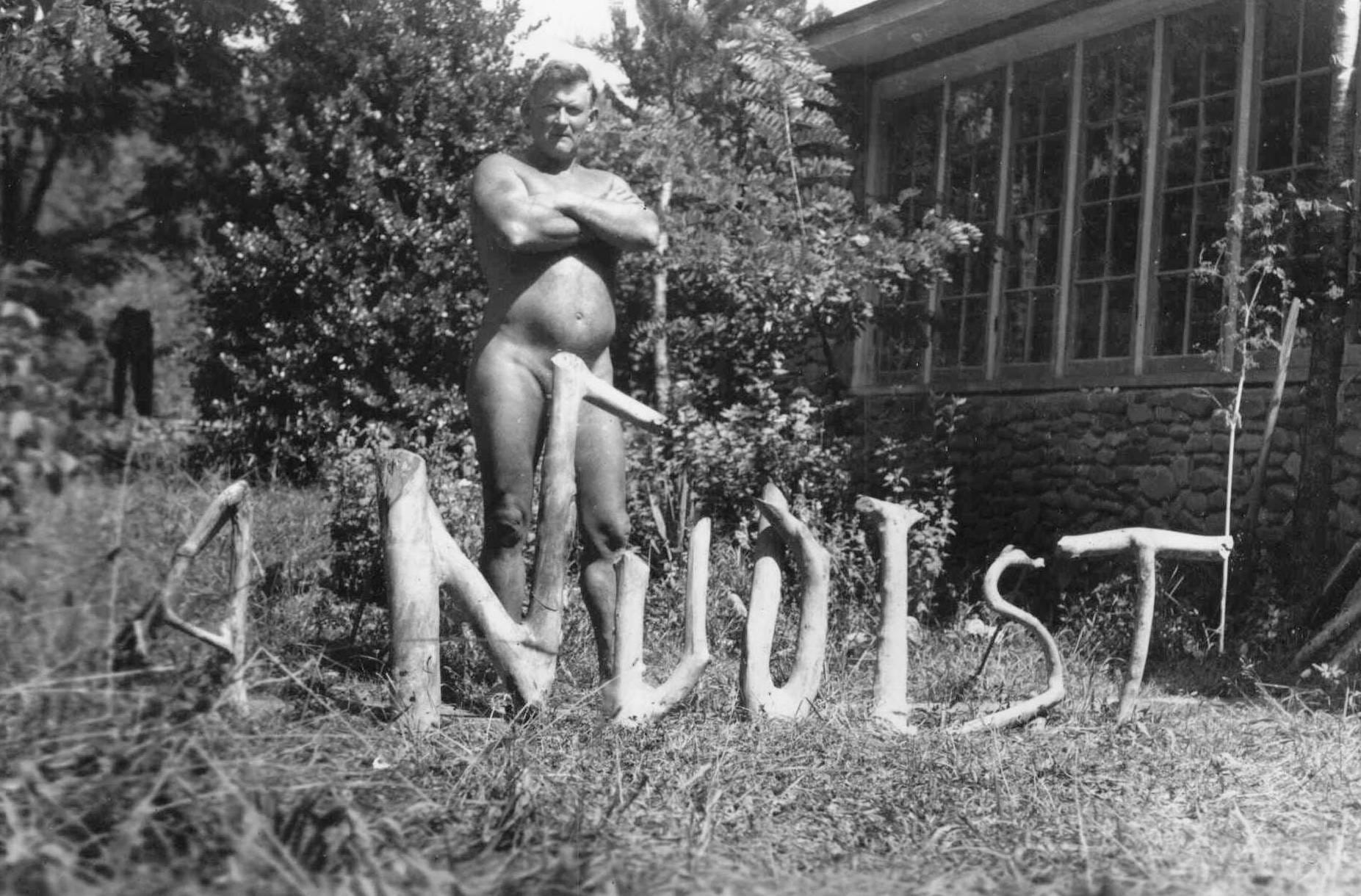
His sense of humor was subtle but sharp, often catching people off-guard. He had a knack for the whimsical, such as keeping his bees in an upstairs room during the frigid months and humorously cautioning the family to keep the door closed. Yet, it was the simple, joyous moments my grandmother described when she and her cousin Carol were perched atop the stone house's roof late at night, their giggles puncturing the still air as they feasted on cherries. My grandma remembers that night because they stirred the otherwise composed Rudolph to raise his voice, a rare break in character—not out of ire, but a frustrated plea for sleep.
To Lovina, he was Grandpa Rudy, a naked patriarch with a heart as grand as the stories told about him. To me, he’s the great-great-grandfather I never met, whose spirit seems to weave through our family tapestry; an American tall tale, at least the way my grandmother tells it.
Sitting down with Pat
I soon learn that Tawnie has not prepared Pat for my arrival at all, despite our having messaged back and forth planning my visit for several days in advance, not to mention her rather explicit instructions on what time to arrive and how to find my way down the gravel roads to his front door.
She encourages me to trust her plan. “I mentioned connecting you two several times over the years, but Dad procrastinates, you know,” she explains. “Now you’re here, I'm not gonna blow it. I'll just say, ‘Hey Dad, he texted me and said he might be able to come out…’”
“Oh,” I say, suddenly feeling like I’ve overstepped. I made this trip explicitly to meet Pat; I assumed he at least knew I was coming. “No pressure,” I say, “I’m happy just to meet you and Zeke and maybe walk down to the river. I don’t want to bother him.”
“Oh no,” she assures me. “As soon as you start talking to somebody, you know it's fine. Yeah, yeah. But try to make a date with them? Pfffff.”
I like Tawnie. I’m not sure about her strategy, but I have to trust that she knows her dad’s social intricacies better than anyone. Anyway, what choice do I have?
I follow her over to his house about a hundred yards away. It’s a small prefab home that Lovina placed there in the 90s on a lot adjacent to the one where the great stone house stands, whatever was left of Rudy’s original acreage that had remained in the family. We pass a detached garage, and I’m hit with a flashback of painting it one summer with Mikey, a major chore Lovina assigned to us at the time to teach us some character. At some point in the intervening years, Pat must have painted both structures green. It’s a nicer color than the blue-grey we used; it now seems to fit better with the verdant surroundings. Everything feels smaller than I remember.
As we walk up to the house's side door, Tawnie warns me that her dad’s memory isn’t what it used to be, and he may not be able to recall certain things or could get mixed up. I understand, I tell her. If his memory loss is anything like my maternal grandma’s was, even at the worst of her dementia, it was the newer memories that she lost. The older stories she could recall with clarity even when she couldn’t remember who she was sharing them with.
Tawnie pulls back the screen door and kicks off her shoes as she enters; I awkwardly follow. Before Pat even realizes he has a visitor, Tawnie delivers a bare minimum introduction, prompting him to recall Lovina's grandson, whom she has mentioned to him several times. Luckily, he seems to know what she’s referring to, and after looking me up and down with a mix of grace and a natural modicum of suspicion, he invites me to sit.
The family resemblance is plain. He looks like a mix between Rudolph and my uncle Bruce. His manner of speaking is very much like my grandma’s: loud and direct. Like she and most of my family, Pat spent a life working outdoors, spent his free time reading books, and never had a formal education. By all visible metrics, he is a tough-as-nails octogenarian I wouldn’t want to find myself on the wrong side of.
The room we’re in is much like I remember it, but Pat has painted and done some custom woodwork here and there—there’s a kitchen island that’s new and a cast iron stove I don’t remember with a splintering pile of firewood on the floor in front of it.
“Last time I was in this house was about 1996,” I say, looking around. “Lovina lived here still. It was still a new house back then.”
“Pert near,” Pat replies, which I take to mean just about. One of those folksy old hillbilly phrases my grandma also uses sometimes.
I sit on a loveseat next to a stack of magazines, and Tawnie pulls up a spot near her dad on a footstool. I’m promptly mobbed by four tiny dogs I never learn the names of, and before any of us knows it, we’re talking about the great stone house.
The great stone house
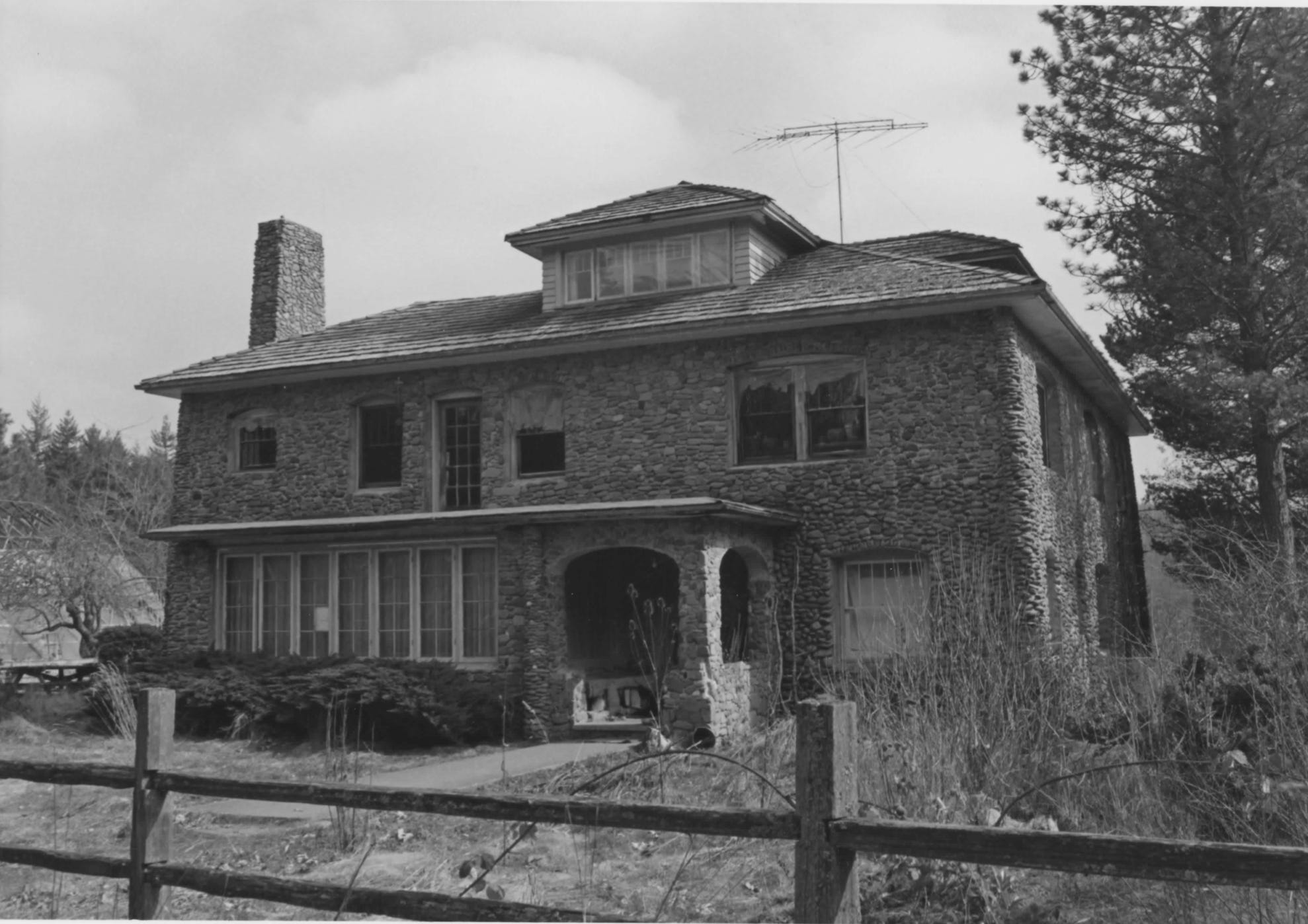
The great stone house was built by Rudolph and his brother, Holger Jensen, in 1927-1928. Holger was the architect, and Rudolph was the master carpenter. The house is massive, and according to the surveyor who examined the property for the National Register of Historic Places in 1985, it is historically significant for a few reasons:
The Johnson House is one of only two cobblestone houses in the county and is significant for the unusual interpretation of the American Foursquare Style in that building material. With the abundance of wood resources in the county, most other Foursquares are of a more traditional wood-frame construction and do not feature the distinctive porch, wall construction, fenestration or other Craftsman detailing of the Johnson House. Unlike other cobblestone houses from the period, the stones of the Johnson House form load-bearing structural walls rather than a veneer. Rudolf Johnson, [sic] the builder, was an individualist who later operated a nudist camp at the site.
The Johnson House is constructed of native prairie cobblestones. The boulders are remnants of the ice sheets of the Pleistocene Ice Age which left the stones as it retreated. The house is the design of Holger Jensen, the builder’s brother. Holger Jensen was trained at the Vancouver Deaf School and designed a number of houses in Olympia.
Rudolf Johnson came from Denmark to the area in 1905-06 and ranched on 160 acres bordering on the Deschutes River. From 1940-1955, Johnson operated a nudist club at the house called "Cobblestone Suntanners" at what was then known as "Cobblestone Lodge." Johnson also published the "Sunshine Health Magazine," [sic] advocating nudism. At that time, the house also had an adjoining swimming pool which has since been filled in.1
The Historic Register does not list square footage nor name how many rooms the house has, so it’s hard to convey its size, but it is massive. Lovina once told me that Rudolph had to cut down a tree a day just to keep it warmed, though, like many of her stories, I don’t know if that’s factual or embellished. I do know the fireplace was built large enough for Rudolph to stand upright in it without hitting his head. I know this to be true because I have stood in it.
At some point, I’m not exactly sure what year or how, the house fell out of the Johnson family’s ownership. For at least thirty years, its inhabitants have been basically strangers to the family, aloof neighbors.
I’ve been inside the house twice. Once when I was a kid and another time during that 2006 visit. Both times, we knocked on the door unannounced and expressed to the residents, who answered that we were related to the builder and were interested in viewing it. Both times, our exploration inside was politely allowed but limited to the main living area. It was clear to me in 2006 that the place was in significant disrepair, and to bring it up to modernity would be a monumental undertaking. The pool, not filled in as the above report suggests, is badly overgrown and nearly unsalvageable. I took pictures of it on that visit.
Discovery
Tawnie reveals that she’s never been in the great stone house, and I’m dumbfounded. She has spent her entire life here; how is that possible, I wonder. I realize it’s like this moment we are in. She sees her dad all the time and it’s business as usual, but now that I’m here to talk about the old family stories, she’s percolating with questions.
In response to a question she posed a few minutes ago, Pat is trying to picture the interior of the great stone house in his mind and count out the bedrooms, thinking back to his childhood, the last time he spent any time inside. “There's three stories… Four bedrooms on the top story. The main floor was the kitchen, dining room, the big living room. The alcove with the fireplace, the flower room, Grandpa's office, Grandma’s closet, Grandma's bedroom, Grandpa's bedroom. I never counted the two bathrooms in the house.”
“How many rooms total, Dad?” Tawnie asks.
“Well, there was six rooms downstairs, four on the top floor and ten rooms upstairs, so twenty rooms,” he finally settles on.
“Wow, twenty rooms,” I say, surprised. I’d previously thought twelve.
“When Grandpa died,” Pat says, “I lived with Grandma for, oh, three or four years… My bedroom was above Grandpa’s office.” Pat looks up to the ceiling as he retrieves these memories. “He died of colon cancer,” he continues. “He suffered terrible. He was only 67. He had just retired. Retired from Weyerhaeuser.”
“That was a logging company?” I ask.
“Yeah, they're a worldwide logging company.”
“They own everything behind and around us,” Tawnie adds.
“Yeah, your grandfather Tony worked for them too. He retired from them. He was a tramp logger before he met your mom's mother. All over the Northwest. I don't know if you read any of them old logging books of the logging camps up and down the coast, northwest coast?”
“No,” I say. “I would like to.”
“There’s a whole lot of history there,” Pat says. “It’s a major part of our history.”
We talk for an hour or so, flitting like birds on a patio from one topic to the next. It’s hard to focus on one discussion because there’s so much history to cover, so many stories to share, and we’ve barely had time to grasp what we know, let alone start to discover what one another doesn’t know. It dawns on me that I could spend weeks here and not leave feeling satisfied with all I’ve learned. I could spend a lifetime here, and there would still be some story I’d never heard, some new facet that has been unexplored. Generations have passed here, a hundred years. One can’t possibly catalog all the memories. Hell, Tawnie has lived in the area for fifty-plus years and hasn’t explored the great stone house where her father grew up and to this day lives no more than 500 yards from.
A person can never see the full picture. Like the cobblestones beneath the mighty Deschutes, the memories and stories are weathered down to smooth shapes over time. The best we can hope for is to identify the stories that endure, the broader features that form the shape of our character, which aren’t so easily worn away.
Maybe I’d hung too much hope on this trip, expecting something revelatory or meaningful rather than just a casual meeting, I can’t help but think.
Sharing new finds
“I'd like to get a copy of the book Ted made, the one Lovina has,” Pat says.
He’s referring to an old photo album I’ve seen many times, which, thanks to Lovina, I’ve scanned and saved digital copies of. “I've seen those,” I say. “I've scanned them. I'll make you copies.”
“That is my favorite,” Pat says, “‘cause it really shows Grandpa’s photography. There were some nice pictures of the swimming pool.”
“That’s right,” I say.
“But then Grandma, after Grandpa died before the nudists moved out, she hired a guy to come sandblast the swimming pool, reseal it, all the cracks, and he painted the bottom blue.”
“I've seen a film of that, too,” I say. “Eight-millimeter footage.”
“God, I'd like to get a picture of that,” Pat replied.
“I could probably show you one right now, actually,” I say. “If I can pull it up.”
I have a whole collection of old films and photos on my Dropbox account, which I can access on my smartphone. With some assistance from Tawnie, I’m soon on her dad’s Wi-Fi network. I notice Pat has a streaming device plugged into his TV, which is still playing an old Kevin Costner movie on mute from when he was surprised by the knowledge that he had a guest. With minimal effort, I broadcast the media from my phone onto the television.
In a moment, I pull up a clip I personally scanned from an old 8mm film reel. In it, two nudists are hosing down the freshly painted blue bottom of the emptied cobblestone pool.


Pat is stunned by what he’s suddenly seeing on his own TV. “How did you do that?” He asks.
“He’s a techie guy, Dad,” Tawnie assures him. “He can figure this stuff out.”
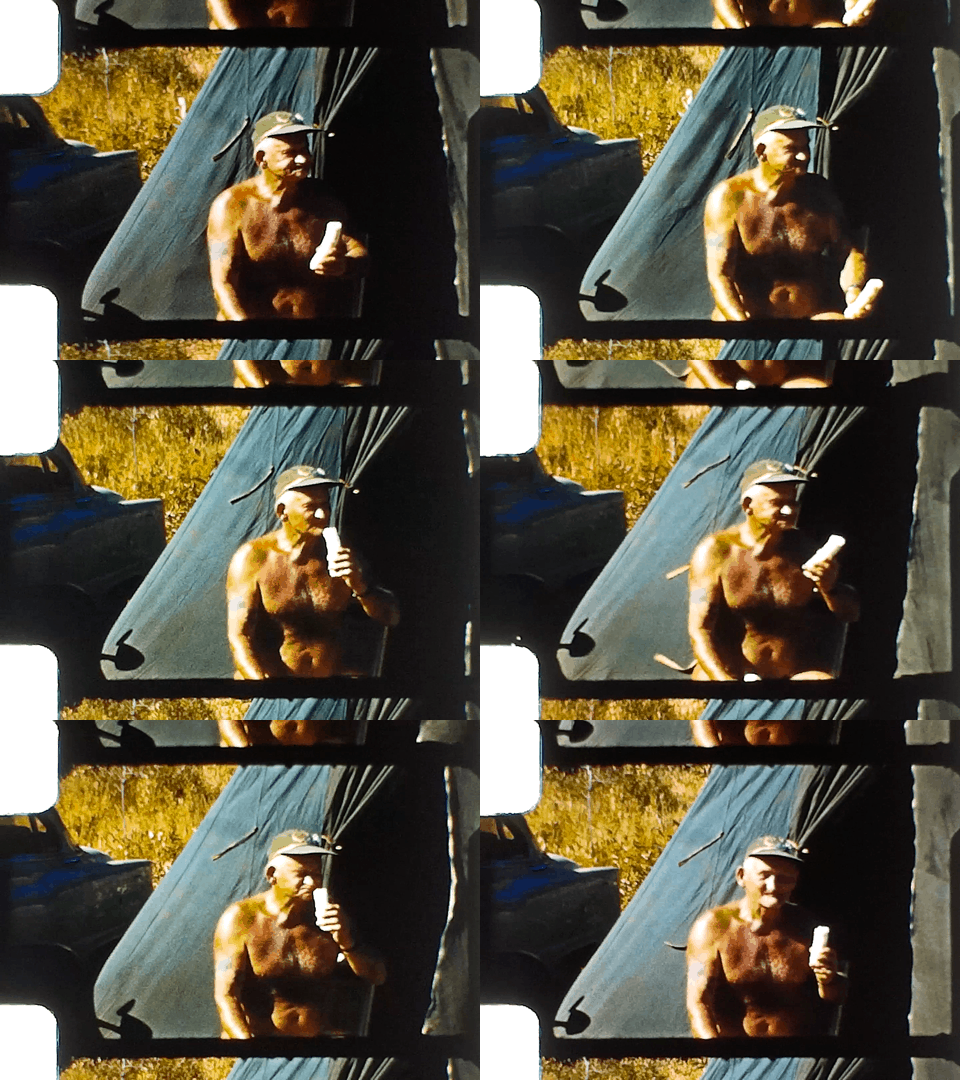
I pull up another clip. This one features Rudolph up close. He’s eating what appears to be a banana or a sweet treat of some kind, smiling. It’s clear in this image he has dentures, and he’s not wearing them: his jawline looks a little too shallow as he gums his dessert.
“Wait, he had no teeth?” Tawnie says. I chuckle; it was news when I first saw the clip, too.
Pat watches, speechless. The image on the screen is from 1957, about a year before Rudy died, probably around the last time Pat saw him in motion like this.
“I got tears coming to my eyes,” he finally says.
Exploring the land
It’s soon clear that Pat is getting fatigued from the visit. I ask if he minds if I walk around a little bit and explore by the river. Not at all, he says. He tries giving me directions to the walking path, but I don’t need them. I remember well.
I say goodbye to Tawnie, who’s ready to return with Zeke to their home in Yelm, twenty minutes away.
Before I leave the house, Pat digs out an old thumb drive from a wooden hutch next to his recliner. “There’s some photos on this that I had someone save for me a few years ago,” he says. “You might have them already. I gave them to your uncle Mike some years back.”
I thank him and assure him I will mail it back to him once I’ve copied the contents. I slip the little thing safely into a zipper pocket in my trousers. Then I walk.
It’s now late afternoon and the sun is dipping lower in the sky, but still high enough to cast warmth over the woods. The ground below my feet is soft and moist but not so wet that it hinders walking. The sound of the river current draws me toward it, and I poke around the banks a little, looking to see if there’s any enticement to dip a toe. I reach down and touch the water, and it’s ice cold. I’m good on land, I think.
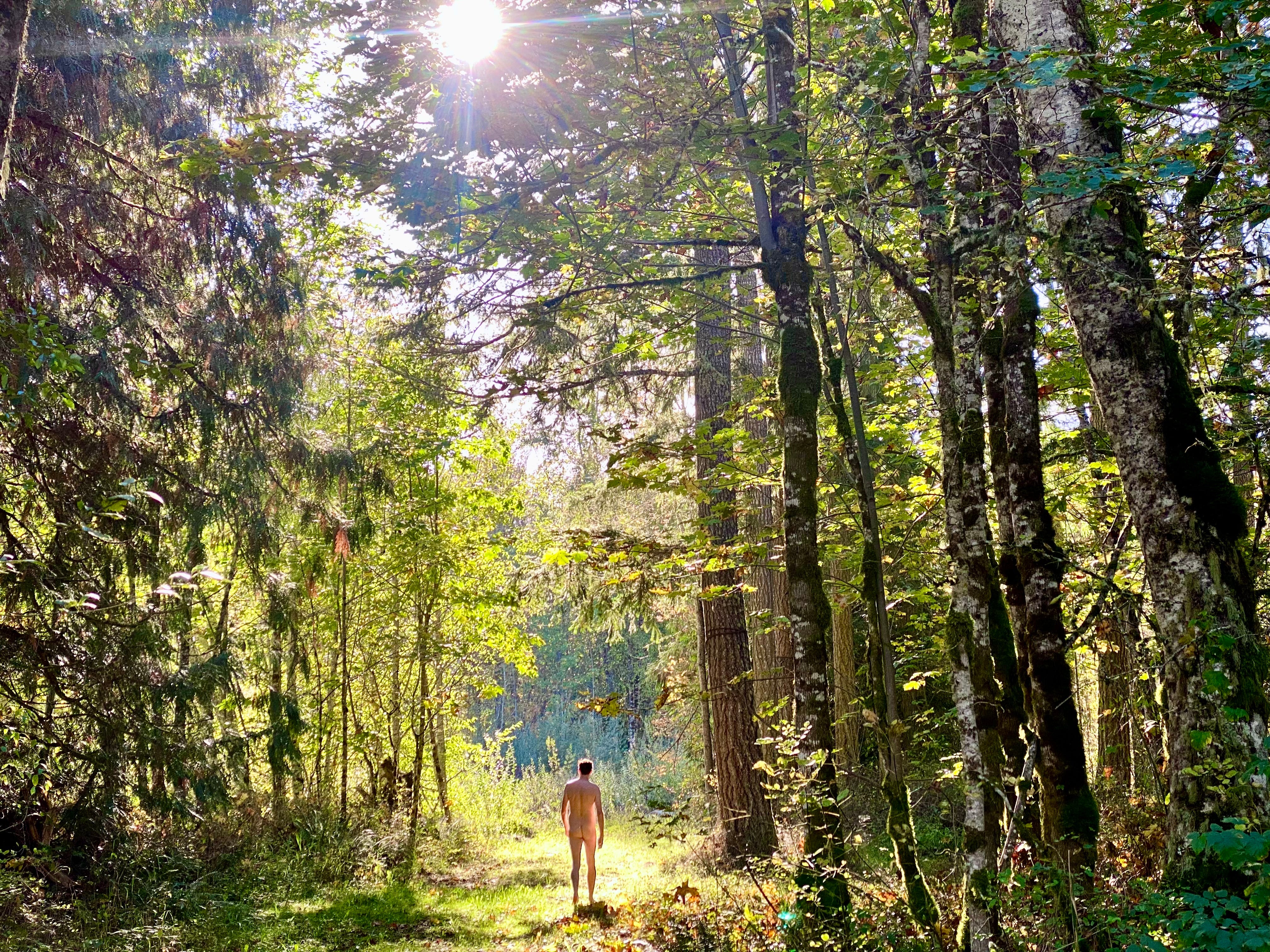
I hike around for a few minutes, looking for photogenic spots. I came prepared with a little extendable selfie-stick-slash-tripod I like to carry with me when I go for hikes. It’s equipped with a handy Bluetooth remote that allows me to take well-composed tripod selfies without the annoying running-back-and-forth bit that comes with using a camera timer.
I soon come upon a beautiful clearing in the woods, a narrow grass-carpeted glen with one striking tree jutting out of the middle. I look up the tree trunk and find an old rusty climbing cable attached about twelve feet up. It looks antique, but I can’t ascertain its age.
I stand in this spot, enjoying the serene tableau. I listen to the river and the birds. I watch these immense yellow leaves around me detach from their branches and float slowly to the ground. I feel connected to this place at this moment. I can picture Rudolph in this spot; I have film footage of him along the river somewhere that may well have been right here, playing gleefully with other nudists.
I remove my shirt, laying it out over a bush so it doesn’t fall in the mud. I kick off my shoes and pull off my socks, and soon enough I’m nude, walking around and stretching out in the sunlight. I imagine that Rudolph sees me and approves.
I’m slightly nervous that Tawnie might literally see me—I imagine her forgetting something she wanted to tell me and setting out to come find me—but after glancing apprehensively over each shoulder a couple times, I decide that’s unlikely and put the thought out of my mind.
I try to be present, to live in the ephemeral, fleeting joy of this moment.
I set up my tripod and snap a few shots.
I soon dress and continue tramping around, testing my memory of the land. There’s no demarcation to tell me when I’ve crossed the line, but before long, it’s clear that I’m standing on the neighboring property, looking up through the trees at the great stone house.
I freeze, unable to look away from this structure, this creation that has occupied so much of my thoughts and research over the last five years. I’m not sure if I should try to get closer or leave it for another visit. I can’t tell if anyone’s home. I pull out my phone and snap a photo. At least I’ll be able to prove I saw it, I think, though I’m not sure to whom I would ever have to furnish such proof.
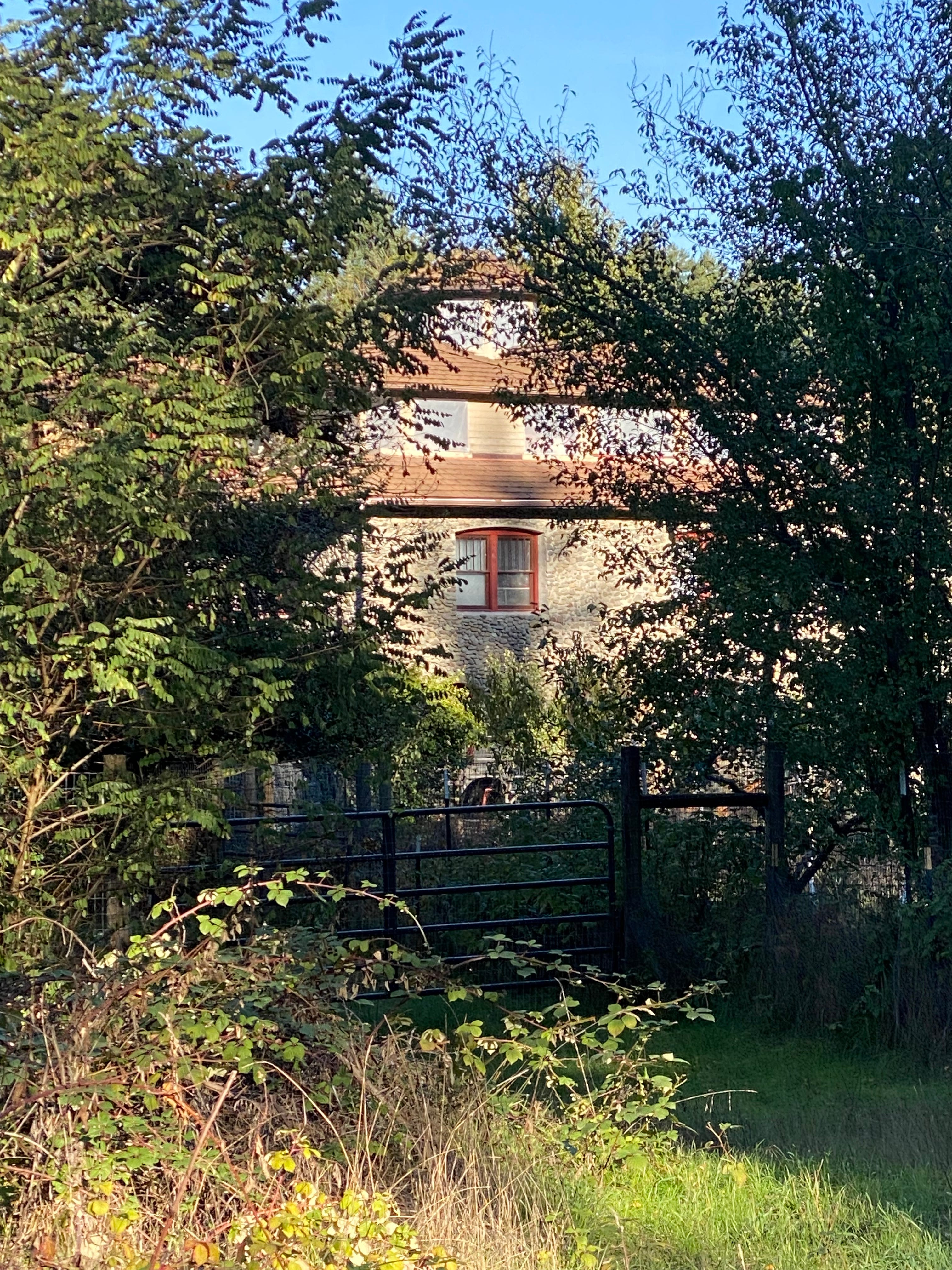
I try walking a little closer to see if I can get a different view of the front of the house, but I’m obstructed by a fenced-off pen full of white geese. The geese have become alarmed by my presence, and a cacophony of honking soon fills the air. Not a bad security system, I think. I’m effectively spooked from getting any closer and decide to turn around. It will be dark soon anyway, and I should get on the road.
Pat in the garden
I walk back along the footpath toward Pat’s house and my parked rental car, and I’m suddenly inundated by four small, yipping dogs again. “Hello there!” I say.
I walk another twenty yards and come upon Pat, now working in his garden. I recognize it as occupying the same spot as the garden Lovina used to keep; only he has surrounded it with a chainlink fence, perhaps to keep out many of the critters that Lovina used to complain loudly about.
I tell Pat I’m headed out, and he instructs me to wait one second; he’s got a parting gift for me. He’s slow going as he stands, finds his cane, and lumbers out of the fenced garden to a Hoveround mobility scooter parked in the loose gravel. I walk alongside him as he ploddingly navigates his craft through the loose rocks back to his front porch.
It’s only a thirty-foot trek, but it takes us nearly five minutes because we stop as Pat gives me a guided historical tour of the non-native fauna that our ancestors have transplanted there, a veritable melting pot of trees: a cypress California, a willow Pennsylvania, and more. All these trees, each with their own unwritten history, the memories of which exist in fewer and fewer minds as the years pass. I’m saddened by the realization that I can hardly even follow Pat’s memories, let alone carry them forward. All I can do is cherish this moment.
“Dammit, what am I doing!” Pat says, snapping out of his reverie. “I forgot about your gift.” He forgets his cane on the scooter and limps to the porch. He digs around and comes back up holding a plastic milk jug full of opaque, amber-brown cider. “This is fresh. Zeke made it yesterday. It’s still cold from being left out last night.”
I can’t help but smile. To my knowledge, I’ve never had fresh cider. “Careful with this,” he cautions as he hands it over. “It’ll give you the squirts if you drink too much. Best to let it age a little. It’s tough to do because it’s really good.”
Epilogue: Two weeks later
It takes me several days after returning home to California before I can review the images on the thumb drive Pat left me with. After two weeks away, my five-year-old needed a few hard days of dad time, bless him.
When I find time, I plug in the drive and copy the images to my laptop, letting them finish before looking. When the time comes, I click open the folder and preview the pictures, one by one.
To my disappointment, each one is familiar. As Pat expected, I’ve seen these photos from my uncle Mike. Most are of the construction of an older wood frame house that Rudolph built and lived in with his young family before the Cobblestone mansion was devised. Many more photos are of Rudolph as a young naval officer or Andy, Antone, and Helen as kids before the rest were born. I’ve seen these photos so many times that I’ve committed them to memory.
Just as I feel unimpressed with this archival haul, the pictures become unfamiliar. I continue flipping through them, realizing there are many more photos in this batch than I've previously encountered. I’m delighted to find Rudolph in his twenties, tending to bees; a new image of the great stone house with Rudolph’s trailer parked in front and Rudy working up on the roof; a dozen family members huddled in the large kitchen of the rock house filling plates for a holiday meal; Antone and a friend laughingly supporting each other’s weight, too drunk on moonshine to stand; the cobblestone house blanketed in snow. Each new picture paints a life purposeful and filled with joy.
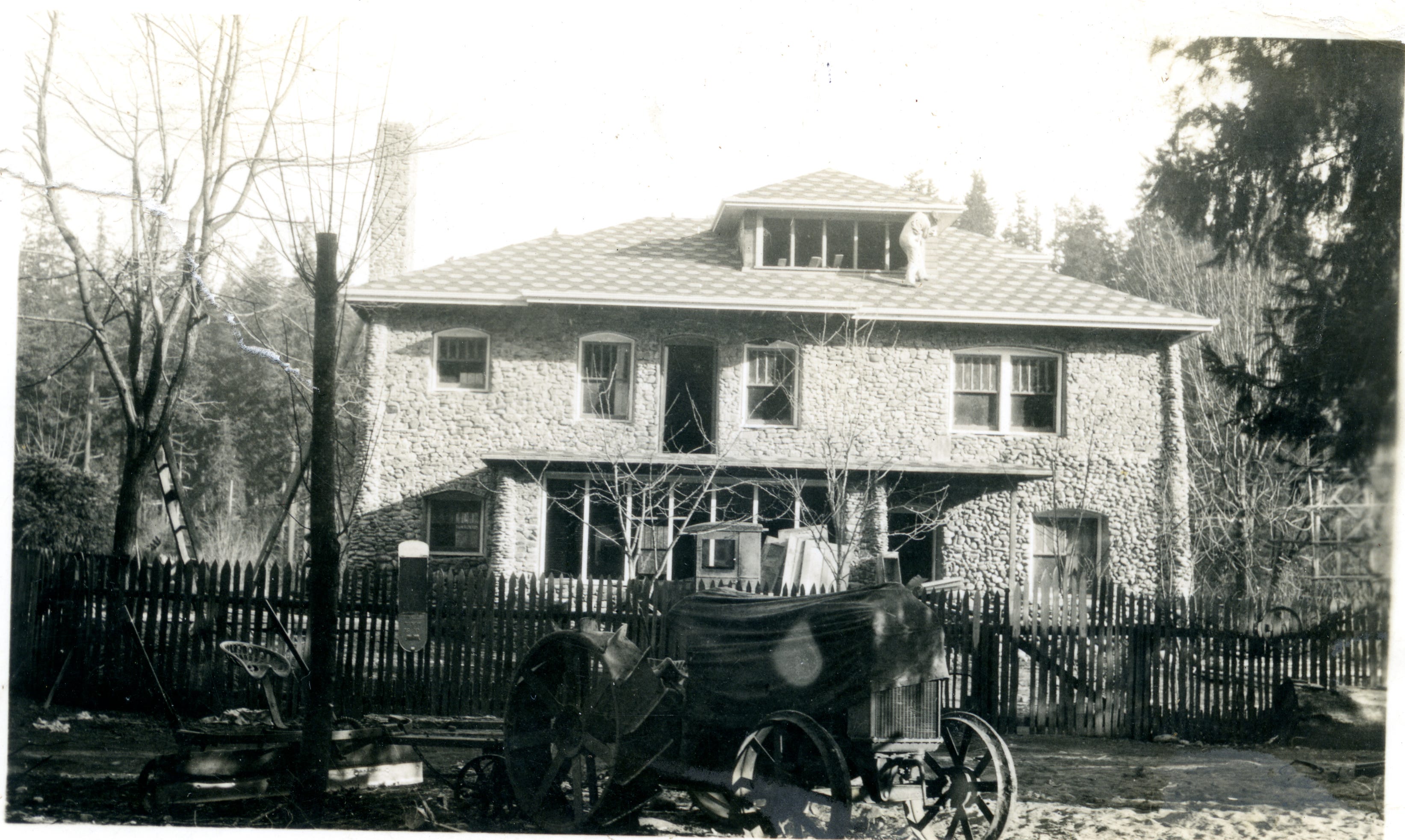
Each new picture floods my brain with dopamine, and I can’t resist smiling as my picture of this side of my family grows ever larger. While I know I can never fully capture it all in my heart or see the complete picture, immersing myself in these memories allows me to reconnect with my family's heritage. And the more I do, the picture I have, though never complete, continues to grow richer and more robust, drawing its nutrients directly through the branches that connect it to the earth. 🪐
Support this project with swag
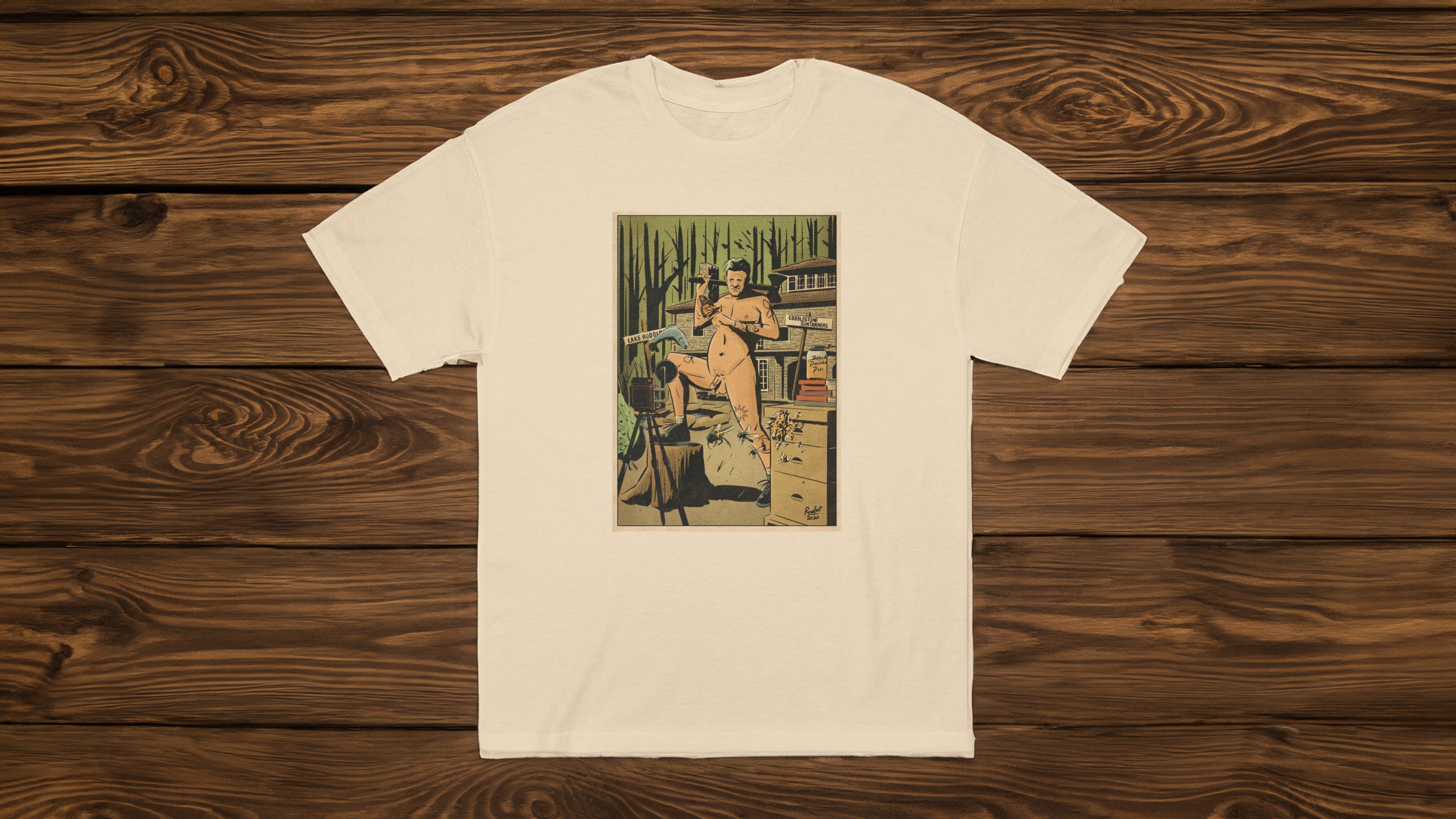
It’s a personal passion project for me to research and write about the life of Rudolph Johnson. One way you can support the project is by picking up a Rudy the Nudie t-shirt with original artwork by Ahmed Raafat. Your purchase helps support this newsletter, and your t-shirt helps spread the word. Plus, it’s guaranteed to turn heads at the grocery store. 🚀
Get one in the Planet Nude gift shop.
National Register of Historic Places inventory form #88000695
It’s worth noting that there are several inaccuracies in the final paragraph of this excerpt. First, Rudolph purchased the land in 1905, but his family immigrated to the United States from Denmark almost twenty years earlier. Second, the nudists never occupied the Cobblestone Lodge—they enjoyed the surrounding land. They made a clubhouse out of the old chicken coop, and Mary Johnson would sometimes prepare meals for the nudists in the stone house, but the place was never more than home to Rudolph and his family. Third, Rudolph was not the publisher of Sunshine & Health magazine, but he did submit writing and photos regularly. Finally, the stone pool was never actually filled in.
What a wonderful read. Thank you so much for sharing. ❤️
Thank you for the fabulous read Evan! Such a wonderful heritage and a great legacy (living on through you with such brio) ... looking forward to the book! 😉