

Going natural in the Natural State: The lost history of Arkansas nudism
Once home to the country’s fastest-growing nudist park, it's now the most anti-naturist jurisdiction in the U.S.A.

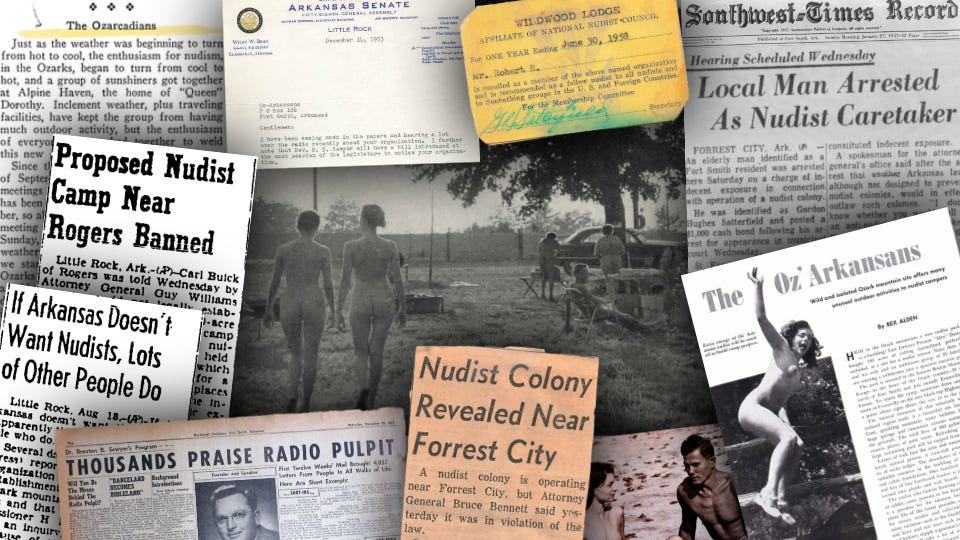
Arkansas has long marketed itself as “The Natural State,” a nod to the rugged hills, shimmering lakes, meandering river valleys, and pristine pine forests that make it an outdoorsman’s paradise. But for a small and determined group of Arkansans in the middle of the last century, going “natural” meant something more literal. They were nudists, and they wanted what nudists everywhere wanted: a place of their own, outdoors, in the sun, free from the encumbrances of clothing and the judgments of the world.
The lost history of organized nudism in Arkansas is, in the end, a story of thwarted ambition. It begins with the Ozarcadians, a discreet club meeting in Fayetteville in the early years of World War II and dreaming of a park in the Ozarks. It runs through the Oz’Arkansans, a group that found itself in the crosshairs of a crusading preacher before it ever had a chance to turn its undeveloped camp into the dream resort its leaders envisioned. And it reaches its fullest expression in the remarkable story of Gordon Satterfield, a Fort Smith nudist who actually did build a park—carving it by hand out of an overgrown Arkansas cotton farm—only to watch it be destroyed by a law passed without debate or hearings in a matter of minutes.
And looming large in the story is the figure of Rev. Braxton Sawyer, a Fort Smith radio evangelist who made the eradication of nudism a national crusade. He largely failed, except in his own backyard. Thanks to his machinations, Arkansas became, and remains to this day, the only state in the country where nudism is explicitly outlawed as both practice and idea.1
Pioneers: The Ozarcadians
Though the dramatic showdown of Sawyer vs. Satterfield marked a crescendo of the battle over nakedness in Arkansas, the history of organized nudism here doesn’t start with them. Surprisingly, for a rural state in the old Confederacy, the movement had put down tentative roots well before Sawyer took to the airwaves, before Satterfield broke ground in the Mississippi Delta of eastern Arkansas.
With the appearance of the first national nudist magazines in the 1930s, curious Americans in far-flung regions away from urban centers were exposed to positive portrayals of nudism for the first time—a departure from the moralizing and ridicule with which the mainstream newspapers treated the topic in those days.
By the early ’40s, organizations like the American Sunbathing Association (ASA) were attracting interest across the South as publications like Sunshine and Health trickled down to Bible Belt newsstands. Correspondence from Arkansas, for instance, frequently littered the “Letters” page of such magazines in that period, with messages from isolated and aspiring nudists in towns like Piggott, Marianna, or Mena searching for other free spirits.
Some, however, wanted to do more than just make a few nudist friends. On Aug. 19, 1942, the Southwest American, the main newspaper in the city of Fort Smith, reported that “a national nudist organization is contemplating establishment of a nudist colony in the Ozark mountains of North Arkansas.” Asked by a reporter what he thought of the matter, Deputy Land Commissioner H.P. Merritt laughed it off, advising against it “because of the fierce Arkansas chiggers.”2
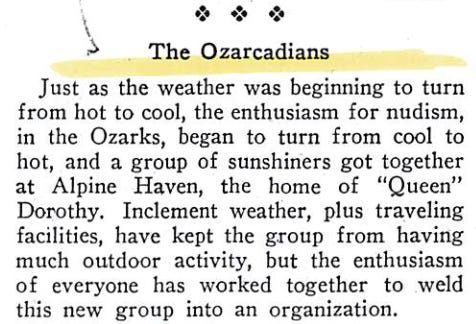
The paper didn’t name the individual or group planning the supposed “colony,” but readers of the nudist press were getting regular updates. In September 1943, a nascent nudist organization called the Ozarcadians—a name blending “Ozark” and “Arcadians,” a classical allusion to pastoral paradise—started meeting in Fayetteville, according to a report in S&H.3
A member named Angus Hart wrote that a “group of sunshiners” had been congregating in the Ozark Mountains at the homestead of Carl Buick and his wife, Dorothy. It was Carl who had been working on the unnamed “colony” discussed in the Southwest American the year prior. Local reporters in Arkansas didn’t know it, but they were actually dealing with the monarchs of nudity in America.
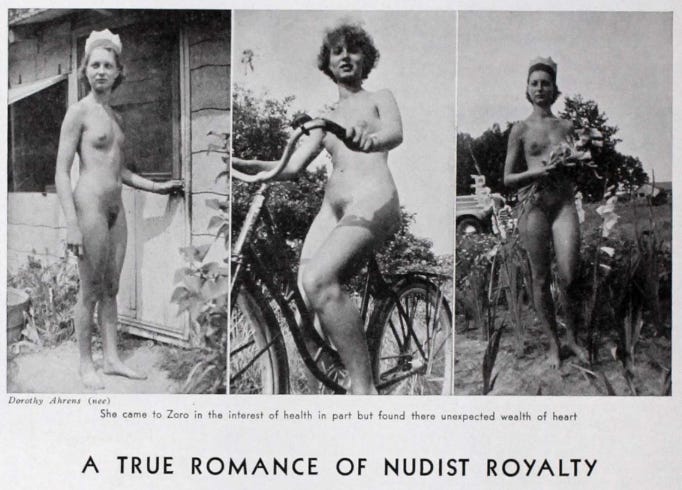
Carl and Dorothy Buick were the reigning Nudist King and Queen at the time, having been crowned at the ASA’s annual meeting at Zoro Nature Park in Indiana in August 1942. Actually, the first time the couple met one another was the moment they ascended the throne together. Their tale was told by ASA President Alois S. Knapp in 1943 in an S&H article entitled, “A True Romance of Nudist Royalty.”4
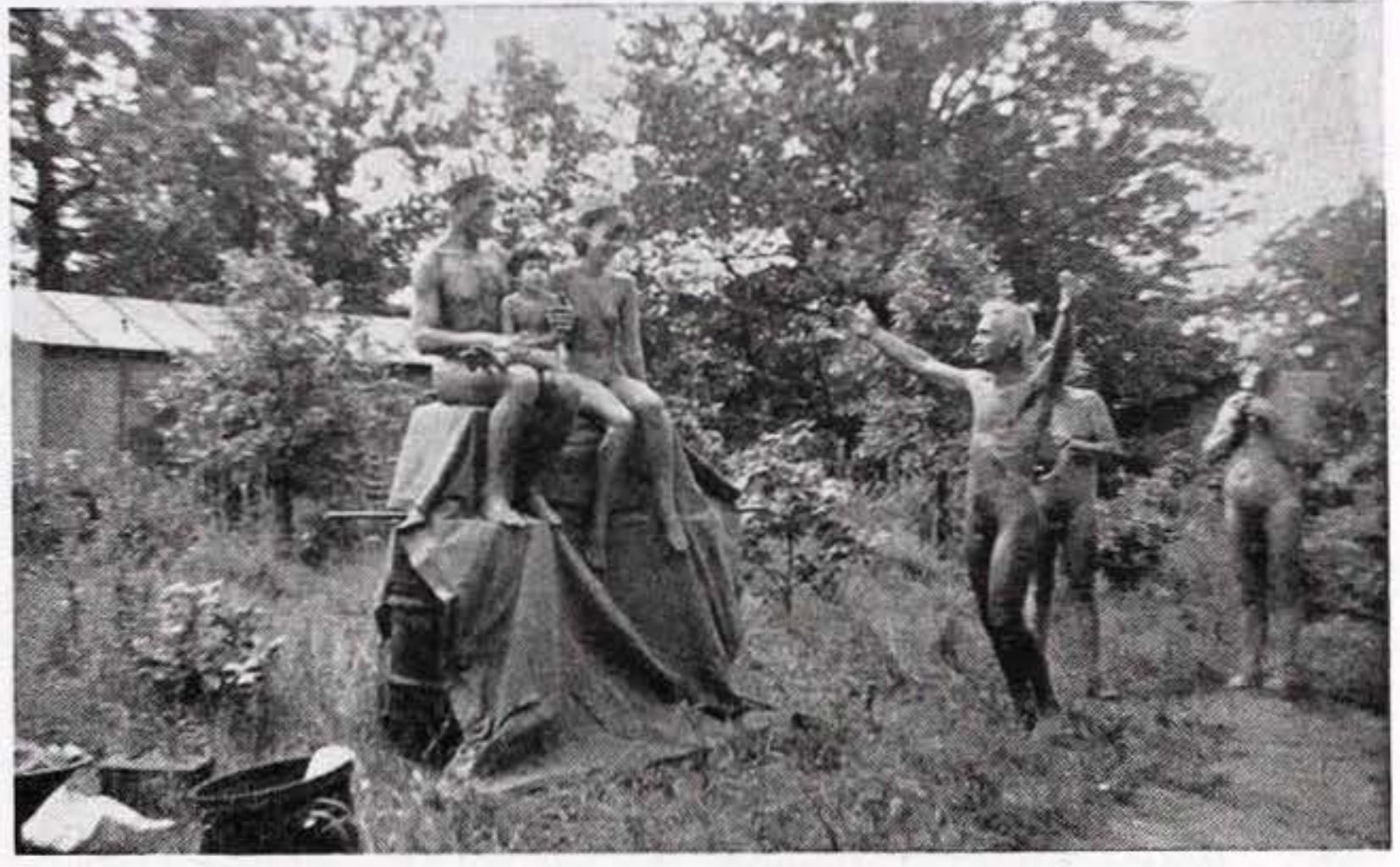
Dorothy Ahrens, 19, of Oklahoma, was a regular at Zoro, together with her parents and older sister. The family came to soak up the sun in hopes of improving Dorothy’s poor health. Carl Buick, 44—born Carl Buich in Agram, Croatia (modern-day Zagreb), in 1898—was a boxer who’d grown up in poverty before immigrating to America. “We had rarely enough to eat,” he said of his childhood. “Generally, we went to bed hungry.” But he got an education, moved half-way around the world, and became a “highly skilled artisan.”
Eventually settling in Detroit, Buick happened to attend a lecture by Dr. Benedict Lust, a medical quack known today as one of the founders of naturopathy. Convinced by what he’d heard, though, Carl apparently converted to vegetarianism, “clean living,” and nudism. He was a member of the Ar-U-Tan Club and its successor, The Bruins, and started submitting photos to S&H in the early 1940s.
His “physical prowess” and “superb body” won over the voters at Zoro in the summer of 1942, while Dorothy similarly impressed with her youthful and tan figure.5 After receiving their crowns, Carl was apparently so taken by the young woman that he proposed on the spot, sort of. “You really got my goat,” he told her that day. “I like you; perhaps we could marry.”6
Dorothy said they didn’t know each other well enough yet, so he went back to Detroit, and she returned home with her family. Six letters and two months later, however, Carl was on his way to Oklahoma City, where the two were married in October 1942. She moved with him to Detroit, but soon enough, the Buick family was back down South, purchasing a large parcel of land in northwest Arkansas and setting about establishing a new ASA affiliate group.
With King Carl and Queen Dorothy at their head, it’s easy to see why optimism abounded for the newly-formed Ozarcadians. But their enthusiasm was soon enough dampened by legal disappointment. “Immediately after our first meeting, we were opposed by the courts,” Hart told the ASA, “and the opposition was given much space in the news.”7
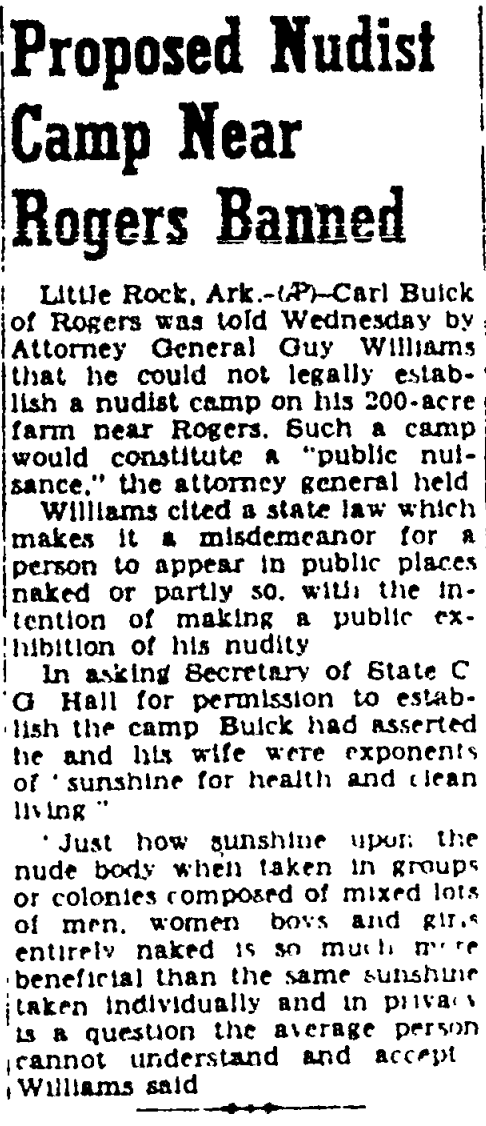
Within days of the Ozarcadians’ inaugural get-together, Buick’s plans for a 200-acre camp called Alpine Haven were sunk. Buick had approached Secretary of State Crip Hall for permission to establish a nudist park on his property, located in the unincorporated Larue area just outside the town of Rogers. Unsure what to tell Buick, Hall consulted with Attorney General Guy Williams, who gave the thumbs-down.
Such a camp would constitute a “public nuisance,” the A.G. concluded, citing a state law that made being unclothed “with the intention of making a public exhibition of nudity” a misdemeanor. Williams found Buick’s claim that he and Dorothy were “exponents of sunshine for health and clean living” unconvincing, arguing that nude sunbathing in mixed company was “a question that the average person cannot understand and accept.”8
Despite their loss, the Ozarcadians seemed undeterred. “We have established a bridgehead on the shores of sunland, and now our eyes are forward, looking for the shape of better things to come,” member Hart boasted in January 1944. “We want to pave the way to the gates of accepted nudism.”
His positivity was premature, though. By the time Sunshine and Health subscribers next heard from the Arkansas nudists, their situation had worsened. In the February 1946 issue of the magazine, Ozarcadian Ralph Shreve wrote that the group, which had been founded under the pressures of World War II, had “barely held on and have only met when and where we could.”9
He said travel difficulties and the moves of members had scattered the group. But they had apparently not given up on the dream, for Shreve listed out what read like a list of tasks for establishing a nudist camp: “Carl has water piped from a mountain spring to a drinking water fountain and shower in the valley and plans a pool and a play field for this coming season.”
Alpine Haven, however, was never to be. Dispatches on the group’s progress stopped abruptly, leaving one to conclude that the state’s 1943 refusal to approve a camp proved to be too high a hurdle. There is no record of the formal establishment of any resort or park, and the Ozarcadians were never heard from again.
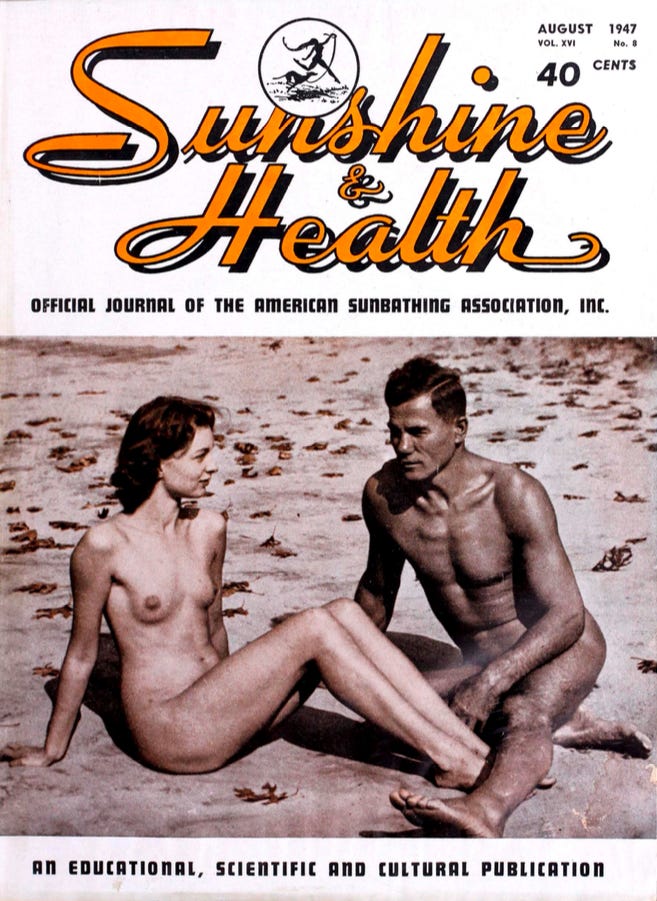
Carl and Dorothy, however, didn’t disappear from the scene. His work as a nude photographer carried on, and hers was an image occasionally seen in national nudist magazines afterward. The two of them even appeared together on the August 1947 cover of S&H. Their trail goes cold in subsequent issues of the nudist press, though, so whether or for how long the two remained a part of the movement is unknown. Carl died in 1977, Dorothy in 1996. They are buried together at Wellston Cemetery in Lincoln County, Oklahoma, not far from where she grew up.
The royal couple may have been the first people to put Arkansas on the nudist map, but they weren’t the last.
Dream chasers: The Oz’Arkansans
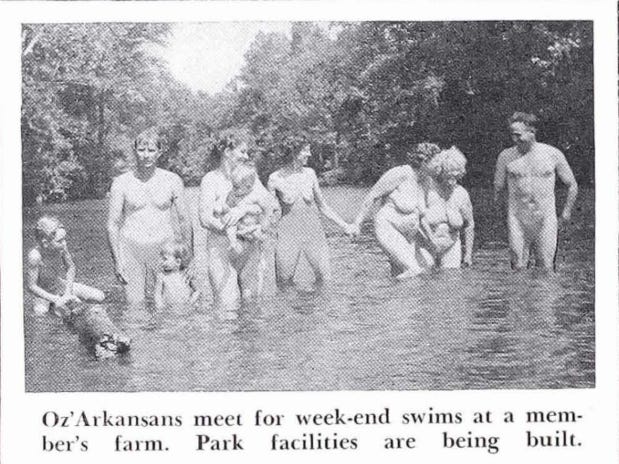
By 1951, another club had formed about an hour south in the city of Fort Smith headed by auto mechanic and postal worker Preston Alexander Dunn and his mother, Linnie Alberta Dunn. Known as the Oz’Arkansans—another play on the Ozarks—this group grabbed the baton from the Buicks and set about establishing a landed presence. Whether they were aware of the Ozarcadians’ travails is unclear, but it quickly became apparent that the Dunns underestimated the extent to which nudism was still a taboo subject among the conservatives of their region.
In January 1951, Preston Dunn purchased 150 acres of wilderness 35 miles north of Fort Smith near the Oklahoma state line in the Boston Mountain Range. It was in an unincorporated area called Evansville, where his father, Alexander Dunn, and later Linnie had been postmaster. It was tax-forfeited land that was had for less than $5 an acre, Preston told the Christian nudist journal Natural Living in a dispatch summarized in its August issue that year.10
The Dunns and the other families who made up the Oz’Arkansans were ambitious, setting about transforming the untamed landscape into a nude sanctuary. An article in the November 1951 edition of Modern Sunbathing told of the abundant resources it offered and the dreams of that first summer:
“The natural resources of this wild and relatively isolated region make it a beautiful site…. Cool, sparkling mountain water bubbles from four large springs…. Layers of rock lace the area and outcroppings form lovely natural grottos. A waterfall pours over a series of rocky ledges. The abundance of stone will be a valuable resource in the building of terraces, walks, and cabin foundations. One hundred and fifty thousand feet of fine hardwood lumber is just waiting to be turned into planks and wallboards. The nudist who fancies hunting can have his choice of rabbit, coon, possum, or fox…. And the park is a paradise for the amateur botanist…”11
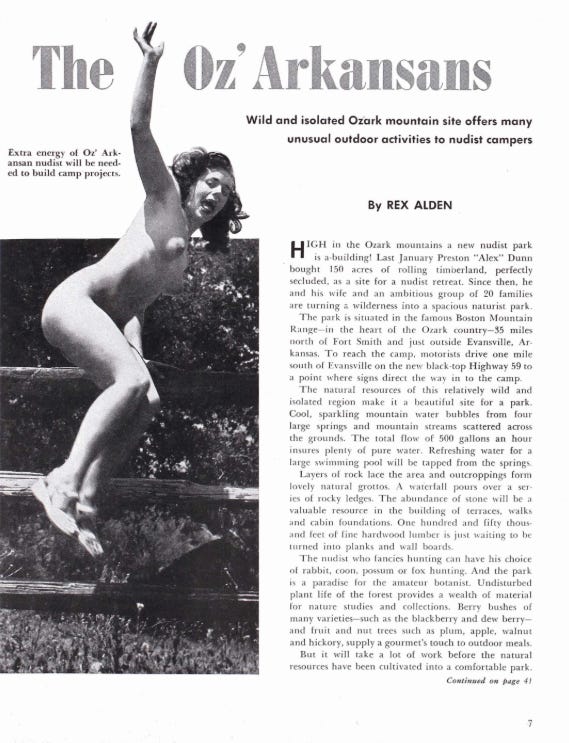
The magazine forecast a lot of hard work would be required to turn the vision into a reality, but the Dunns had no shortage of plans. They’d already drafted schemes for tennis and volleyball courts and even a “projected airplane landing strip” to accommodate all the guests whom they were sure would soon be swarming in. The progress was so swift and the promises so attractive that the Oz’Arkansans were quickly awarded official status as an ASA affiliate—Group No. 460.12
By July of the next summer, the ASA Bulletin was encouraging nudists coast to coast to rush down and see what was rising in Arkansas, which the editors said “has all the makings of a paradise on earth.”13 But before Preston and Linnie Dunn could finish building their nudist heaven, they were put through hell by a rabble-rousing preacher who used them as props in a campaign for fame.
Crusader: Rev. Braxton Sawyer
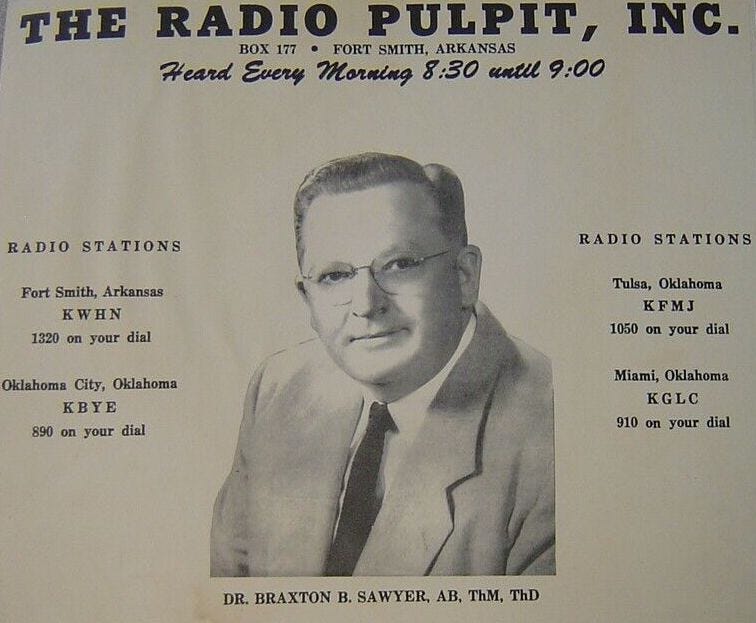
Braxton Bragg Sawyer was born in rural Alabama in 1911 and eventually landed in Fort Smith, Arkansas, where in 1948 he was appointed pastor of the Immanuel Baptist Church. He turned out to be a natural showman more interested in the spotlight than the sanctuary.
After barely three years leading his flock, he quit the pastorate and founded “Radio Pulpit,” an over-the-airwaves ministry broadcast five days a week, first throughout the region and eventually across the nation. The donations that kept it going required an audience, and an audience required an enemy. In 1953, browsing an Oklahoma City bookstore, the reverend found one.
Spotting teenagers ogling nudist magazines on a newsstand, Sawyer rushed back to Fort Smith and alerted his listeners to the naked menace in their midst.14 “I had preached for 20 years without ever using the word nudist,” he later told Time magazine.15 He quickly made up for lost time.
His first target was a hometown one: Preston Dunn. Having heard Sawyer’s radio ravings about nudism, Dunn—himself a Christian—made the catastrophic error of writing to the reverend in hopes of politely correcting his misconceptions.16 He had naively and mistakenly provided Sawyer the perfect gift. Armed with Dunn’s name and address from the return envelope, he went on the warpath, using his weekly program to demand authorities keep Dunn’s kids from mingling with “decent” children in the local school.
Sawyer then filed a complaint with Washington County Sheriff Bruce Crider in December 1953, alleging Dunn was operating a “nudist colony.” The sheriff investigated but reported that he found no nudists on the Evansville property, only a “rundown” four-room house, a barn near collapse, a stone spring, and a sign reading, “Dunn Springs: Home of Oz’Arkansans.”17 The next day, it was reported that Dunn and Sawyer had both been subpoenaed for questioning by prosecutors to “determine if a violation of law was involved.” The front page of the Southwest American also revealed that “an attorney for a national sunbathers’ organization was on the way.”18
At the hearing, held on a Saturday afternoon in Fayetteville, Prosecutor Ted Coxsey concluded after listening to Sawyer’s accusations and Dunn’s defenses for three hours that nothing dirty was going on and that no statute had been broken (a finding contrary to what Carl Buick had been told years earlier). During the questioning, Dunn said that the Oz’Arkansans met monthly at the camp, averaging 20 to 30 per get-together. They swam, sunbathed, and worked on the land. “Everybody knows,” Dunn declared, “that sunshine, fresh air, and outdoor health in limited amounts are healthful, and no law has been violated.”19
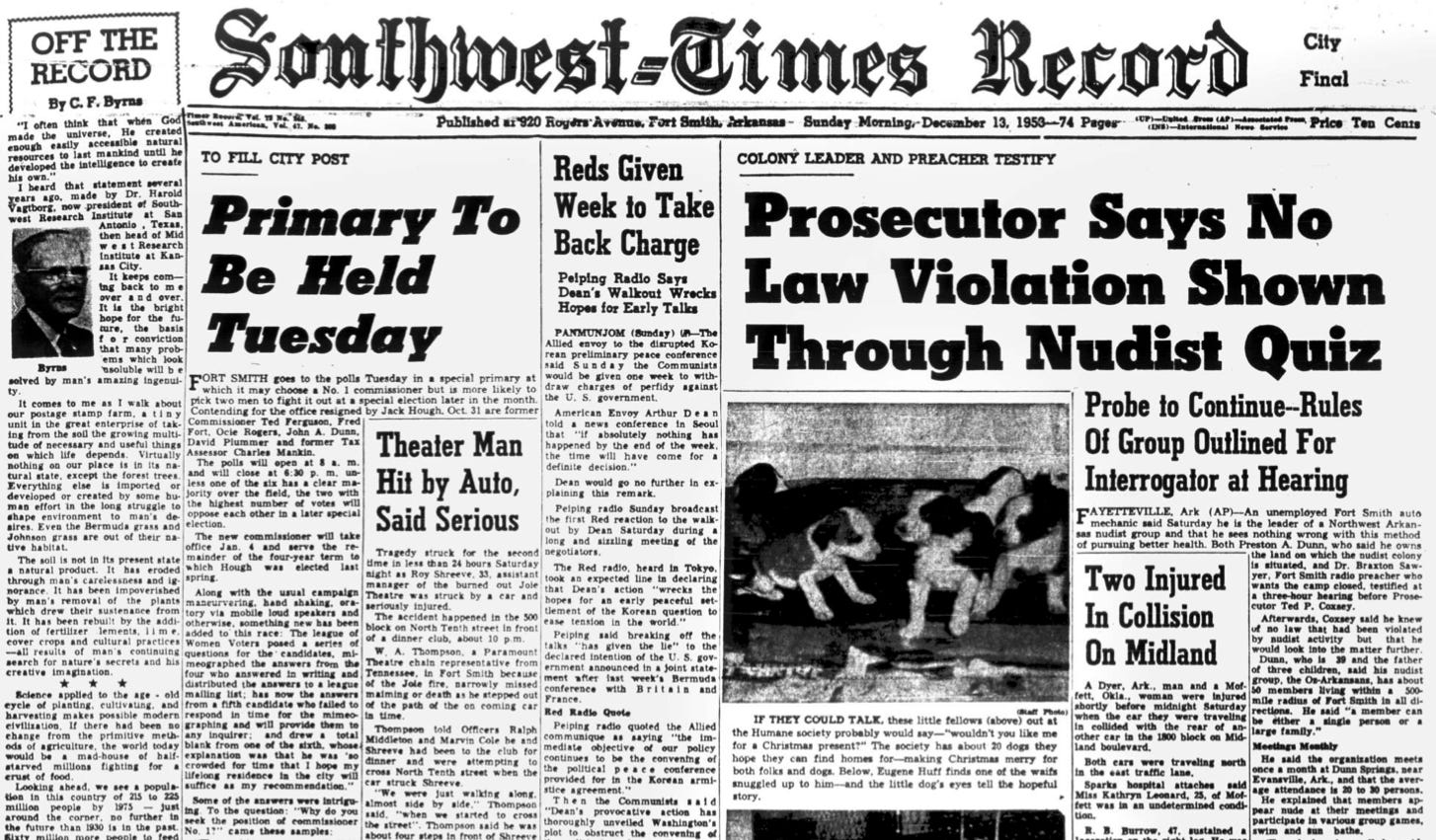
As for Sawyer, he took the opportunity to hand out tape recordings of Radio Pulpit episodes and copies of nudist magazines while announcing that even if there was not yet a law banning nudist parks and activities he’d make sure there soon was. He alleged, without evidence, that “some of the biggest names in Fort Smith are affiliated with the colony,” though he refused to say who. Dunn, feeling relieved by the prosecutor’s assessment, told the press afterward, “I’m happy this has been brought out into the open. I’m glad to have it called to the attention of the people.”
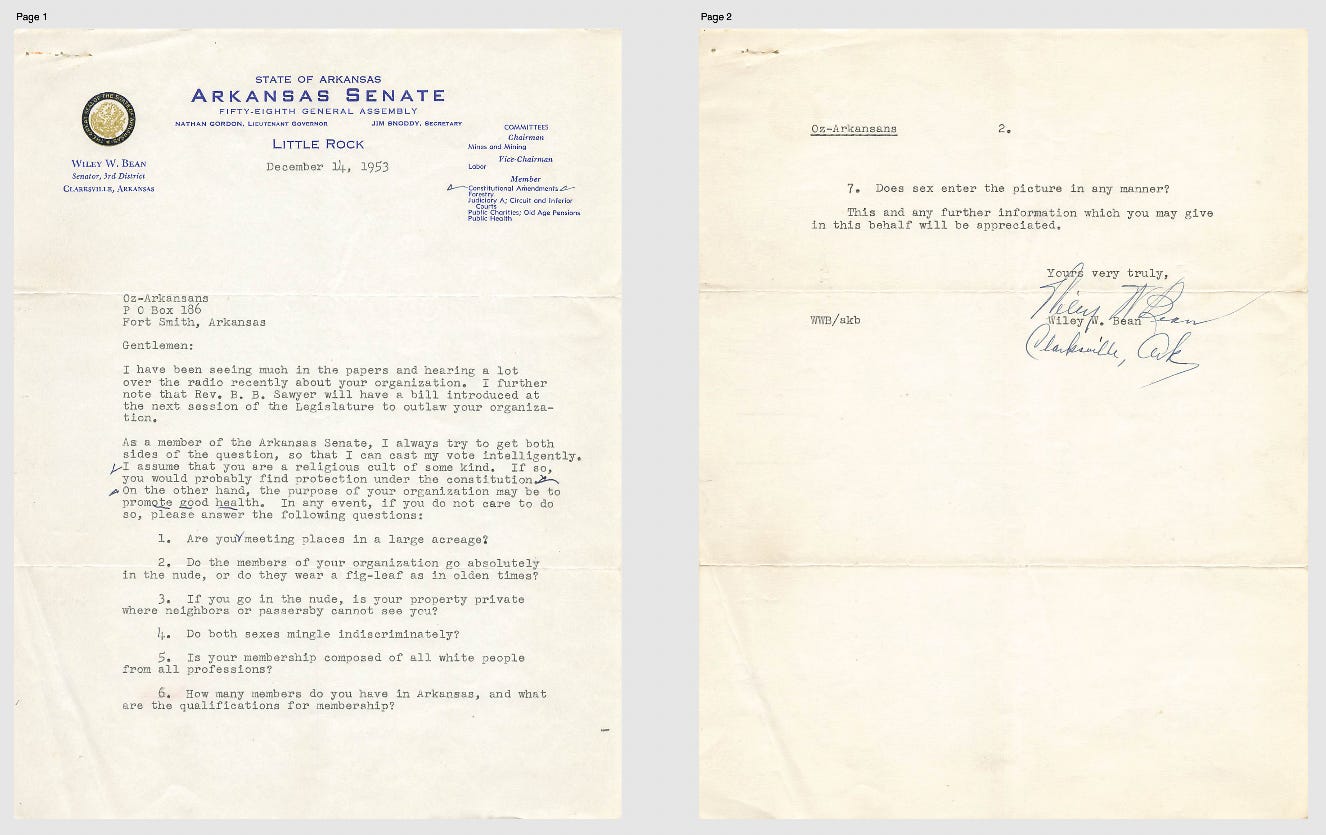
Losing out with the sheriff, Sawyer called up friends at the State Capitol in Little Rock. On Monday morning, immediately after the hearing in Fayetteville, State Sen. Wiley W. Bean, prompted by Sawyer, dispatched a letter to the Oz’Arkansans, grilling the organization on its purpose.20 Bean peppered them with questions: Do your members go absolutely nude, or “do they wear a fig-leaf as in olden times?” Do both sexes mingle indiscriminately? Does sex enter the picture? How many members do you have?
And, appalled at the possibility of naked race-mingling, Bean demonstrated his fealty to the segregationist norms of the time and demanded to know: “Is your membership composed of all white people?” The senator then informed the Oz’Arkansans that a bill would be introduced to “outlaw your organization,” which he assumed was “a religious cult of some kind.”
National Nudist Council leader Edith Church came across a news clipping detailing Preston Dunn’s persecution and rushed to Arkansas to help, only to find that the stress of the ordeal had put the man in the state hospital, leaving his mother, Linnie, as Sawyer’s target. Hearing that a “big-shot nudist” had come to town, Sawyer arranged a mass meeting at a local church where he promised to expose secret recordings of nudists.
Edith Church slipped in, hoping to see for herself what Sawyer was all about. When he spotted Church from the pulpit, Sawyer stretched out his hand, parting the crowd like the Red Sea. Pointing an accusatory finger in her direction, he thundered: “She DARES to come into the House of God! There she is, that woman in the red hat!” The assembled faithful roared in response. Church later said she “did not expect to escape with my life.”21
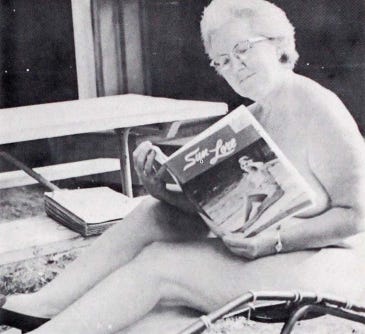
The Oz’Arkansans, rattled and harassed, never really recovered as an organization. Even though state officials never said they had broken any existing laws and didn’t outright ban their camp, as had happened to the Ozarcadians, the Dunns lay low after the incident. They quietly continued working on their camp in Evansville, and ASA officials touring clubs around the country visited in June 1956, noting that “Mother and Preston Dunn as well as the rest of the Dunns are wonderful people” with big plans.22 Dunn Springs never managed to open as a full-fledged nudist park, however.
Comments left by a family member on a genealogy page for Linnie Dunn after her death in 1998 suggested that bringing the camp to life was her passion and that work on the site only stopped when nudism became illegal. The relative also provided an insight into Linnie’s tenacity and commitment, even though her son Preston often got most of the press coverage.
“Aunt Linnie is our wild woman of the family because she ran a nudist colony at Evansville,” wrote an unnamed relation on the Luginbuel Funeral Home website. “She pushed the limits on everything. It took the Arkansas State Legislature to close her nudist colony down. Once she needed more water for the camp and no one would help her, so she threw a stick of dynamite down the well and knocked out water all over the mountain.”
As for Preston, he remained a part of the movement, though the experience of negative publicity appears to have scarred him. In 1958, he proposed an idea which he said would “greatly improve the whole nudist movement and their relations with the non-nudist public”—merging nudism with Christianity. Ditch the word “nudist” and replace it with “Christian naturopathist,” he said, to “get rid of the mental block which the word nudism sets up in the minds of many non-nudists.” If the naked way of life becomes a church, of sorts, he reasoned, it would be protected by the First Amendment’s freedom of religion clause. Needless to say, the initiative never went anywhere.23
He kept the Oz’Arkansans post office box address listed in the nudist club directories that appeared on the back pages of magazines until at least the early 1970s, but how frequently the group continued to meet after the 1953 fight with Sawyer is unknown.24
But for the reverend, the skirmish with the Dunns was merely a warm-up. He took his show on the road, staging rallies across Oklahoma and promising to outlaw nudism state by state, appealing constantly to Radio Pulpit listeners to send “a little increase in their offerings” to fund his campaign.25
The anti-nudism crusade reached its most theatrical—and humiliating—peak on Aug. 4, 1954, when Sawyer traveled to Battle Creek, Michigan, determined to storm the annual convention of the ASA, movie camera in hand. A group of men blocked his rush at the gate, and the next morning newspapers across the country ran photographs of the reverend picking himself up from the dirt in front of Sunshine Gardens.26
The media was almost uniformly unkind, with the Detroit Free Press declaring itself “tired of people—crusaders, evangelists, or otherwise—constantly seeking publicity for themselves via nudist camps.”27 Despite the embarrassment, Sawyer departed Michigan having persuaded a state lawmaker to introduce anti-nudist legislation. He also left behind a freshly-organized committee of local ministers who pledged to carry on the war against nudism.28
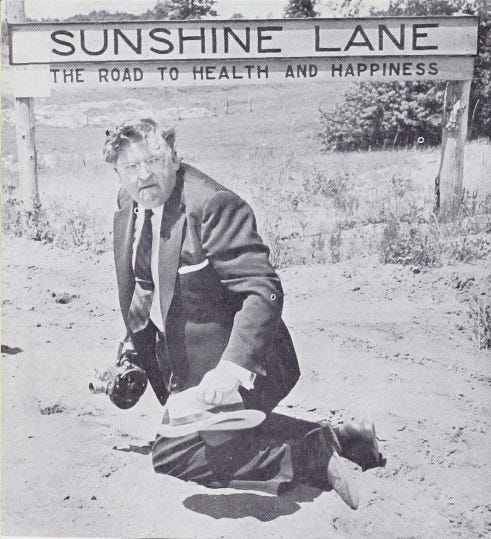
His attempts to outlaw nudism in Arkansas, Oklahoma, Missouri, Michigan, and Kansas all came to nothing, though. Nudist newsletters kept a running tally, scoring it five to zero against him.29 “The taste of victory is sweet on nudists’ tongues,” declared Kurt Barthel, the so-called “founding father” of American nudism. “Waging defensive war against Rev. Braxton Sawyer’s anti-nudism crusade, nudists won a million dollars’ worth of favorable publicity and a bright outlook for 1956—the spoils of a good fight.” So optimistic was Barthel that he exclaimed: “The best thing that could have happened to American nudism was the crusade of the preacher from Arkansas.”30
The nudist world thus largely wrote off Sawyer, thinking him vanquished for good. They were wrong to do so. Radio Pulpit remained on the air, Sawyer’s legislative allies were still in the statehouse in Little Rock, and a new nudist park near Forrest City, Arkansas, was about to hand him the opening he needed to revive his flagging campaign.
Gordon Satterfield and the building of Wildwood Lodge
Gordon Hughes Satterfield was born in 1911 in the unincorporated Western Arkansas community of Hon, near Waldron. A Fort Smith man by the time the 1950s rolled around, he and his wife Beulah were members of the Oz’Arkansans and spent winters at the renowned Lake Como nudist resort in Florida. He knew what a well-run nudist park looked like and wanted to build one of his own. A few years had passed since the fiasco in Fort Smith with Sawyer, whose star appeared to have faded, so Satterfield thought it was time to try again—but on the other side of the state, away from the reverend’s prying eyes.31
The origin story of Wildwood Lodge, as recounted in a February 1957 article by Gordon himself in Sunshine and Health and corroborated by a companion piece written by Jim Hadley in the April 1957 issue of Modern Sunbathing, begins with two Memphis couples who had no idea the other existed.32 Jim and Betty Lane had visited Lake Como in 1954 and come home to Tennessee fired up about starting an ASA affiliate near Memphis. Separately, Cecil and Wilma were entertaining the same idea. In July 1955, Jim and Cecil finally connected. By August, they had begun reaching out to nudist families in nearby states to gauge interest and scout locations.
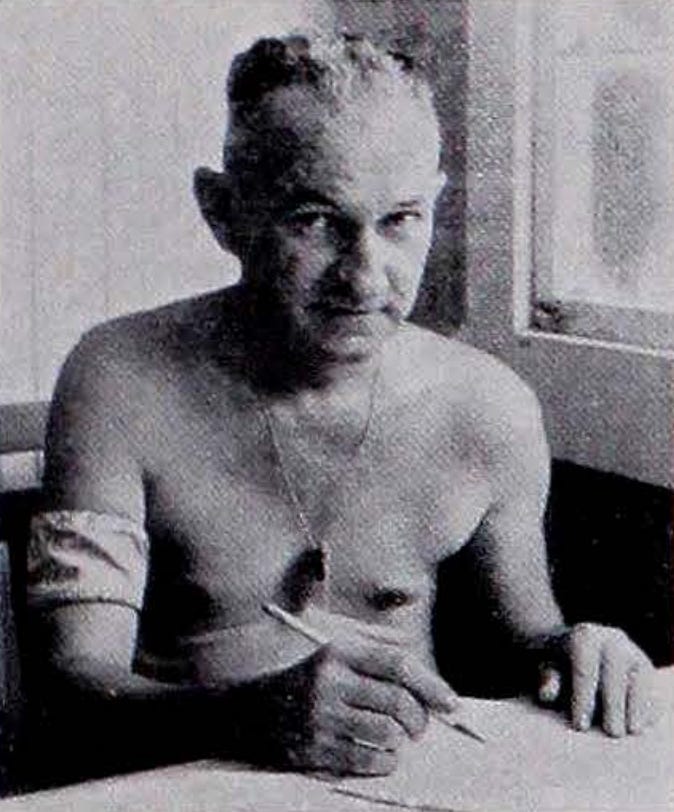
One couple who were members of their group offered temporary use of their farm for sunbathing, but something more permanent was desired. They found a potential site a few miles west of Memphis, but a change in land ownership that September killed the plan before it could get started.
At the October 1955 club meeting, two key figures entered the picture: Gordon and Beulah Satterfield. Having been members of the Oz’Arkansans and familiar with the nudist world, they argued that the club needed a physical home if it was ever going to amount to anything.
Gordon and Beulah acted decisively, purchasing 66 acres of land in St. Francis County, near Forrest City, Arkansas—entered as a loan to the club, to be repaid collectively by members over time. “The park site had not been cultivated in years except for a few small areas in cotton,” Gordon wrote. “There were no buildings or well on it. It had 32 acres in woods, the rest was covered with weeds and sprouts so tall and dense it was almost impossible to walk.”
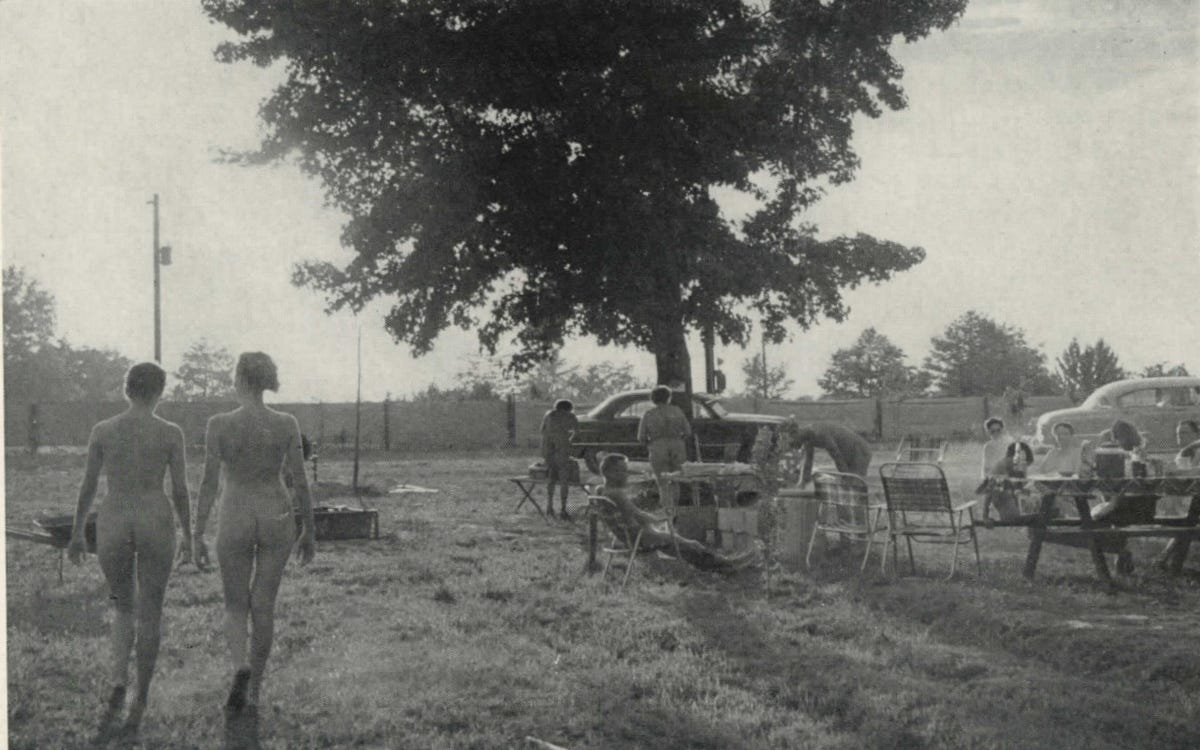
What followed was a remarkable grassroots construction project. Beginning in March 1956—described in Hadley’s article as a “cold and windy day,” with members huddled around a bonfire—the Wildwood community began building their park from the ground up. By April, electricity had arrived, a well had been drilled and fitted with a pump, a road had been graded, and Gordon and Beulah had moved a trailer onto the property. Cecil and Wilma pitched two tents. The land was edged with rose bushes, but heavy sisal paper nailed to the roadside fence would serve as screening until the roses grew tall enough.
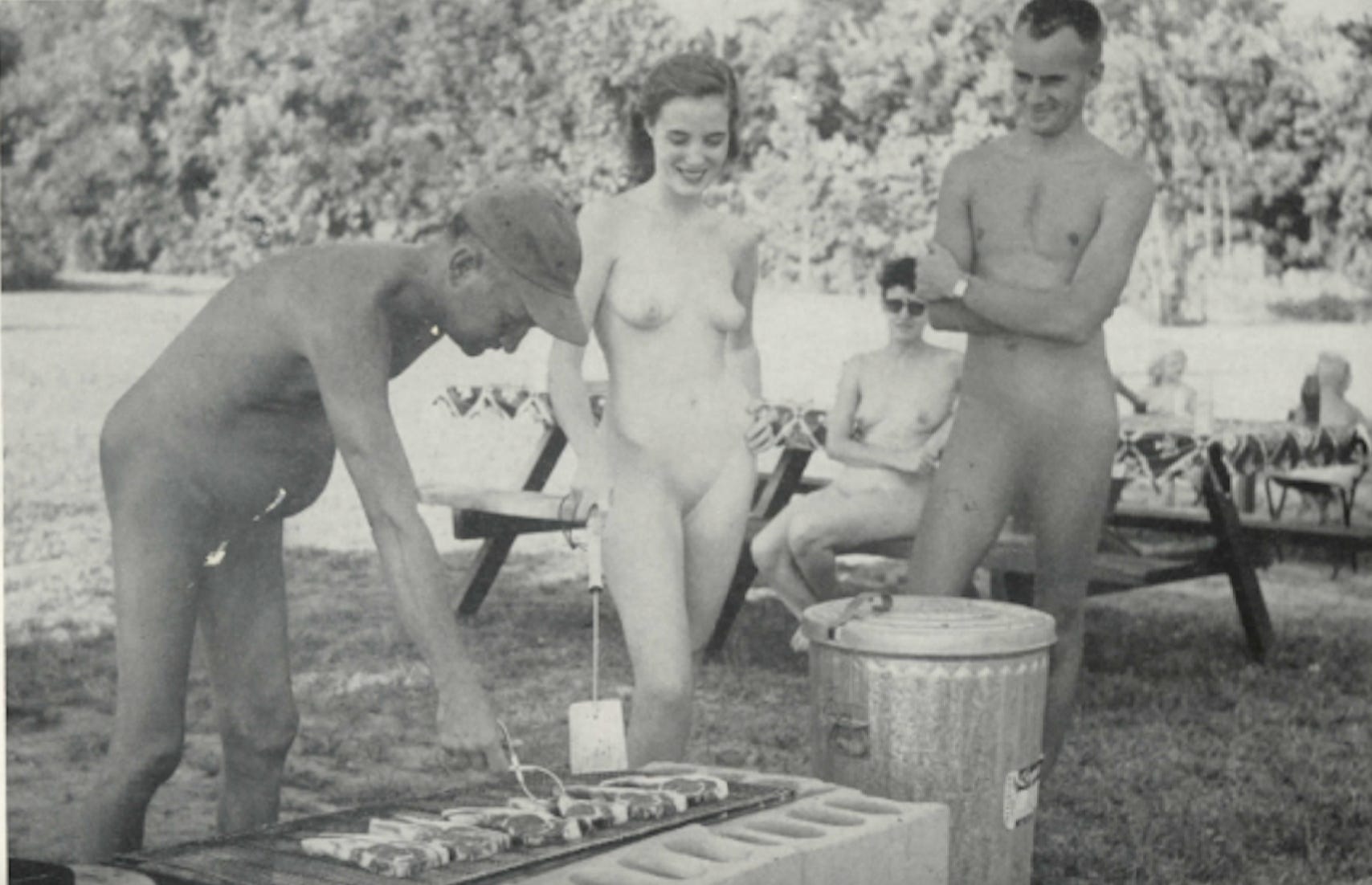
By the end of that first building season—just seven and a half months after the first shovel hit the ground—Wildwood Lodge boasted a modern concrete-block clubhouse measuring 24 by 36 feet, complete with a kitchen, tile floors, a dorm room with eight bunk beds, a full bathroom with shower, and a combined recreation and dining room. A club member donated a 550-gallon tank converted into an outdoor shower.
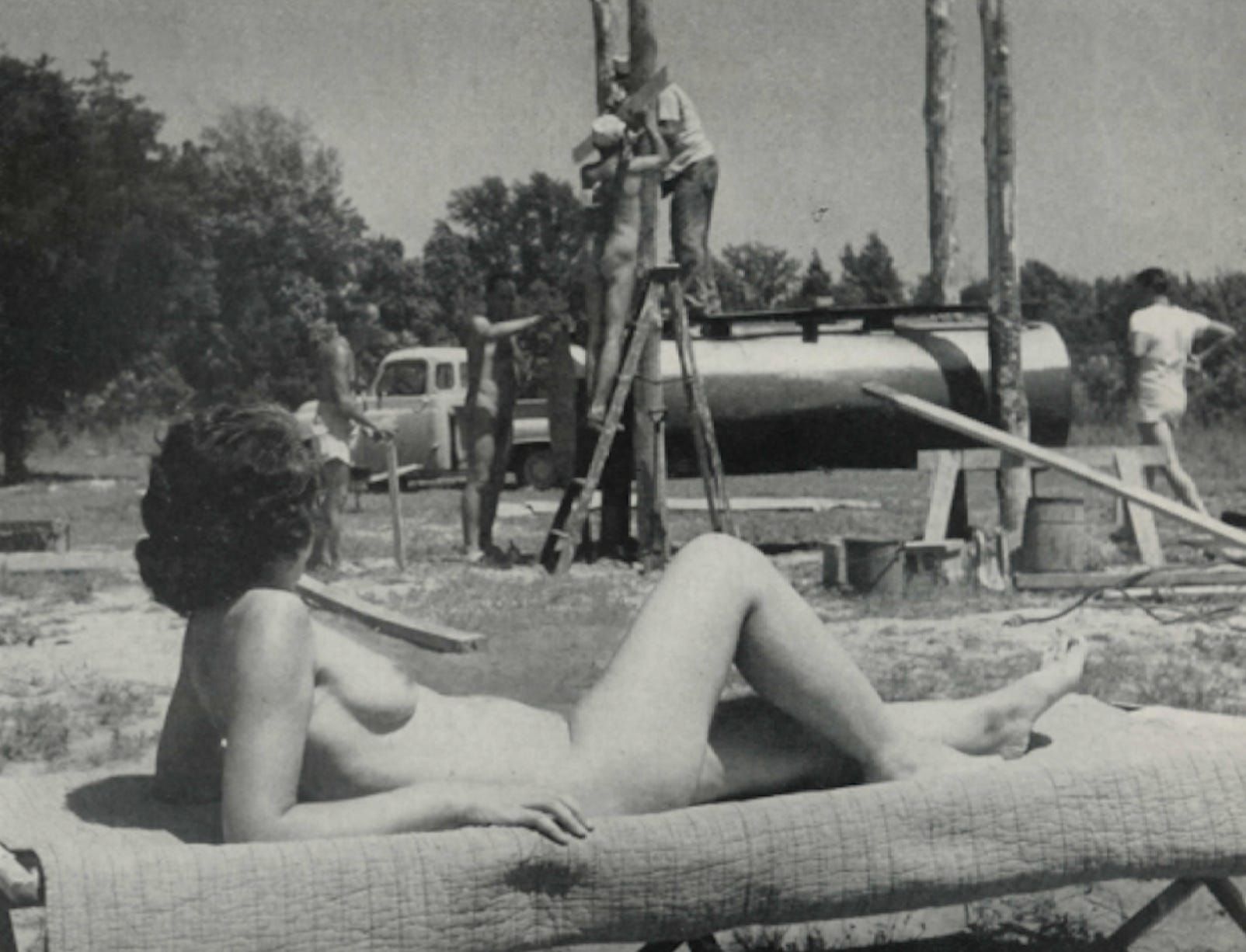
Another couple contributed 50 trees, which were planted to create some shade. Game courts were constructed, picnic tables and grills installed, a gravel road laid, a tractor acquired, and a phone line run to the property. Gordon and Beulah built their own cabin with a bathroom on their lot.
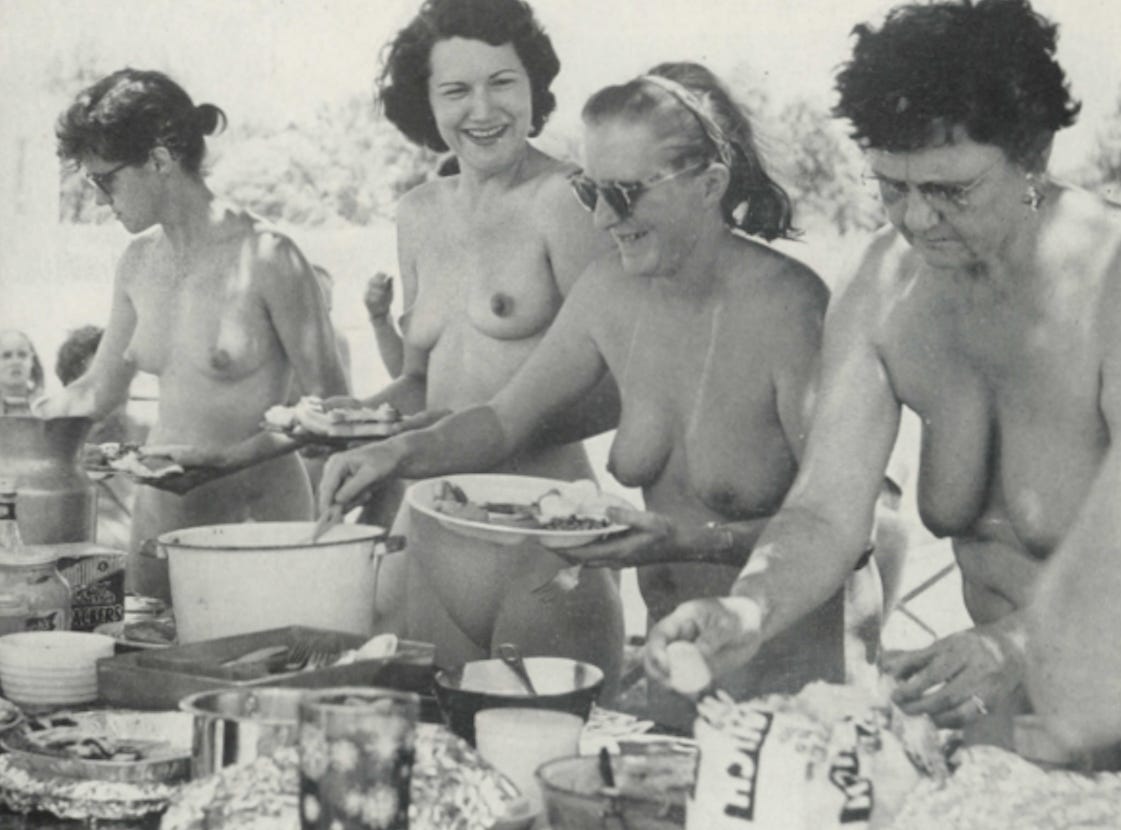
The entire effort was a communal affair. “The club, a cooperative organization, is selling life memberships to obtain working capital,” Hadley said. “Life members are entitled to a cabin-site and automatically become trustees holding the assets of the group.” The enthusiasm among the members was boundless. “It seems as if potential nudists have been around this area for so long that when someone finally set off the spark, the club blossomed forth like an atomic cloud,” Adam and Betty Lanning, a couple who’d become life members, said.33
Satterfield’s Sunshine and Health article glowed with pride. Membership stood at 30 adults and 15 children by the end of 1956, with more prospects on the way and expectations of doubling by the following season, with visions of becoming a year-round nudist park thanks to Arkansas’ favorable climate. Plans were already drawn up for a swimming pool, three private rentable cabins, and an outdoor shuffleboard court.
“We are a happy group and invite all who would like to join or visit us to write today,” Satterfield said. “Plan now for the summer months ahead; come play, relax, and rest in the friendly, congenial atmosphere of Wildwood Lodge.”
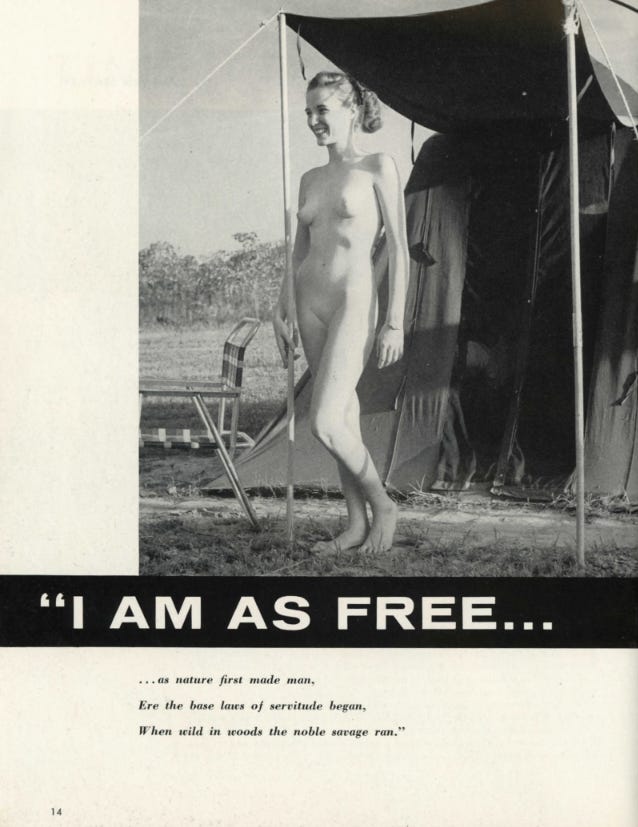
Hadley’s Modern Sunbathing article opened with a quote from 17th century English poet John Dryden that captured the spirit of the group: “I am as free as nature first made man, Ere the base laws of servitude began, When wild in the woods the noble savage ran.” Wildwood Lodge had, by any measure, the makings of a functioning naturist paradise—what Gordon described as the “fastest-growing nudist park in the southeastern United States.”
And it was located in Forrest City, Arkansas—a town named, in a bitter footnote of irony, after Confederate General Nathan Bedford Forrest, the first Grand Wizard of the Ku Klux Klan and architect of the Fort Pillow massacre, which saw the mass murder of Union troops in April 1864, most of them Black. Of course, even Wildwood was still a product of its time and place; there are no records of there being a single Black member, despite more than half of St. Francis County’s population being African American. The region’s history of racial violence thus formed a backdrop for a community trying, however imperfectly, to practice a philosophy of openness, equality, and freedom from social convention. It was, in retrospect, a precarious place to try building utopia.
Though it had such bright beginnings, the situation did indeed start to go south for Wildwood Lodge pretty quickly. Nudists in other locales making plans for an Arkansas summer holiday after reading Satterfield and Hadley’s glowing reports in the spring of 1957 were unaware, but the truth was that things in Forrest City were already falling apart. The articles, written in 1956, didn’t make it to press until months later—long after the crusades had descended on St. Francis County.
Sawyer’s revenge
Though his efforts to outlaw nudism in state after state had come to naught and he’d been humiliated at Battle Creek, Rev. Sawyer never stopped working the local angles. In November 1956, rumors began circulating in Memphis newspapers and eastern Arkansas that a nudist camp was operating. Returning to his usual M.O., Sawyer hammered away at Wildwood Lodge on his Radio Pulpit broadcasts and pestered the local sheriff to investigate.
Having witnessed first-hand the experience of the Dunns and the Oz’Arkansans when they battled Sawyer, Satterfield wanted to get ahead of the curve. He knew about Edith Church’s intervention in the Fort Smith fight, so he contacted the National Nudist Council for advice. Church counseled a strategy of transparency and immediately headed to Arkansas to help.
“I…advised them to ‘sit tight’ for the time being…and talk with the local sheriff, hoping that, by enlightening him as to the purpose, ideals, and practices of a bona fide nudist club, we would forestall any trouble,” Church later recalled. She said the practice had proved successful in other places.34
On Nov. 28, 1956, she and Satterfield visited Sheriff Carl Campbell in person, explained the philosophy of nudism, and invited him to come see the park for himself. They gave him a copy of Wildwood’s by-laws, an issue of Sunshine and Health, and a membership application.
Satterfield believed he was protected in any case by a legal opinion from Attorney General Jack Holt from many years prior which had held that Arkansas’s indecent exposure statute did not apply to social nudism conducted on private property, and he told the sheriff so. Campbell indicated he had no desire to cause trouble for Wildwood, and Gordon and Edith took him at his word. They drove back to the camp “jubilant,” Church said, and she caught the next flight home.
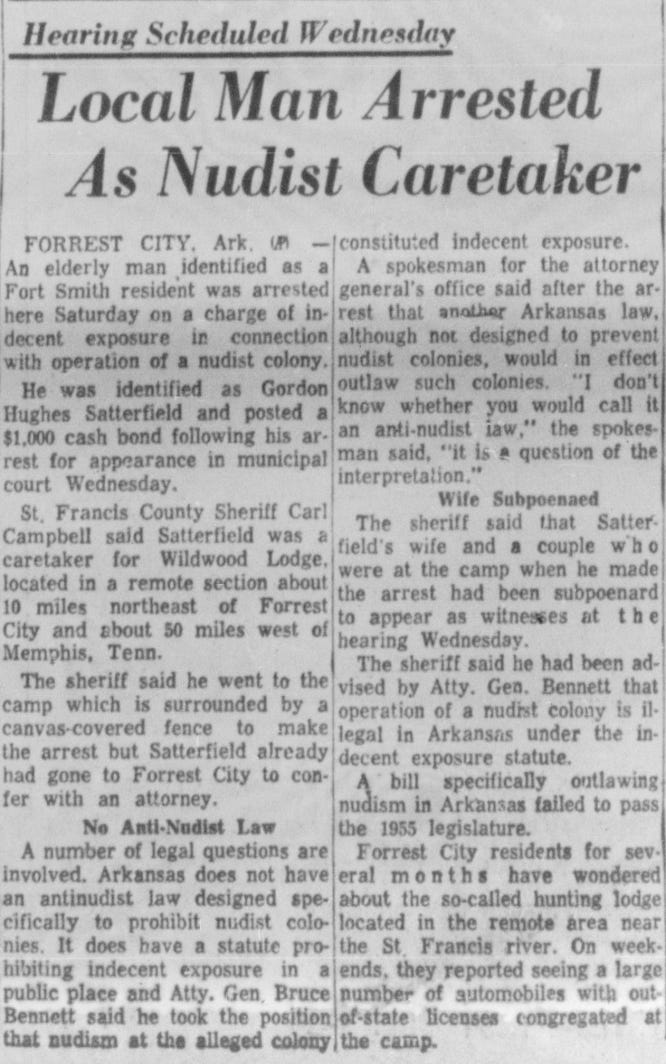
But on Dec. 3, 1956, Sheriff Campbell wrote to new Attorney General Bruce Bennett asking for his opinion on Wildwood’s operation.35 On Jan. 21, 1957, Bennett rendered his verdict: nudism, he concluded—drawing on case law from 1859, 1934, and 1943—constituted a violation of Arkansas’ indecent exposure laws.36 He acknowledged there was no statute specifically banning social nudism or “nudist colonies,” but he ruled that the indecent exposure regulation was enough to shut down Wildwood. “I don’t know whether you would call it an anti-nudist law,” Bennett’s spokesman told the press, “it is a question of interpretation.”37
Five days later, on Jan. 26, Satterfield was arrested and charged with indecent exposure. He posted a $1,000 cash bond. In desperate need of legal help, he contacted both major national nudist organizations, the National Nudist Council and the American Sunbathing Association, as Wildwood held a dual affiliation. Edith Church was traveling on the West Coast, however, and didn’t receive his messages until days later. The ASA also didn’t respond right away, so Satterfield hired his own attorney and tried to prepare for his hastily-arranged trial, which unfolded in pieces.
The hearing opened on Jan. 30, 1957, and Municipal Judge O.H. Hardgraves heard testimony from several witnesses, but then prosecutors announced they were now also charging Satterfield with “possessing and distributing obscene pictures,” in addition to indecent exposure.38 The judge reserved his decision on the first charge, then reopened proceedings a week later to admit as evidence the issue of Sunshine and Health which featured Satterfield’s own article and photographs taken of nude people at Wildwood Lodge—the same piece that had been written to celebrate the park’s remarkable growth.
Confident that the law was on his side, Satterfield acknowledged everything he had written about Wildwood and said the activities that went on there were not inappropriate in any way. “The story is all factual,” he told news reporters. He said the law he was accused of violating was “passed in an era when even the show of an ankle was considered indecent.”39
On Feb. 4, Hardgraves issued his ruling: Satterfield was guilty on both charges.40 He was fined $250 on the indecent exposure conviction and $100 for the obscene pictures. His lawyer appealed the case to the St. Francis County Circuit Court, which scheduled a hearing for May. By now, the NNC had received his pleas for help. It put up the $750 cost of an appeal and also reimbursed Satterfield for his fines. Edith Church said the organization was “determined to clear Gordon of these ridiculous charges, even if necessary to carry them to the U.S. Supreme Court.”41
The law that killed the dream
While Gordon’s case was still working through the courts, however, the legislative hammer fell. On Feb. 13, 1957, seemingly out of the blue, the legislature passed and Gov. Orval Faubus (of segregation infamy) signed Senate Bill No. 95, completely outlawing nudism in the state of Arkansas.42
There were no hearings, no investigations, no testimony. The matter was treated with nonchalance—“a bit of comic relief,” some called it—at the end of a long day of debate on an unrelated tax law.
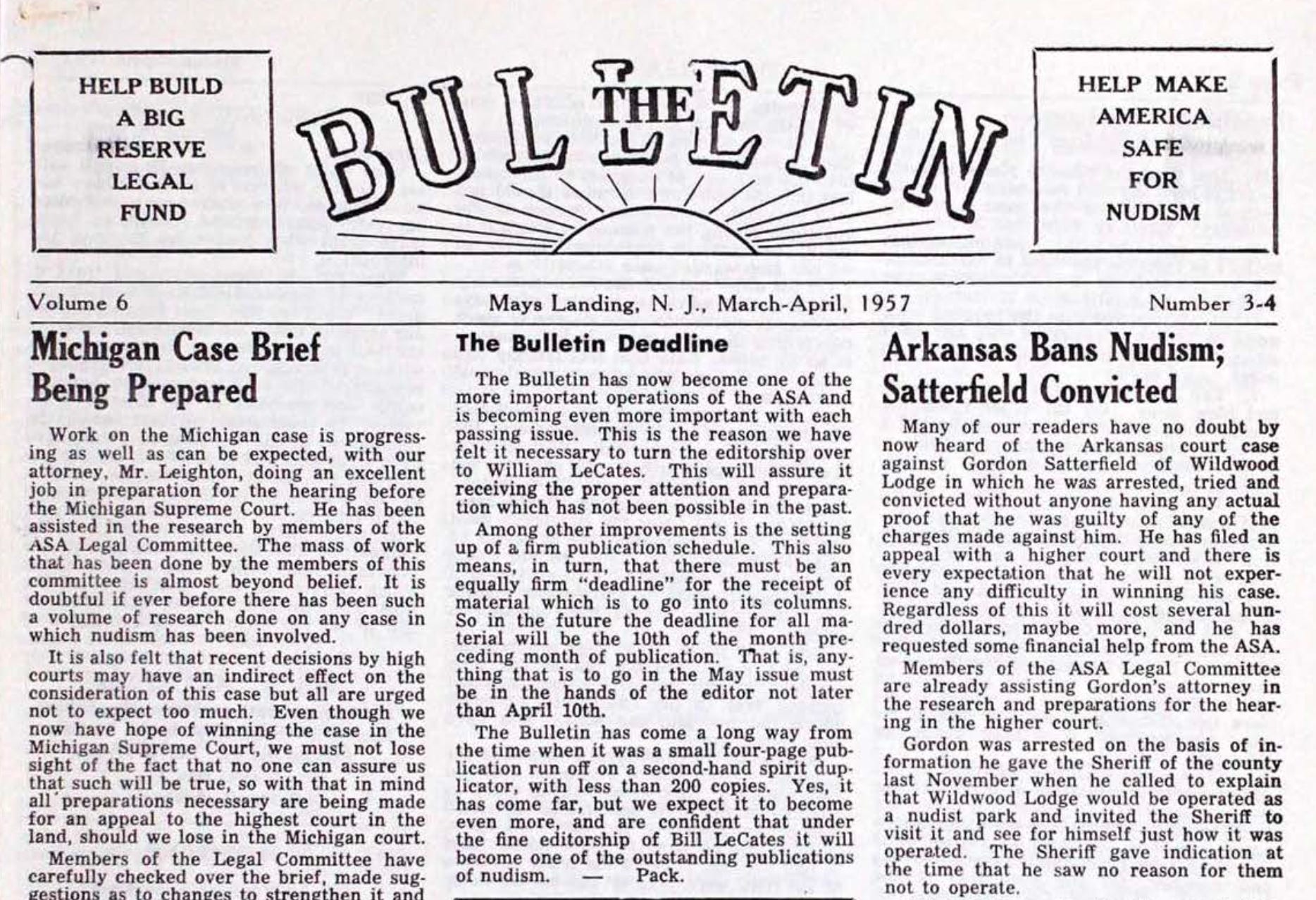
The measure was different than the litany of indecent exposure and censorship laws that had long been used to prosecute nudists.43 This one explicitly outlawed not just social nudity, nude recreation, or publishing nude photos—it also criminalized supporting nudism as an idea. It stated: “It shall be unlawful for any person, club, camp, corporation, partnership, association, or organization to advocate, demonstrate, or promote nudism.”44
The General Assembly determined that there had “grown up in various parts of the nation and in the State of Arkansas a form of recreation or participation known as nudism which entails such practices as sunbathing, hiking, swimming, and other activities in the nude and in the presence of persons of the opposite sex.”
Such practices, lawmakers decided, “constitute a clear and present danger to the public peace, health, welfare, safety, and morals.” They declared the situation an “emergency” requiring stiff legal sanctions—a fine of $2,500 and up to a year in prison.45
Though the law came as a surprise to national nudist leaders, it hadn’t actually emerged out of thin air. Sawyer, of course, was behind the whole affair. The anti-nudism bill he had tried but failed to get passed in 1955 had been hastily resurrected by an ally, State Sen. C.E. Bell, who represented the district where Wildwood Lodge was located.
Satterfield knew what Sawyer had been up to and tried to warn his allies. In the letter dispatched to ASA Executive Director Norval Packwood before his trial, he said that Sawyer “was broadcasting some of his lies…harassing my employees by threatening to give their names” and saying “that he has another anti-nudist bill introduced in the legislature.”46
Rather than protecting the morals of the people of Arkansas, Satterfield said the preacher had one goal: “Same old Sawyer racket, anything to get money.” He asked the ASA for “financial help, moral support, and a good nudist lawyer.” Before his letter even made it to Packwood’s desk, though, Sawyer’s bill was already law.
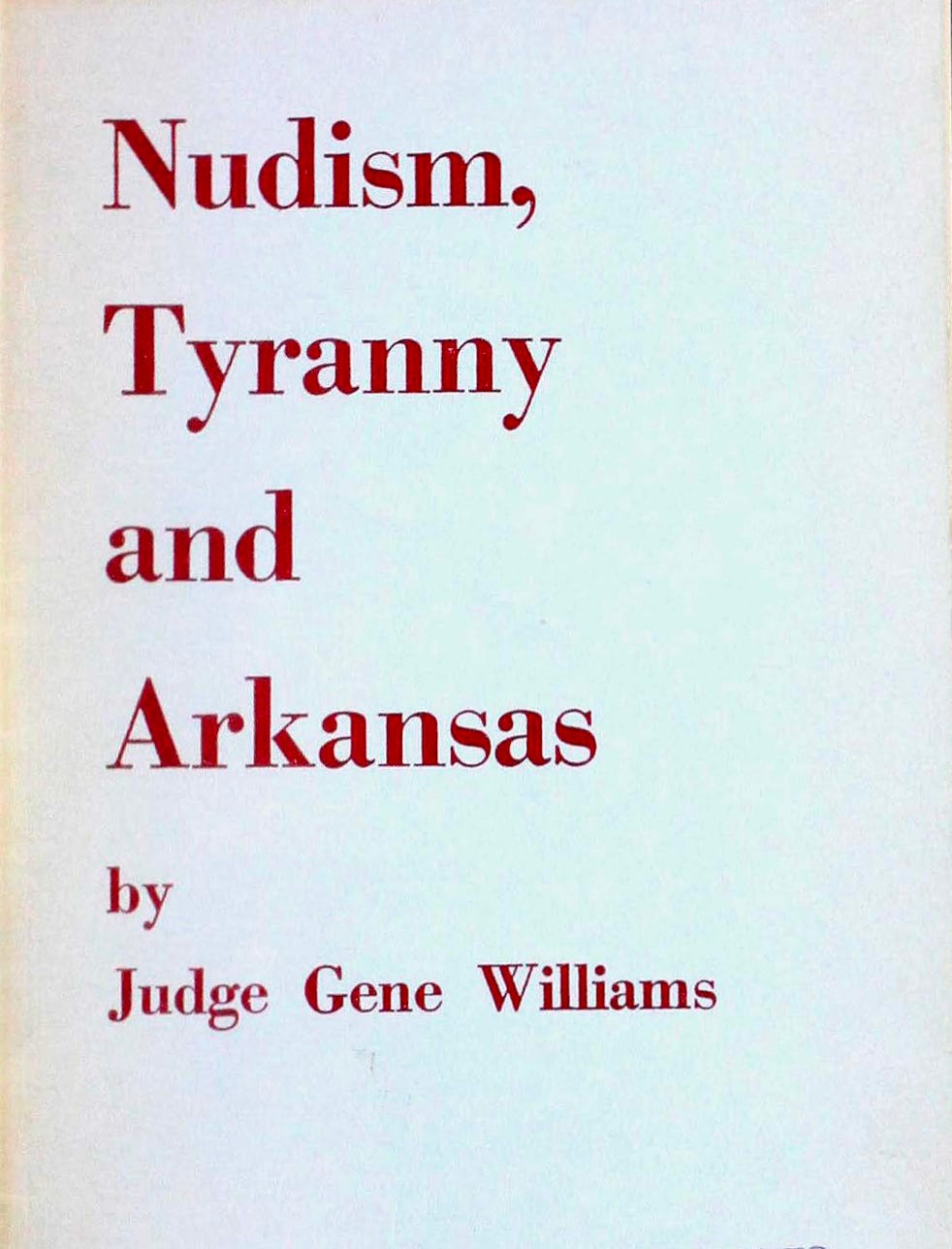
Just before Satterfield’s appeal was set to be heard, the ASA jumped into the ring, providing another attorney, Gene Williams, to supplement the legal team.47 With a rival group stepping on the NNC’s turf, Edith Church would not even acknowledge it was ASA who sent the new lawyer, simply referring to them as “another organization” in her later account of the case. The addition of a new attorney meant the hearing would have to be postponed.
The case wound its way through continuances and delays. The circuit court kept pushing the date—at one point because the county was reportedly too broke to hold court—until the appeal was finally heard in October 1957. Church flew back to Arkansas to support Satterfield, while his new lawyer from the ASA, Williams, came armed with a brief that ripped the prosecutors’ arguments to shreds.
But the clock kept ticking. Too many cases were on the docket, and the Wildwood file was repeatedly pushed back on the schedule, day after day. It was starting to look like it would be put off to the next court session, whenever that might be. That’s when Williams started huddling with the county’s lawyers.
“There was talk along the line of not carrying Gordon’s cases to the higher courts,” Church said, “because the Michigan case and several magazine cases, already appealed, were considered more important…. To this, neither Gordon nor I could agree.”48
At the same moment Gordon’s case was working through the Arkansas courts, a legal battle was already unfolding at a higher level in Michigan. In People v. Hildabridle, the state had prosecuted the owners of Sunshine Gardens—the very resort where Sawyer had made his infamous charge at the gates—on obscenity and indecency charges that, if upheld, could have set a devastating national precedent against organized nudism. The case was related to the earlier anti-nudist effort Sawyer had waged in Michigan, which had been taken up by local disciples.
With limited resources and legal attention to go around, nudist movement attorneys concluded that a definitive ruling in Michigan, striking down the state’s ability to prosecute a well-established nudist resort, would do far more for the cause than a misdemeanor fight in a cash-strapped Arkansas county court.
Church and Satterfield were adamant, though: “No deals.” She said the cases “would stand or fall on their own merits” and “if necessary, we would carry them to the highest court in the land.” But in the end, Satterfield’s attorneys struck a deal with prosecutors. The indecent exposure charge was dropped for lack of evidence, and Church and Gordon were promised that the obscene literature charge would also eventually be quietly dropped. It was not; the charge was upheld, and Gordon was fined $100 plus fees.
Hinting again at the NNC-ASA rivalry, Church later implied the lawyers provided by ASA caved prematurely. “Were we sold out?” she asked. “NNC was ready and willing to fight it out all the way, and Gordon was with us on our stand.”
Satterfield seemed less interested in the nudist civil war, at least for the moment.49 Writing to ASA President Maria Park in early 1958, he was philosophical but unbowed: “Until the Arkansas anti-nudist laws are disposed of in some manner and nudism made safe here, we cannot count this a victory, and we have a fight ahead yet.” He thanked both the ASA and NNC for their “financial, moral, and legal support,” but with nudism now explicitly outlawed in Arkansas and no national organization eager to fight a drawn-out appeals process, Wildwood Lodge didn’t last much longer.50
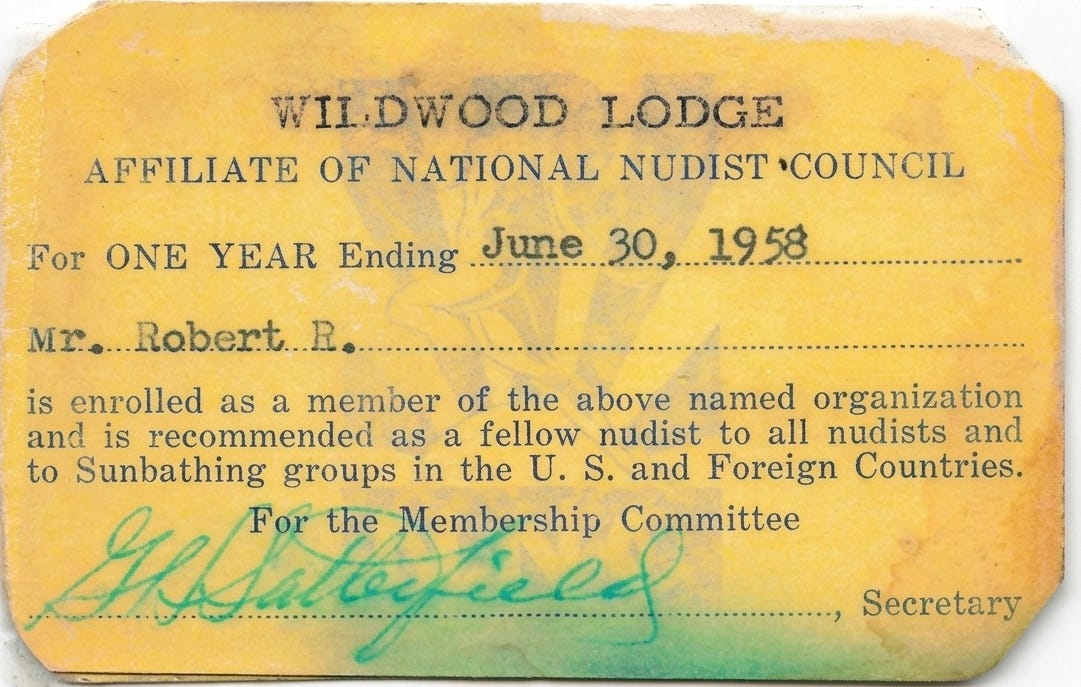
Membership cards were still being issued for 1958, and a report in Sunbathing Review in the spring of that year said the camp had surprisingly not closed and still had sites for cabins, trailers, and tents. The same piece also trashed Arkansas Gov. Faubus for adding the anti-nudism law to the list of things already embarrassing the state, primarily “the question of school integration.”51
Soon enough, though, Satterfield was done with Arkansas. He continued to be a part of the nudist movement, however. By 1960, he’d moved to Dade City, Florida, a hub of Southern U.S. nudism.52 Two years later, he represented NNC at an event hosted by the Floritans and Sunny Acres Lodge.53 He’d been elected to the NNC board of directors the previous year.54
But in 1964, the newsletter of the American Nudist Association, The ANA Essay, said “former NNC Board member” Gordon Satterfield was chosen as the organization’s Man of the Year.55 The article suggests that Satterfield was so honored because he had broken with NNC and joined the new upstart nudist group. The ANA itself was a breakaway from the Eastern Sunbathing Association, which in turn was a division of the American Sunbathing Association.
So, it appears that Satterfield did eventually get caught up in the turf wars, personality battles, and sectarian splits that plagued American nudism in that era, but the full details of his role in it all remain to be uncovered. He died in Florida in August 1968.
What remains
Which brings us to the present. The Ozarcadians are gone, the Oz-Arkansans dissolved long ago, and Wildwood exists only in the pages of old nudist magazines. The state that was once home to the country’s “fastest-growing nudist park” has for almost 70 years been the most anti-nudist jurisdiction in the U.S.A.
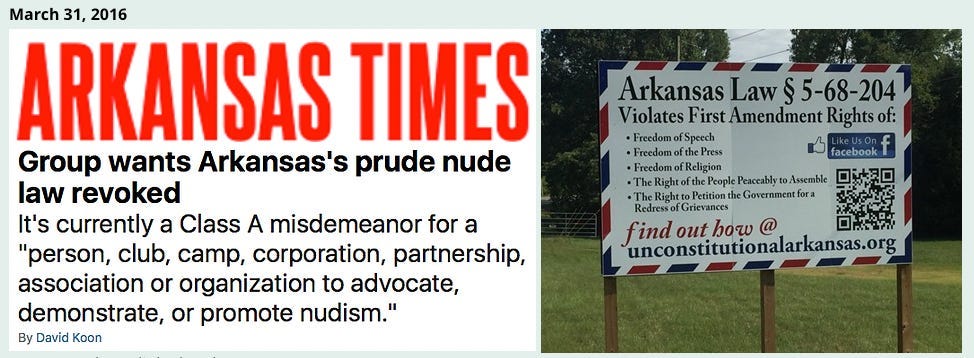
The law that ended those early experiments was born in bad faith, passed without debate, and has never been meaningfully challenged in the courts. Amended around the edges over the years, it is today designated as “Arkansas Code § 5-68-204: Nudism.” It stands as the most stringent legal restriction of social nudity in the country, forbidding any two (or more) persons of the opposite sex from being nude in each other’s presence unless they are married or one of them is a medical professional engaged in a procedure or examination.
Most observers at the time the law was passed in 1957 expected it to be quickly struck down, with one jurist comparing it to Tennessee’s law forbidding the teaching of evolution—the Scopes “monkey trial” law.56 An advocacy group called Unconstitutional Arkansas has pushed repeal for years, arguing the statute contravenes the First Amendment’s guarantees of freedom of thought, speech, and association, but the campaign has yet to gain much traction.57
The only entities that have found a workable niche within the law’s restrictions are those operating clothing-optional spaces exclusively for members of a single sex. Magnetic Valley Resort in Eureka Springs is an all-male clothing-optional retreat nestled in the Ozark hills catering to gay, bisexual, and straight men that stays within the narrow lane of what the law permits.58 It strictly follows Arkansas restrictions regarding its clothing-optional areas, which allows such spaces so long as they are not public and members of the opposite sex are not present.
The Boar’s Rut Men’s Campground in southern Arkansas functions on a similar basis—males only. No doubt Rev. Sawyer and the conservative lawmakers of the 1950s would be appalled to learn that, though they managed to squash “mainstream” social nudism, they inadvertently left a loophole in state law allowing gay nudist recreation to flourish.
These are thin threads of continuity to what came before—a couple of clothing-optional men’s retreats—in an otherwise nude-free state. Of course, it would be foolish to think Arkansans aren’t getting naked outdoors. With its vast stretches of Ozark wilderness, its hidden swimming holes and isolated trails, the Natural State undoubtedly harbors more outdoor nudity than its legislators would care to acknowledge. But none of it is organized or protected.
So, until the legislature is someday moved to act or a court finally weighs in, the Natural State will remain, in one specific sense, profoundly unnatural—the only state in America where taking off your clothes and advocating social nudism are both not just taboo, but illegal. 🪐
Special thanks to the American Nudist Research Library and the Western Nudist Research Library for access to the archival nudist publications referenced in this article.
For the full story, see: Curtis Atkins, “Reverend Braxton Sawyer: The crusading anti-nudist of Arkansas,” Planet Nude, Sept. 11, 2023. https://www.planetnude.co/p/reverend-braxton-sawyer-the-crusading
Associated Press, “If Arkansas Doesn’t Want Nudists, Lots of Other People Do,” Southwest American, Aug. 19, 1942, p. 3.
Angus Hart, “The Ozarcadians,” Sunshine and Health (ASA Bulletin), January 1944, pp. 28-29.
Alois S. Knapp, “A True Romance of Nudist Royalty,” Sunshine and Health, January 1943, pp. 20-21.
Ilsley Boone, “’Neath Summer Skies at Zoro Nature Park,” Sunshine and Health, November 1942, pp. 5-7, 13, 21.
Knapp, “A True Romance…”
Hart, “The Ozarcadians.”
Associated Press, “Proposed Nudist Camp Near Rogers Banned,” Southwest American, Sept. 16, 1943, p. 3.
Ralph W. Shreve, “The Ozarkadians,’ Sunshine and Health (ASA Bulletin), February 1946, p. 22.
Natural Living, August 1951, p. 8.
Rex Alden, “The Oz’Arkansans,” Modern Sunbathing, November 1951, pp. 7, 41.
“Alex of the Oz’Arkansans (Preston Dunn), “The Oz’Arkansans,” Sunbathing and Health, Letters Page, June 1951, pp. 18-19.
“Roads leading to the Oz’Arkansans Park,” The ASA Bulletin, July 1952, p. 4.
Mr. Harper, “Cherokee Strip,” Harper’s. August 1955, p. 84.
Quoted in: “The Preacher & the Nudists,” Time. August 16, 1954, p. 46.
Tommy Dee. “Nudism’s Proudest Hour (Part I),” Sun Lore. Vol. 1, No. 2, November 1964, pp. 27-30.
“Sheriff Finds House But Nary a Nudist,” Southwest American, Dec. 10, 1953, p. 1.
“Nudists’ Leader Says Attorney for Parent Group on Way Here – Preacher and Group Head Subpoenaed,” Southwest American, Dec. 11, 1953, p. 1.
“Prosecutor Says No Law Violation Shown Through Nudist Quiz,” Southwest Times-Record, Dec. 13, 1953, 1.
Correspondence from Arkansas State Sen. Wiley W. Bean, 3rd District. Letter and response in the American Nudist Research Library archives.
Tommy Dee. “Nudism’s Proudest Hour (Part II),” Sun Lore. Vol. 2, No. 1, January 1965, pp. 31-34.
“More Clubs Visited by Executive Director,” The Bulletin, July 1956, p. 1.
Preston A. Dunn, “A Nudist Church Idea,” Natural Herald, January 1958, p. 5-6.
The latest one found in archival materials appeared in the December 1973 issue of Nudist Sundial.
Mr. Harper, “Cherokee Strip,” Harper’s. August 1955, p. 84.
Donald Johnson. “The Crumpled Crusader,” Modern Sunbathing. Vol. 24, No. 12, December 1954, p. 7.
“Preacher Rebuffed in Effort to Prowl Around Nudist Camp,” The Shreveport Journal (Shreveport, Louisiana). August 5, 1954, p. 21; and Detroit Free Press, quoted in The Nudist Newsletter. Issue 36, p. 3.
Stan Stohler, “Donnybrook at Battle Creek,” Urban Nudist. Vol. 1, No. 8, October 1963, pp. 54-7.
“Sawyer Falls Flat,” The Nudist Newsletter. Issue No. 41, 1955.
Kurt Barthel, “The Taste of Victory,” Modern Sunbathing, October 1955, pp. 10, 38-39.
Brief parts of the history of Wildwood Lodge are presented in: “‘They were made of stern stuff, fired with determination’ — A history of nudism in Tennessee part 1: The beginning,” Planet Nude, July 24, 2023. https://www.planetnude.co/p/they-were-made-of-stern-stuff-fired
Gordon Satterfield, “Wildwood Lodge,” Sunshine and Health, February 1957, pp. 6-7; and Jim Hadley. “I am as free…” Modern Sunbathing and Hygiene. Vol. 27, No. 4-119, April 1957, pp. 14-18.
Adam and Betty Lanning, “Wildwood,” American Sunbather and Nudist Leader, January 1956, p. 22.
Edith Church, “The Wildwood Lodge Case,” Sunshine and Health, March 1958, p. 26.
Associated Press, “Rules Nudist Colony Illegal,” Southwest American, Jan. 25, 1957, p. 1.
“Wildwood Lodge Case Status,” The Bulletin, June 1957, p. 1
Associated Press, “Local Man Arrested as Nudist Caretaker,” Southwest Times Record, Jan. 27, 1957, p. 1
Jack Stout, “Local Man Faces New Trial Charge,” Southwest American, Jan. 31, 1957, p. 1, 11.
ibid.
Associated Press, “Court Convicts Satterfield,” Southwest American, Feb. 5, 1957, p. 8.
Church.
Editorial Board. “Rape of the Democratic Process,” American Sunbather & Nudist Leader. Vol. 9, No. 6, June 1957, pp. 3, 17.
“Arkansas Bans Nudism; Satterfield Convicted,” The Bulletin, March-April 1957, p. 1.
2010 Arkansas Code § 5-68-204 - Nudism. https://naturistaction.org/laws/arkansas-laws/
“Anti-Nudist Bill Passed in Arkansas,” The Nudist Newsletter. Issue 63, 1957.
Gordon Satterfield, Letter to Norval Packwood, reprinted as “Nudist Park Owner Arrested!” in The Nudist Newsletter. Issue 63, 1957.
“Wildwood Lodge Case Status.”
Church.
For background on the ASA-NNC feud, which centered around the personality of Ilsley Boone, see: Evan Nix, “The untold history of America’s oldest nudist magazine,” Planet Nude, Aug. 20, 2024. https://www.planetnude.co/p/the-untold-history-of-americas-oldest-ac5
Gordon Satterfield, “Wildwood Lodge Expresses Thanks,” The Bulletin, January 1958, p. 1 (Letter to Maria Park, ASA President).
“Nudist case bears same stripe as Arkansas integration,” news item in the “Nudistviews” column, Sunbathing Review, Spring 1958, p. 48.
Oak Leaves, August 1960, p. 4.
“Daveandag Day Big Success,” The Bulletin, March 1962, p. 2.
Ken Price, “At the NNC Helm,” Sunshine & Health, November 1961, p. 24; and Elvin S. Carlisle, “Boats, Tennis, and Furs at the NNC,” Sundial, April 1962, p. 25.
“A Glance at ANA Convention Highlights,” The ANA Essay, March 1964.
Judge Gene Williams. Nudism, Tyranny, and Arkansas. Spokane, Wash.: Outdoor American Corporation, 1957.
David Koon, “Group wants Arkansas’s prude nude law revoked,” Arkansas Times. March 31, 2016. https://arktimes.com/news/arkansas-reporter/2016/03/31/group-wants-arkansass-prude-nude-law-revoked
Matt Kirouac, “Everything I Learned From My First Clothing-Optional Gay Resort,” Inside Hook, Nov. 27, 2024. https://www.insidehook.com/hotels/clothing-optional-gay-resort
I've read elsewhere about Sawyer. Apparently he was known to send bundles of nudist magazines to politicians to show them the evils of nudism. I'd bet those magazines were carefully examined again and again.
Thank you for this very informative article. A great piece of nudist history and an example of the continuing legacy of the early fights, which we still deal with today. According to William Calhoun Walker, who formed the Common Sense Club in 1919, there was a "Camp" in each state of the union, implying that there had been a nudist contact and some activities in the 19teens in Arkansas. As a bit of irony, in 2017 when the skinny-dipper flag was being designed by a group in Alaska, it was The Flag and Banner Company of Little Rock which made the production happen and even offered the name. In conversation the idea of a flag supporting body acceptance and social nakedness was mentioned. When it was clarified that the idea was to promote skinny-dipping the response was "why didn't you say so. Just call it that. The skinny-dipper flag" The flag now promotes social nakedness and body acceptance all over the globe, and the company offering this positive message is from Arkansas.