

Denny Blaine's abatement plan is being used to police topless visitors
Private security guards hired by a neighboring homeowner have been citing the court order to confront topless parkgoers—FoDB filed a motion Monday to stop it

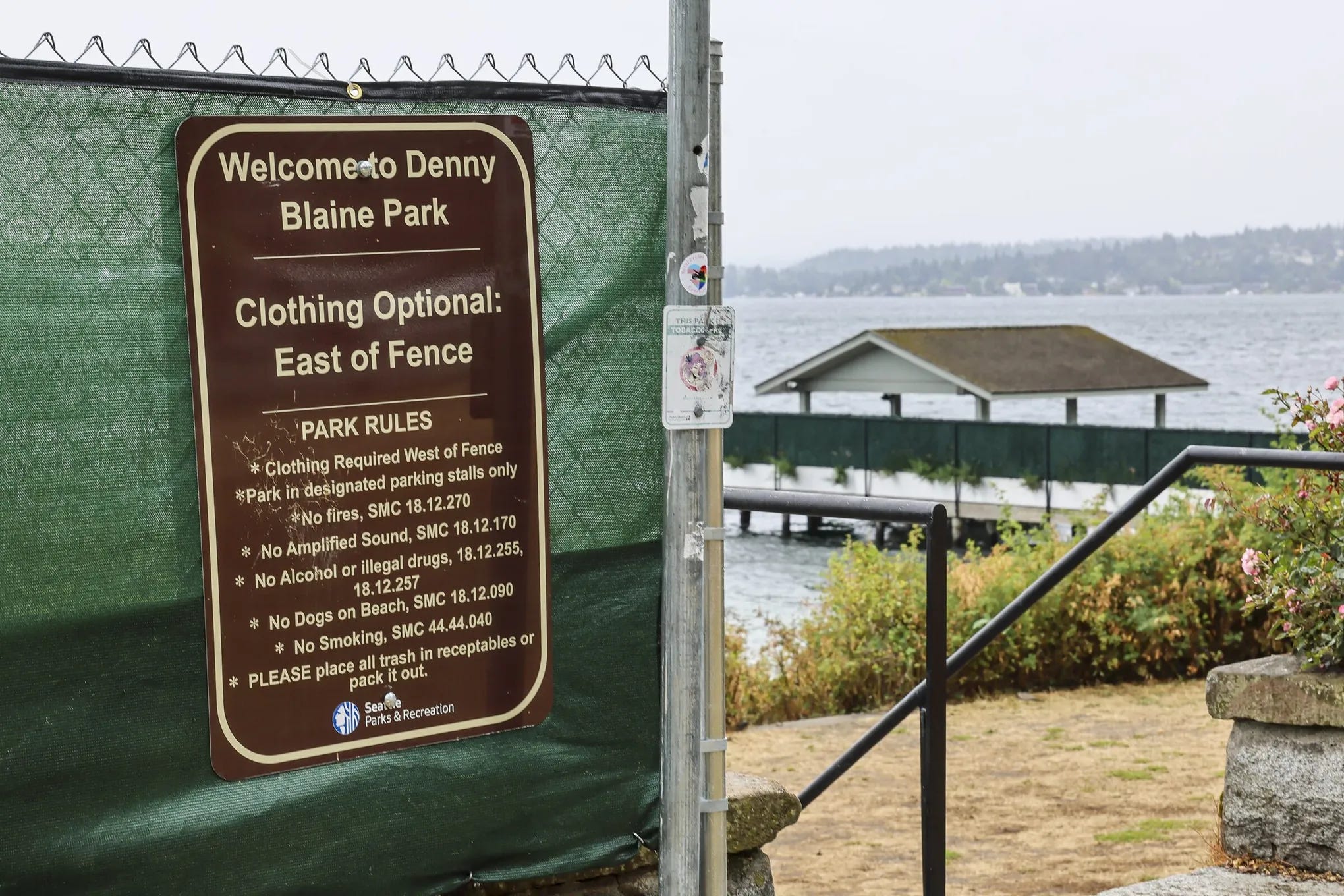
Friends of Denny Blaine, the queer-led stewardship group that has defended Seattle's clothing-optional beach through years of legal pressure, filed a motion in King County Superior Court on Monday asking Judge Samuel Chung to clarify that toplessness remains lawful throughout Denny Blaine Park, including in the zone where the court-ordered abatement plan designates “clothing required.” A hearing is scheduled for May 1.
The filing is a response to something that has been reportedly happening at the park since the abatement plan took effect last August. As Planet Nude has reported, the abatement plan divided the park into two zones—a beach-level area designated “clothing optional” and an upper lawn area designated “clothing required”—installed under court order last July. According to FoDB, parkgoers have been “confronted, intimidated, and told to cover up their bare torsos by private security guards hired by neighboring homeowners—who have invoked the court-ordered abatement plan as justification for their directives.”1
Seattle Parks rangers and SPD officers have both said that toplessness is not prohibited anywhere in the park, but the guards have been calling the police on people anyway. Toplessness has no legal prohibition under either city or state law; Seattle repealed its lewd conduct ordinance in 1994, and Washington’s indecent exposure statute only applies when a person knows their conduct is likely to cause reasonable affront or alarm. As SPD has put it publicly, it’s the conduct, not the nudity, that determines whether a law has been broken.
Inside the motion
The motion, prepared by Perkins Coie (the firm representing FoDB pro bono since it intervened in the lawsuit earlier this year) makes a detailed legal case that the “clothing required” designation was never meant to ban toplessness. The nuisance Judge Chung identified last July was specific: public sex acts, masturbation, and genital exposure with lascivious intent. Toplessness, the filing argues, was never part of the evidentiary record before the court, never part of what any party complained about, and cannot be read into an abatement order whose scope must be construed narrowly. The motion puts it plainly:
“Just as socks and scarves are not required to cover the feet and neck, shirts are not required to cover the torso.”2
The motion draws on deposition testimony from the plaintiff's own witnesses to make the point. Stuart Sloan, the real estate developer and neighboring homeowner whose security firm is named in the filing, testified that toplessness “is not the same as full nudity,” that it had been present at the park since at least the early 1990s, and that he did not consider it a nuisance. Another plaintiff member testified that topless sunbathing by a respectful group “would not preclude her from going.” If toplessness was never the nuisance the lawsuit complained of, the motion argues, the court-ordered remedy cannot be stretched to address it.
The motion also documents the enforcement pattern itself. According to court filings, private security through Security Services Northwest has monitored the park 24 hours a day, seven days a week since April 2025. Incident reports included in the filing describe guards photographing a topless woman sunbathing, calling SPD on a person who walked topless from the beach to their car to retrieve an item, and as recently as April 4 of this year, confronting a FoDB member twice on the upper lawn as she walked topless to the restroom, telling her “there are rules that say you need to be fully clothed while walking on the upper level at Denny Blaine.” A senior park ranger who arrived on scene confirmed that toplessness is not prohibited for parkgoers of any sex or gender identity. The guard’s claim, the motion states, was not enforcement of the court’s order. It was a misrepresentation of it.
A constitutional dimension
FoDB also raises Washington’s Equal Rights Amendment, which prohibits sex-based discrimination in stronger terms than federal law, with no carve-out even for compelling state interests. The filing argues that selectively targeting some bare torsos while leaving others undisturbed, based on a guard’s perception of a parkgoer’s sex or gender, would be unconstitutional even if the city tried to impose it directly. A private security firm, the motion argues, cannot wield enforcement powers the government itself does not possess.
The stakes are sharpest for trans and gender-nonconforming parkgoers, who the filing identifies as among the most vulnerable and historically significant users of the park. FoDB notes that the guards’ own incident reports document attention to parkgoers’ gender presentation—whether bodies and voices matched the guard’s expectations about gender—raising obvious risks for people who don’t conform to those expectations. As FoDB put it in its statement accompanying the filing, the goal is to ensure “our state’s first official LGBTQ+ historical site isn’t erased.” Denny Blaine was added to the Washington Heritage Register last September—the first nude beach and first LGBTQ+ site so recognized in the state—a designation the motion invokes to underscore what’s at stake in how the court’s order gets interpreted.
The remedy FoDB is seeking is narrow: a court clarification that toplessness is not prohibited, and authorization for the city to update the park’s signage accordingly. The current signs read “clothing required.” FoDB is proposing language that says “bottoms covering genitals required west of fence”—specific enough to eliminate the ambiguity the guards have been exploiting, and clear enough that parkgoers of any gender identity know where they stand.
Planet Nude has been reporting on the campaign against Denny Blaine since 2023. The May 1 hearing will be the next turn in a fight that keeps finding new ground. 🪐
More to read:


Friends of Denny Blaine. (2026, April 20). Toplessness is not nudity. And we are not backing down. [Email newsletter]. Friends of Denny Blaine Park.

The use of private security guards to police the activities of beachgoers is especially disturbing. I wonder why that that’s allowed in a public park managed by Seattle Parks and Recreation.
It is strange how the sight of female nipples is seen by some people as so offensive.