

Cape Town’s World Naked Bike Ride is canceled after 18 years
Organizers say the city demanded a fully clothed event this year, ending a long-running protest

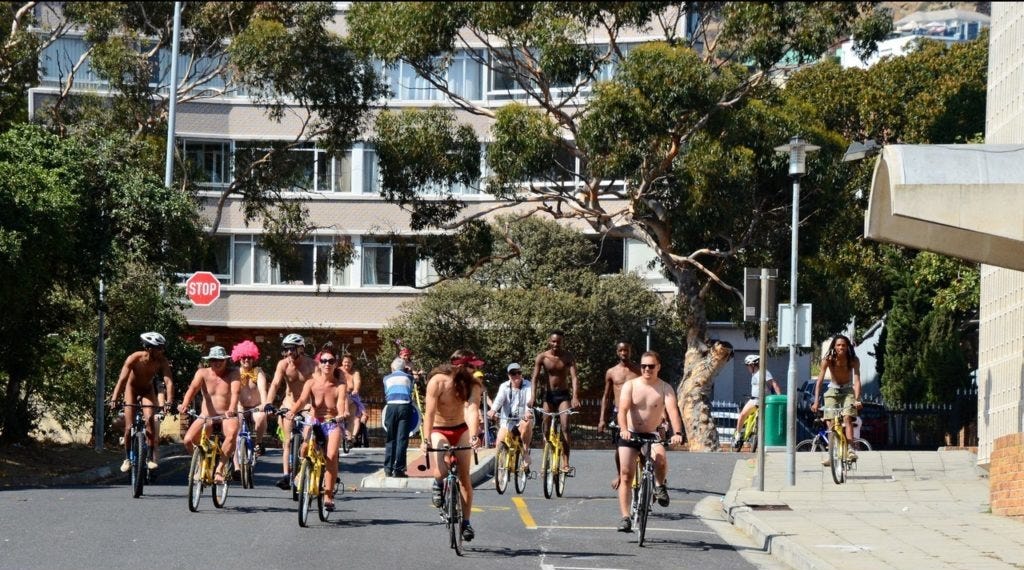
Cape Town’s World Naked Bike Ride did not roll this year. After 18 years of annual rides, organizers have canceled the 2026 event, saying local authorities imposed new conditions requiring participants to be fully clothed. For a protest built around public vulnerability and visibility, that condition effectively ended the ride.
The event is traditionally held the day before the Cape Town Cycle Tour, placing this year’s ride on March 7. Event coordinator Marthinus Pretorius told local media that previous rides were approved through meetings with the City of Cape Town under the Public Gatherings Act. This year, he said, the process stalled. Communication broke down, approvals never materialized, and organizers were ultimately told the ride could not proceed as a nude event.1
Pretorius framed the decision as part of a broader tightening around public nudity in Cape Town. He said police have recently told people to cover up at Sandy Bay, the city’s long-time unofficial nude beach.
The city’s legal rationale has been conveyed largely through organizer accounts and media reports. Officials reportedly cited sections 9 and 22 of South Africa’s Sexual Offences Act, which restrict public exposure where consent cannot be assumed—an issue difficult to manage in an open street protest.
That ambiguity has lingered for years without stopping the event. Launched in 2004 as a global protest linking cycling safety, fossil fuel dependence, and body acceptance, the World Naked Bike Ride has taken place in Cape Town since 2008, operating more through informal negotiation than clear legal consensus.
Even in 2025, the ride went forward under tighter constraints. Participants were encouraged to wear minimal coverings or body paint, though many remained fully nude. Whatever tolerance existed then appears to have narrowed sharply in the past year.
What’s next
Supporters see it as protest and expression, connecting environmental concerns with bodily autonomy and the vulnerability of cyclists in traffic. Officials, or at least those managing permits and legal risk, appear to view it as a public nudity issue moving through spaces where consent cannot be guaranteed. That tension is reflected in both legal interpretations and public reaction.
Pretorius has said that organizers have filed a complaint with South Africa’s Commission for Cultural, Religious and Linguistic Rights, arguing the decision raises broader questions about expression and community rights. The commission has the authority to investigate and mediate such disputes, though its involvement does not guarantee any immediate change to permitting decisions.
For nearly two decades, Cape Town allowed the ride to go forward, even as the legal footing remained unclear. In 2026, that changed. Whether the cancellation is temporary or marks a longer shift may depend on how the city chooses to handle public nudity in the future.
At least for this year, the bikes stayed parked. 🪐
Kelly, C. (2026, March 10). Cape Town cancels World Naked Bike Ride following backlash. Cape {town} Etc. https://www.capetownetc.com/news/cape-town-cancels-world-naked-bike-ride-following-backlash/