

Before Boone
New translations and a forgotten founder push the origins of organized American nudism back to 1925

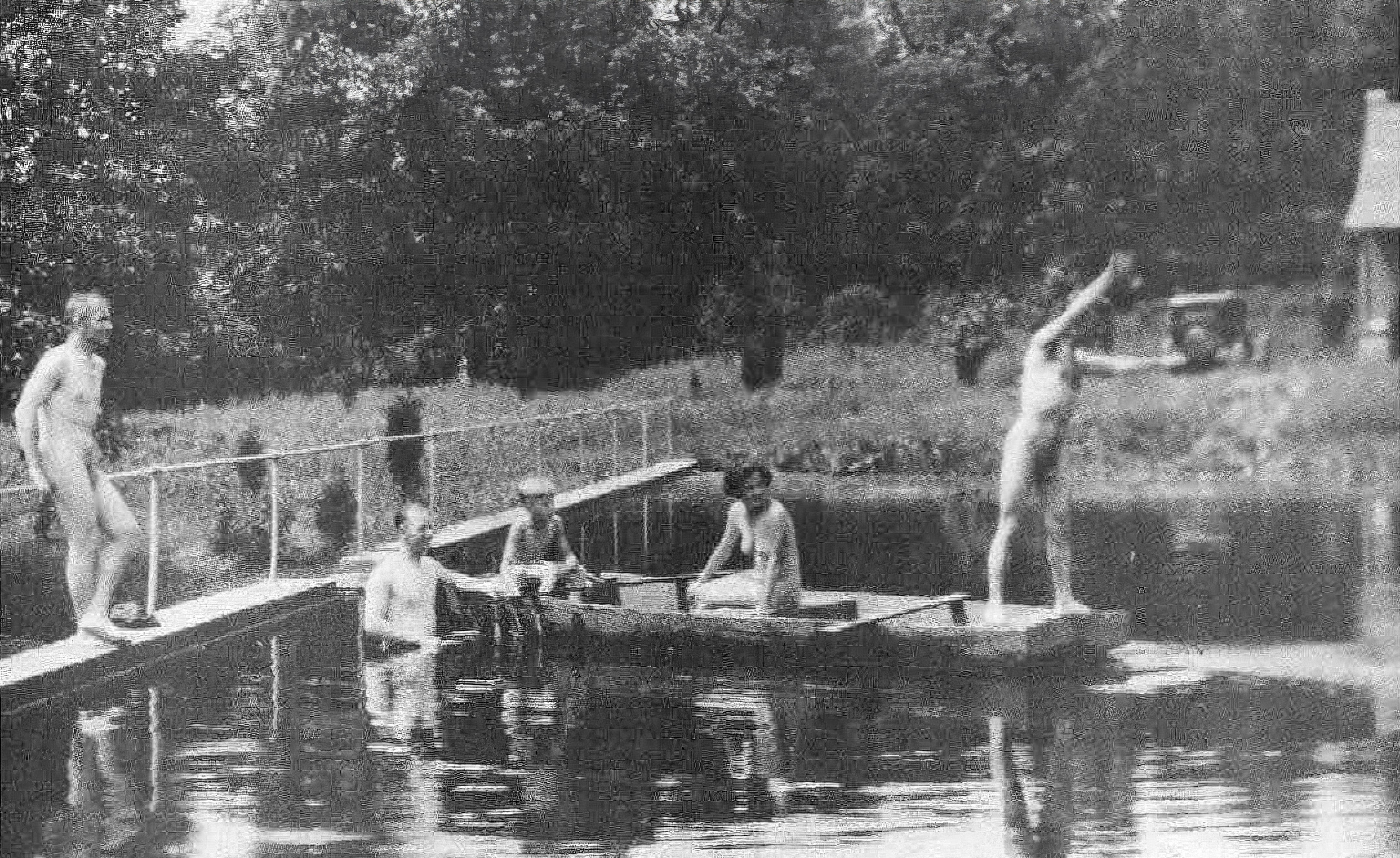
The American Association for Nude Recreation cites its beginning with the formation of the International Nudist Conference in 1931. Their centennial is approaching in five years. But that history was largely written through the perspective of Rev. Ilsley Boone, not Kurt Barthel.
New information suggests the beginning may be considerably earlier than the familiar 1931 story.
Between Cec Cinder’s The Nudist Idea and the recent first-ever English translation of Gui Hong’s Birthright Bodily Freedom—along with Gui Hong’s preface to his translation of two French authors’ accounts of Germany in 1928, Portrayal of the New Life in Germany—there is fresh material to consider. It changes the picture somewhat.
But first, what do we even mean by “the beginning” in this context? Should it be the incorporation of an entity that has changed its name multiple times, or the moment a group of people first agreed on the concept and went out and actually did it? Is the policy what is written in the book that is on the shelf, or what is actually done in practice? Perhaps going backward is a way to approach this conundrum.
AANR was named in 1995. Its structure didn’t change, so it’s really the American Sunbathing Association—new set of clothes? Oh no, not that comparison. New haircut. The ASA was named in 1937. Its purpose didn’t change, so it’s really the International Nudist Conference with a new haircut. The INC formed in 1931 under Rev. Ilsley Boone, who came out of the American League of Physical Culture—and that’s where AANR currently plants its flag, making the organization 95 years old.
You get the pattern. And in 1931 it does get confusing.
The INC wasn’t the only thing that came out of the ALPC in 1931. Kurt Barthel—German-born, where Boone was American—led a parallel organization out of the same parent group: the International Nudist League (note: not Conference), which was actually international at the time, through its direct connection to Leipzig, Germany — unlike the INC, which was not international despite its name. Note the use of “League” as we go back.
There does appear to have been a catalyst for this split. At the time, Bernarr Macfadden was publishing the widely read Physical Culture magazine out of New York City. Macfadden had been writing favorably about air baths and nude exercise since 1900, with a clear description of social mixed-sex nudist activity by 1904—but his definition of physical culture encompassed serious exercise, wholesome diet, abstention from alcohol, avoidance of stimulants including coffee and tobacco, and no consumption of any dead flesh. When Macfadden challenged the ALPC, the group reorganized under two of its members—Barthel and Boone—producing both the INC and the INL almost simultaneously. It is logical that rather than using the 1931 formation of the INC, AANR could look to the organization to which Boone belonged, the ALPC, and continue going back.
So where did the ALPC itself come from? You have to go back further still.
The ALPC was primarily a group of German-Americans, formed in December 1929 under Barthel’s leadership. Boone joined later. And the ALPC had grown out of something earlier—Barthel’s efforts organizing people who had already been gathering in the Hudson River Valley near Peekskill, about 35 miles north of New York City. They had permission to use remote land for nude activities, built small cabins for overnight stays, and called themselves the League of Free Construction of Life—or, depending on the translator, the League for Free Lifestyle, Local Group New York (LFL-LGNY).
Barthel had placed announcements in German-language publications and used his employer’s address—Room 1401, 39 Broadway—as a mailing address for the Local Group. He was offering a familiar experience from the homeland for immigrants. Per Cinder, the first inquiry reportedly came from people in Texas who had spotted Barthel’s announcement. Whatever name we attach to it, Barthel was evidently organizing real activities years before the INC existed.
The connection to Germany appears to have been fairly direct. Barthel had been in contact with Robert Laurer, who published two nudist magazines in Germany for the League for Free Lifestyle: Lachendes Leben (Laughing Life) and Lichtland (Land of Light). Those magazines were circulating in the United States. Barthel reached out to a Leipzig nudist group, and they offered him the chance to establish an American branch—the Free Body Culture Association, or Free Body Culture League, depending on translation. Whether that Leipzig group was based in the city of Egestorf or in the Engelsdorf district of Leipzig—more likely the latter, given its listing in Gui Hong’s Appendix II under the Ost subsection of Leipzig known as Engelsdorf—remains unclear across sources. Gui Hong’s preface states the New York branch was founded out of Leipzig, while the associated publications are listed as coming from Egestorf. There is genuine room for confusion here, and the record may never be fully resolved.
The new documentation comes from two books written in Chinese by Gui Hong in 1930 and published in Shanghai in 1931, translated into English for the first time in 2025. In the preface to the first book, Gui Hong writes plainly: “An association of Leipzig even established a branch in New York five years ago.” Written in 1930, that places the first documented nudist activities in America at approximately 1925.
Birthright Bodily Freedom—the second book, now available in English—fills in the picture further. Gui Hong uses “New Life” as his translation for nudism:
In the United States, the principles of the New Life were utterly unknown three or four years ago. With the increasing development of the New Life movement in Germany, it was introduced to the United States. Over the past three years, the headquarters of the League of Construction of Free Life were established at Room 1401, 39 Broadway, in New York City’s financial center. The leading figure of the League was a German named Kurt Barthel. Although the name was in English, the organization was in fact a branch of the League for the Regeneration of Free Life in Egestorf, Germany. Its initial goal was to offer convenience to German New Life practitioners residing in the United States, including facilities such as a gymnasium.
In summer, members would go to the Hudson Highlands near New York City for sunbathing or sporting games. The Hudson Highlands, a plateau between New York City and Albany, were rarely frequented and geographically remote. The League built many small lodges there for members’ accommodation. Though originally established for Germans, the New Life movement—as a novel introduction to the United States—attracted many Americans who joined enthusiastically, as they were by nature a freedom-loving and curious people. Today, most members of the League are American, with a small proportion being German.
By 1930, the movement appears to have already become mostly American, despite its origins in a German immigrant community.
What was the beginning, then? Was it a German-language effort starting in 1925? The LFL-LGNY existed. It had regular outings. It had permission to use land and built cabins on it. It predates the ALPC, which predates the INC. And a December 1934 issue of The Nudist includes a piece by William Calhoun Walker noting organized activities going back to nearly 1900. The documentation for a fully continuous chain to the present remains incomplete—that research continues.
There appears to be well over a century of organized nudism in America, with roots that run considerably deeper than the familiar 1931 story. It is wonderful to know that new information can still appear at any moment from a dusty corner of an antique bookstore. 🪐
Editor’s Note: Carl Hild, PhD is a historian of early nudism. The research behind this piece draws on his recent translation and expanded edition Birthright Bodily Freedom: Portrayal of the New Life of Europeans, available by calling Bookshop Santa Cruz at 831-423-0900 and requesting the local author book by Gui Hong ($25.95 plus shipping).
 | A guest post by
|